
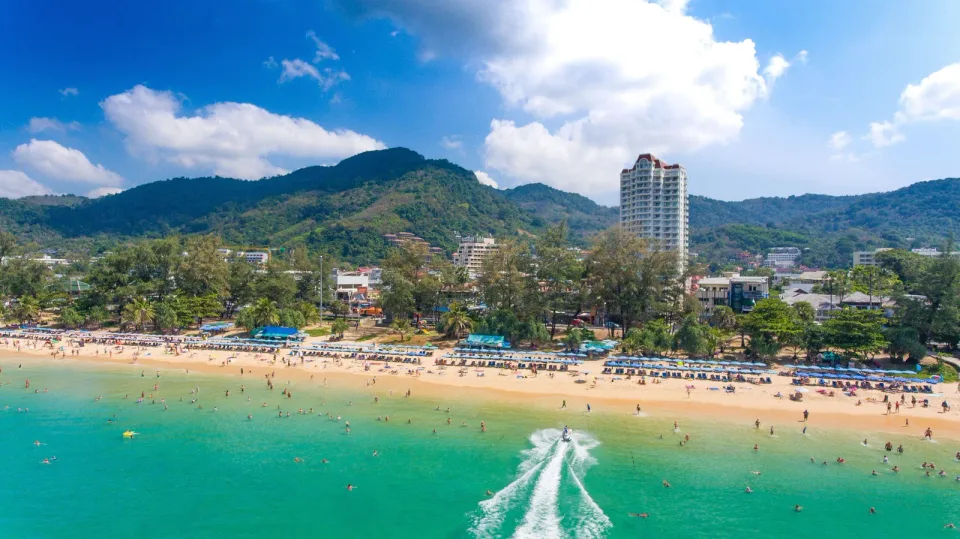
Most beach areas in Phuket are short enough that “near the beach” means one thing. Karon is not. Its bay is long enough that two units the same 200 metres from the water can sit a 25-minute walk apart, facing different restaurants, different noise and different guests. Buyers who treat Karon as one market overpay at one end and miss value at the other; the area only makes sense read lengthwise.
The 3.5-kilometre premise
Karon’s shape, a long beach with a wide road behind it, produces more variation inside the area than between Karon and its neighbours. Four positions behave like four different markets:
Beachfront and near-beachfront. Closest to the sand, strongest rates, and occupancy that holds through the shoulder: carless guests can live their whole holiday from this position. Also the noisiest position and the most exposed to salt air, which shows up later as maintenance.
The second row and behind. A short walk becomes a fifteen-minute one surprisingly quickly, and the beach road is wide enough that crossing it matters to a family with a stroller. Units marketed as Karon that sit well back behave like a different market at a different rate, and the purchase-price gap to the front row is usually narrower than the rental gap, which is the trap.
The hillside towards Kata (Karon Hill). Views, quiet, and a car requirement. Access is the underwriting question: gradient, road surface after rain, and whether a taxi will take a guest up at night.
The inland stretch. Cheapest, and furthest from what makes the area work. Some of it is quietly good value; some is priced low for a reason specific to one street. Only a visit tells them apart.
The practical method is to stop reading distances off the map and start walking them - midday in November lies about both heat and crowds, so time your test walk for a February afternoon or accept that the number is optimistic.
What Karon costs, lane by lane
| Unit type | Typical size | Indicative price range | Notes |
|---|---|---|---|
| Studio | 24-32 sqm | $80,000-$145,000 | Verify juristic health in older stock |
| 1-bedroom beach-zone | 35-50 sqm | $97,000-$230,000 | Strong liquidity when walk-to-sand is real |
| 2-bedroom | 60-85 sqm | $180,000-$400,000 | Family demand peaks Q4-Q1 |
| Karon Hill seaview | 45-75 sqm | $160,000-$380,000 | View band dominates; test access after rain |
| Premium penthouse | 90-140 sqm | $420,000-$600,000+ | Thin liquidity; long holds and lifestyle |
Resale inventory can start earning the month it transfers, but deferred maintenance hides in older buildings, budget a professional snag list before you model a nightly rate. New-build defers first revenue until handover; a financed buyer should stress-test debt service against low-season net rather than peak gross. Entry here starts lower than anywhere else on the west coast’s swimmable beaches, which is why Karon anchors the value end of the southern beaches comparison.
Two products, one postcode: sand minutes or sunset decks
Karon sells exactly two stories, and a unit committed to the wrong one underperforms for its whole holding period.
The beach-zone product is convenience: strollers, flip-flops, minimal driving, repeat family bookings. It wins on sand minutes and it should be marketed on nothing else, the guest who books it never asks about the balcony orientation.
The Karon Hill product is the view: sunset decks, quieter nights, and a short drive down to swimmable water. Genuine panoramas earn a nightly premium, and the operative word is genuine, a partial sea glimpse photographed at full zoom collects the booking and then pays for it in the review.
Owners who try to run both stories at once (“beach proximity” marketed from the ridge, or a beach-road unit priced like a view unit) get friction that no seasonal promotion repairs. Pick the lane the property actually occupies, underwrite that lane’s rate, and let the other lane go. Blended models that assume beach occupancy at hillside pricing are the most common Karon spreadsheet error we see.
Karon’s rental year, and what to underwrite
The season here has a distinct shape, and it rewards being modelled rather than averaged.
High season fills and rates hold: true across the whole west coast, so it is not where Karon differentiates. The shoulder is where the area does better than its price band implies: the long beach and a mix of European families and returning seasonal visitors keep demand alive either side of the peak, in months when tighter resort corridors have already started discounting. April to November is promo-heavy but not empty: Australian school breaks, Thai weekends and couples hunting quieter sand still fill calendars when pricing flexes.
Low season is genuinely quiet, and it is where the gap between a managed unit and a neglected one is widest: listings without active management simply stop selling nights, and no January performance compensates.
Three consequences. Underwrite the annual number, not the peak, and below the figure you are quoted. Weight walk-time heavily, because it decides shoulder and low-season performance far more than it decides January. And if you plan owner use, take your own weeks in the low season, when the revenue cost is smallest and the beach is at its calmest anyway.
Ownership and letting rules on this coast
Two national rules bear particularly on Karon stock, and both are checkable before any deposit.
Foreign quota. A foreign buyer may hold a condominium unit freehold only within each building’s 49% allowance under the Condominium Act B.E. 2522, measured against total floor area rather than by counting units, and consumed at registration rather than at reservation. Karon carries a substantial share of Phuket’s older stock, and in older buildings the position moves as units change hands, an allocation returns to the pool whenever a foreign owner sells to a Thai buyer. Ask the juristic office for the remaining allowance in square metres for your unit type, dated and in writing.
Short-stay letting. Accommodation for periods shorter than a month is hotel business under the Hotel Act, and the licence attaches to the premises rather than to the owner. Karon’s older buildings need this checked with particular care, because much of that stock was built as holiday inventory and let by the night for years before the question was enforced, so a silent set of bylaws here often means nobody ever wrote a rule, not that the practice is permitted. Some Karon buildings are licensed and run programmes; some tolerate nightly letting without a licence; some prohibit it outright. Only the first is safe. Get the licence position and the bylaws in writing, and read the recent general-meeting minutes: the argument always precedes the vote by a year or more.
For villas, foreign freehold land does not exist in Thailand, so a Karon villa is a registered lease or a company structure needing real legal review. On the hillside, add the access road itself to the diligence list: who owns it, who maintains it, and whether that obligation is registered anywhere a court would find it.
Karon against its neighbours
The southern beaches get compared as a set, and the price differences are small enough that a buyer can genuinely choose.
Against Kata: Karon is longer, wider, less concentrated. Kata’s strip is walkable end to end; Karon’s is not, which is exactly why position within Karon matters more. Kata is livelier after dark, averages a higher price, and the good Karon positions close most of that gap in performance.
Against Nai Harn: considerably more infrastructure, considerably less calm. Nai Harn suits an owner-user; Karon suits an owner who wants the property working while they are away.
Against Patong: Karon trades volume for rate. Patong fills more nights at lower prices with more operational churn; Karon sells fewer nights at better rates to a guest who wanted a beach rather than a strip, and generates fewer noise-refund headaches along the way.
Against Bang Tao: the difference is depth rather than quality. Bang Tao has more management options, a broader buyer pool and a faster exit; Karon costs less and, with a carefully chosen manager, performs closer than the price gap suggests.
Daily life, and the small frictions that reach reviews
Peak season brings tour buses and parking pressure near the central strip; a beach-zone unit with a dedicated space wins family reviews for that reason alone. Low season slows the crowds but raises the flags, literally: surf conditions make swim-safety flags part of a host’s guest notes here. The south’s distances are real too: Central Phuket, the major hospitals and the international schools are all a longer drive than northern owners accept, which matters for owner use and rules Karon out for most school-run tenants.
Hillside operations have their own physics. Confirm how a guest actually arrives, ride-hail drivers accept the fare in peak season but unclear last-mile instructions on a dark slope are a refund request forming. And visit in monsoon rain before buying on the Hill: gradient, drainage and road surface tell you in twenty wet minutes what no brochure will.
Insider tip: at 21:00, ask a taxi at the beach rank to take you to the exact hillside address you are considering. If the driver hesitates or quotes a premium, your guests will meet the same hesitation, and their version of it gets published.
Book a Karon + Kata comparison tour
See how view versus beach access changes nightly rates on the same day, with 0% buyer commission and legal support end to end.
Buyer scenarios
The yield-first buyer under $150,000 buys the beach zone or doesn’t buy Karon. A studio or compact one-bedroom with an honest walk-to-sand story earns through the shoulder in a way no discounted inland unit matches, and exits to the same kind of buyer who bought it.
The view buyer around $200,000-$380,000 belongs on Karon Hill, eyes open: a genuine panorama, a safe wet-season road, and a nightly rate underwritten for a driving guest. This profile often includes owner use, which the Hill rewards, the quiet is the product.
The hybrid buyer wintering eight weeks should decide which lane serves the empty weeks before choosing the unit, then check the building’s letting position supports it. Foreign-quota clarity and furnishing-package transparency matter most at handover, the mechanics are in the off-plan guide for pre-completion stock and the buying guide for resale.
Before you commit: the Karon-specific checks
- Time the actual walk to the water at 09:00 and again at 18:00 on the busiest day you can find, with a bag on your shoulder.
- On the Hill, drive the access after heavy rain and run the 21:00 taxi test above.
- Quota letter from the juristic office: remaining square metres, dated.
- Letting position in writing: Hotel Act licence status, bylaws, and the last two general-meeting minutes.
- In older buildings, a professional snag survey before any rate modelling, deferred maintenance is Karon’s quietest cost.
- Map what completes within a fifteen-minute drive, not just within Karon: the units competing for your guests ignore the area’s boundary, and the pipeline that matters in three years is already visible from the road.
Frequently Asked Questions
Yes, with lane discipline: beach-zone units earn 7-9% gross when the walk-to-sand story is real, hillside units earn a view premium when the panorama is genuine. The common failure is marketing one lane from the other's position.
An elevated ridge towards Kata with sunset seaview condos, typically trading below beach-zone prices per square metre. It suits view-led guests and owner use; access quality after rain and at night is the make-or-break diligence item.
Yes, within the building's 49% foreign quota under the Condominium Act, measured by floor area. Karon's older buildings are the ones to check carefully: the quota position moves as units change hands, so get the remaining square metres in writing before transferring funds.
Typically 45-60 minutes by car depending on traffic, with the Chalong circle the common bottleneck heading north. Factor the transfer into guest instructions - it is the longest airport run of the major west-coast beaches.
Kata is compact, walkable end to end and livelier at night; Karon is longer, quieter and cheaper at entry with a wider internal spread. Buyers wanting the smallest-crowd boutique feel choose Kata; buyers wanting price range and a family guest profile choose Karon.
Related Guides:
- Kata Beach Property Guide, the compact boutique neighbour
- The Title KUARTZ in Karon and The Title FIZZ in Kata, new The Title launches of October 2026
- Patong Investment Property Guide, volume and nightlife one bay north
- Nai Harn Property Guide, the calm southern alternative
- Buying Property in Phuket: Step-by-Step, from reservation to the Land Office
- Phuket Rental Yield Guide, gross-to-net maths by area
Questions about this guide? Ask us on WhatsApp. The guide's title is already in the message, so you only need to write your question.
Ask on WhatsApp
Olga
Head of Rentals, MORE Group
Runs the rental side at MORE Group: occupancy and rate data from managed Phuket units, management-company selection, and what an owner actually nets after costs.
About MORE Group →Get a Net Yield Calculation for Phuket Projects
Share your budget and preferred area. We will compare live projects using rent, fees and occupancy assumptions.
