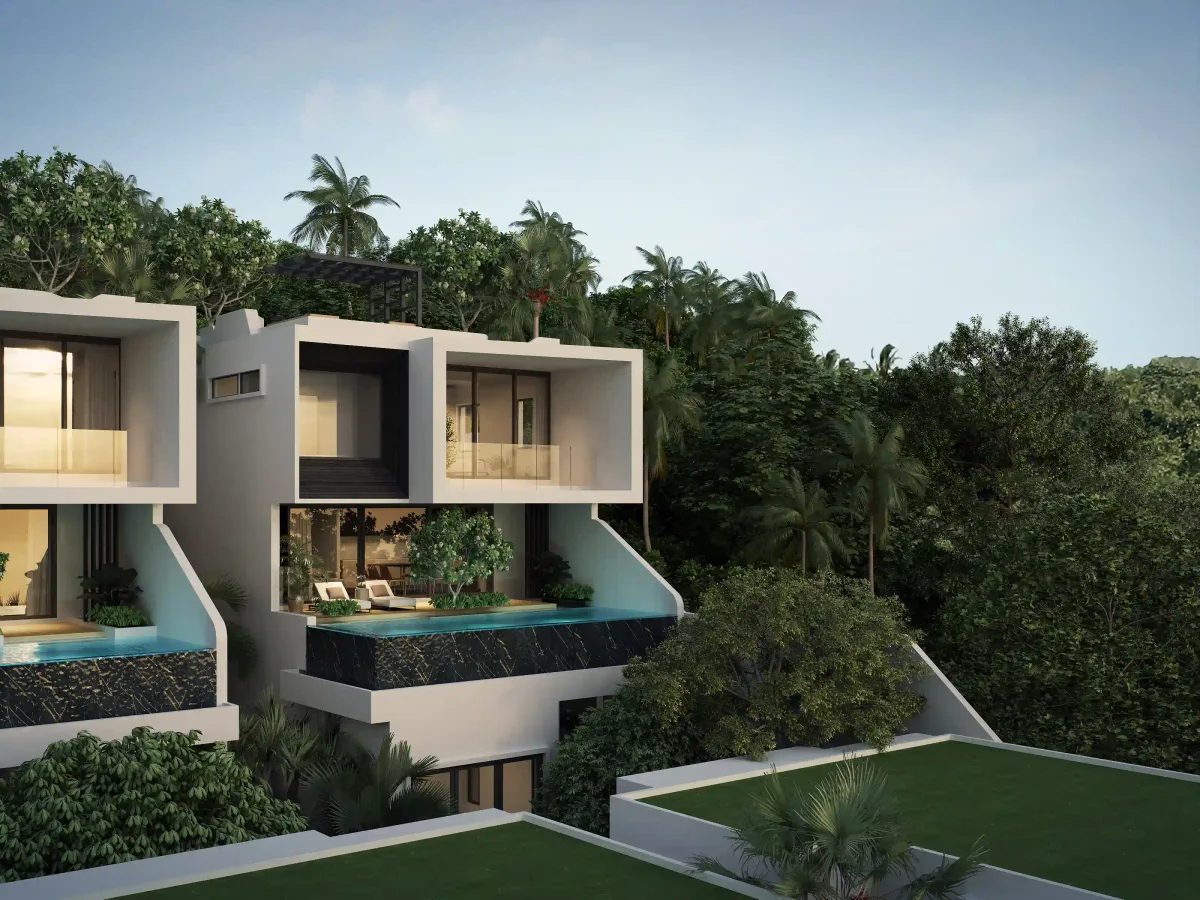
Foreign Buyers in Phuket 2026: Market Share, Trends, and What It Means
Foreign buyers represent approximately 45-55% of new-build condo purchases in Phuket’s prime zones (Bang Tao, Cherng Talay, Kamala), with European buyers (UK, Germany, France, Scandinavia) leading, followed by Russians, Americans, and Australians. This deep international demand pool is what makes Phuket’s resale market more liquid than any other Thai resort market, and understanding the buyer mix tells you where demand is heading next.
European Buyers: The Foundation of Phuket’s International Market
What European Buyers Want
European buyers in Phuket skew toward the 45-65 age range, semi-retired or actively retired professionals with disposable capital, seeking both investment return and lifestyle access. They prioritise:
- Legal security: European buyers are acutely sensitive to ownership structure. Freehold condo title under the Thai Condominium Act is typically non-negotiable, leasehold is often declined outright by European buyers with legal advice.
- Management quality: European buyers want passive investment returns. Hotel-affiliated rental programmes from established operators (Banyan Tree, Anantara, Wyndham) appeal directly to this preference.
- Beach proximity and quality: Bang Tao Beach and Kamala Beach are consistent preferences, long, clean, less crowded than Patong.
- Price range: Most European buyers target the $150,000-$400,000 range for investment condos.
The Euro-Winter Driver
European buyers are seasonally motivated by the northern European winter (November-March). This is when most European buyers make site visits and purchase decisions, driving a specific peak in Phuket’s developer launch calendar and resale activity from October-April. This seasonal buyer activity pattern actually supports the short-stay rental market, European buyers rent units when not personally using them, and European tourists fill the rental pool during high season.
Russian Buyer Recovery: The 2023-2025 Story
Recovery has been substantial. By 2024-2025, Russian buyers have returned to the Phuket market through adapted financing routes (UAE-based banking, SWIFT alternatives, cryptocurrency transactions in some cases), and their preference for Phuket as a lifestyle and asset destination appears unchanged.
Impact on Prices and Zones
Russian buyers significantly influenced the development of Cherng Talay and parts of Kamala, where their preference for newer, larger, premium-quality units drove developer product positioning. The recovery of Russian buyer volumes has supported price appreciation in these zones.
Russian buyer preferences:
- Newer projects (2020+ launches)
- Larger unit sizes (1-bed from 55 sqm, 2-bed preference)
- Premium amenities (large pool, gym, rooftop)
- Cherng Talay and north Kamala location preference
American Buyer Growth: The Fastest Growing Segment
- Remote work enabling geographic flexibility, the post-COVID work-from-anywhere shift is permanent for many US professionals
- USD strength, a strong dollar extends the purchasing power of US buyers in THB-priced markets
- Asia-Pacific investment thesis, US investors are increasingly diversifying into Asian real estate as portfolio diversification
- Phuket’s global visibility, direct connectivity via Qatar Airways (via Doha) and other connections has shortened the perceived distance
American buyers tend to target the upper price segment, $300,000-$800,000 per unit, and prefer established brands (Rosewood, W, Banyan Tree affiliated residences) over smaller independent projects. This buyer profile drives the luxury branded residence segment in Kamala and Bang Tao.
Australian Buyers: The Stable Long-Term Participant
Australian buyers are concentrated in:
- Bang Tao and Laguna (managed investment, established zone)
- Rawai and Nai Harn (lifestyle quality, south island character)
- Kata and Karon (beach lifestyle, accessible entry)
The Australian buyer profile skews toward lifestyle-investment hybrids, buyers who intend personal use alongside rental management. Budget range typically $150,000-$350,000 for 1-2 bedroom managed condos.
How Foreign Demand Affects Prices
Foreign demand does not raise prices uniformly across the island. It concentrates in a small number of corridors and in specific formats within them, which is why the same year can look like a boom in Bang Tao and like nothing much in Chalong.
| Demand Effect | Mechanism | Zone Most Affected |
|---|---|---|
| Premium pricing in foreign-preferred zones | Competition between nationalities drives prices above Thai domestic levels | Bang Tao, Kamala |
| Developer product positioning | Developers build to international specifications (unit sizes, amenities) that command foreign pricing | Cherng Talay, Kamala |
| Foreign quota scarcity premium | When a building’s 49% quota approaches exhaustion, scarcity drives last available unit pricing up | Bang Tao prime buildings |
| Resale market depth | More foreign buyers in zone = shorter resale times and fewer price concessions required | Bang Tao (fastest resale) |
| Nightly rate premium | Foreign-preferred zones generate higher Airbnb/Booking.com rates (international tourist base) | Bang Tao, Kamala vs Patong |
Impact on Resale Liquidity: The Numbers
| Resale Speed Factor | Effect on Time to Sell |
|---|---|
| Active European + Australian + Asian buyer pool | Reduces average sale time by 30-40% vs single nationality zone |
| Zone featured in international property media | Increases buyer enquiry volume 2-3x |
| Property management with documented income history | Attracts investment buyers who can value by yield |
| Building near active agent offices | 15-25% faster sale time vs remote properties |
| Unit type: 1-bed, 45-65sqm, managed resort | Fastest-selling category across all nationality groups |
The multi-nationality foreign buyer pool in Bang Tao and Kamala specifically means that even if one nationality’s buying volume drops (as Russian volumes did in 2022), others compensate. This resilience is the structural basis of Phuket’s liquidity advantage.
Market Outlook 2026: Foreign Buyer Trajectory
Growing segments: US buyers (remote work + dollar strength), Indian buyers (growing middle class with international lifestyle aspirations), Middle Eastern buyers (lifestyle diversification and UAE connectivity)
Recovering strongly: Russian buyers (adapted payment routes, continued lifestyle demand)
Stable with slight growth: European buyers (ongoing winter escape motivation, increasing lifestyle migration interest post-Brexit for British buyers)
Emerging: Japanese buyers (yen volatility driving some capital into hard assets, improving flight connectivity)
| Indicator | Signal |
|---|---|
| 2025 foreign buyer enquiry volumes | Up 25-35% vs 2023 (recovering post-COVID) |
| Off-plan sellout velocity (Bang Tao, Cherng Talay) | Faster than 2021 in equivalent product |
| Average buyer commitment size | Increasing, more buyers at $200k+ than $100k range |
| Number of nationalities active in market | 40+ (diversification is increasing, not narrowing) |
The multi-nationality demand expansion means Phuket’s foreign buyer pool is deeper and more resilient in 2026 than at any point in its history. For sellers and developers, this translates to faster sale velocity and sustained pricing power in prime zones.
Buyer scenarios tied to nationality trends
US remote-work buyer: $300K-$600K branded residence; values timezone overlap with US clients; less price-sensitive on CAM.
Australian hybrid family: Rawai or Bang Tao 2BR; school holidays drive owner-use calendar; compares Phuket families neighborhoods.
Indian HNI diversifier: Bang Tao off-plan with exit to European resale pool; reads Phuket vs Goa vs Dubai Indian HNI for context.
How developers market to foreign buyers in 2026
| Channel | Typical product | Price positioning |
|---|---|---|
| European roadshows | Bang Tao managed 1BR | $150K-$280K |
| Russian broker networks | Cherng Talay 1-2BR | $120K-$260K |
| US luxury events | Kamala branded residence | $400K-$1M+ |
| Australian expos | Rawai + Bang Tao hybrid | $150K-$350K |
| Indian wealth seminars | Off-plan Bang Tao entry | $130K-$220K |
Understanding channel marketing explains why identical sqm can list at different perceived values, always compare net yield and quota status, not launch theatre.
Buyer due diligence regardless of nationality
Foreign buyer diversity helps liquidity (a market drawing from several countries is more resilient than one dependent on a single source), but it does nothing about project-level risk, and it is regularly presented as though it does.
The checks are the same whoever else is buying.
The quota, against your unit. A dated letter from the juristic person stating the remaining foreign floor area in square metres, tied to your unit number. Strong foreign demand makes this more urgent rather than less: a busy quota is a quota that runs out.
The developer’s substance. Company registration date, paid-up capital, directors, previous handovers. Foreign demand attracts developers with no track record precisely because the money is available.
The payment schedule against construction. Milestones defined by work done and certified by someone other than the seller.
What the building already earns. An operator statement from a comparable unit, not a projected yield. Marketing to foreign buyers leans on gross figures, and the gap between gross and net is where the disappointment lives.
The currency record. Funds from abroad in foreign currency, converted in Thailand, in your own name. This one is nationality-specific only in the sense that the sending bank differs; the requirement does not.
Your own tax position at home. The one item nobody in Phuket will raise with you, and the one that varies most by nationality.
Strong foreign demand is a reason to be quicker about these checks, not a reason to skip them. The buildings that disappoint owners are frequently the ones that sold fastest.
Summary: what foreign demand means for your purchase
Three things carry over from all of the above into an actual decision.
Buy where demand comes from more than one direction. A corridor supported by several buyer nationalities, and by residents as well as visitors, is more resilient on both the rental side and the resale side than one carried by a single market.
Treat nationality data as context rather than as a signal. It describes who has been buying, which is a fact about currencies, flight routes and visa policy elsewhere. What pays you is who rents, and that is a different question with a different answer.
And check the corridor’s supply pipeline before its demand story. Foreign demand raises prices where new stock is constrained and dissipates where it is not, and the difference between those two situations is visible in the planning record long before it is visible in the market.
Looking for the right property in Phuket?
Our experts send a shortlist within 2 hours. 0% buyer commission.
Frequently Asked Questions
In prime zones (Bang Tao, Cherng Talay, Kamala), foreign buyers represent approximately 45-55% of new-build condo purchases. In mid-market zones (Patong, Karon, Kata), the proportion is lower at 25-35%. In the expat residential south (Rawai, Chalong), a mix of foreign buyers and Thai domestic buyers creates a more balanced market. The foreign buyer concentration in prime zones is what drives the higher prices, premium product specifications, and greater resale liquidity in those areas.
European buyers taken together (British, German, French and Scandinavian) are the largest bloc in the prime zones. Russian buyers are the largest single country group in some zones, Cherng Talay in particular. Chinese buyers from the mainland are a smaller share and growing. Australian, American, and Indian buyer volumes are all increasing. The market's strength is its multi-nationality diversity; no single country dominates enough to create dependency risk.
Yes, Russian buyer activity in Phuket has recovered substantially from the 2022 disruption. By 2024-2025, Russian buyers have returned to the market using adapted financial routes (UAE-based banking, alternative payment channels). Their preference for Phuket as a lifestyle destination appears unchanged, the Russian market's long-term attraction to Thailand's climate, culture, and legal simplicity is a structural driver that geopolitical events disrupted but did not eliminate.
Yes, American buyers are Phuket's fastest-growing foreign buyer nationality by percentage increase in 2022-2025. Drivers: post-COVID remote work flexibility, strong USD purchasing power in THB markets, portfolio diversification into Asia-Pacific property, and increasing global connectivity to Phuket. American buyers target the premium segment ($300,000-$800,000) and prefer branded residences from international hotel operators. This demographic adds significant purchasing power to Phuket's upper market segment.
Foreign buyer demand creates premium pricing in the zones they prefer (Bang Tao, Kamala, Cherng Talay) relative to Thai domestic buyer zones. The mechanism: international buyers compete across multiple nationalities, driving prices above what Thai domestic buyers would establish alone. This 'international premium' is the price foundation for prime Phuket zones, and is self-sustaining as long as international tourist volumes and buyer diversity continue growing, which the data supports.
Growing, on multiple metrics. Foreign buyer enquiry volumes in 2025 exceeded pre-pandemic (2019) peaks. The number of active buyer nationalities in the market is increasing. The average transaction size is increasing (more buyers in the $200k+ range). Off-plan sellout velocity in prime zones is faster than comparable 2021 launches. The forward indicators, airport expansion driving more arrivals, increasing digital nomad and remote-work migration, and growing Asian middle-class wealth, all point to continued foreign buyer demand growth through 2026 and beyond.
Reading buyer-mix data without being misled by it
Nationality shares are the most quoted and least useful figures in this market, and it is worth understanding why before letting them influence a purchase.
They are compiled from different sources that count different things (some from developer sales records, some from Land Department registrations, some from agency books), and none of them is comprehensive. A single large project selling heavily into one market can move a corridor’s apparent mix for a year without anything structural having changed. And a buyer nationality tells you who bought, not who rents, which is the demand that actually pays you.
What is worth extracting from the data is directional rather than numerical. Which markets fly here directly, and in which season. Whether a corridor’s buyers are concentrated in one country, which is an exposure, or spread across several, which is not. And whether the mix has been stable over three years or has swung, because a swing usually reflects currency or visa policy somewhere else rather than anything about Phuket.
The red flag to watch for is a sales conversation built on a nationality trend: strong interest from one market is a fact about the developer’s marketing budget as often as it is a fact about demand. Ask instead what comparable units in that building have achieved in occupancy and rate, month by month: that number describes the asset rather than the sales pipeline.
What the mix means for your own exit
The practical consequence of buyer concentration arrives years later, when you sell.
A unit in a corridor bought predominantly by one nationality has a resale market exposed to that country’s currency, its economy and its visa arrangements with Thailand. When any of the three moves, the buyer pool thins quickly and the effect is more pronounced in the segments where that group was most active.
A corridor with a genuinely mixed buyer base is more resilient, and it is also easier to market into: an agent has more channels to work and a wider set of comparable sales to price against.
So when you look at buyer-mix data, the useful question is not which nationality is buying most today. It is how many different groups are buying at all, and whether your unit would appeal to more than one of them.
Where each group actually concentrates, and why
The clustering is real even where the percentages behind it are not, and the reasons are worth knowing because they tell you something about demand rather than about marketing.
Russian-speaking buyers have been the largest single presence in parts of Cherng Talay and the Bang Tao hinterland for years, and the pull is the combination of direct flights, an established community, Russian-language services on the ground and a price point that works. That concentration is also why those corridors have the deepest Russian-language rental marketing, which matters if you intend to let.
British, German, French and Scandinavian buyers, taken together, are the largest bloc in the prime west-coast zones. They arrive for different reasons (the British and Germans weighted towards Bang Tao and Kamala, the Scandinavians towards Rawai and Nai Harn, the French spread across all three), but they behave similarly once here: longer holding periods, a preference for freehold where it is available, and more use of the property themselves than a pure investor would make.
Chinese buyers from the mainland are a smaller share and growing, concentrated in newer developments and more sensitive to the direct-flight schedule than any other group.
Indian and Middle Eastern buyers have grown noticeably in the branded and larger-format segments, where the family-sized units and the resort infrastructure suit how they use the property.
Australian and American volumes are steadier and less concentrated, spread across the island rather than clustering.
None of that should determine where you buy. It should tell you who your competition is when you let, who your buyer might be when you sell, and which corridor’s marketing already speaks the language your likely tenant reads.
What actually moves the mix
Three things move buyer nationality shares in Phuket, and none of them is anything the island does.
The first is flight connectivity. A new direct route from a city changes the buyer mix from that market within a season or two, because property purchases here follow visits and visits follow convenience. Watch the route map rather than the sales figures if you want to see what is coming.
The second is currency. A market whose currency strengthens against the baht sees its buyers become more active almost immediately, and the reverse is equally quick. Most of the apparent surges and retreats in nationality data are exchange-rate movements with a lag.
The third is visa and residency policy, both Thailand’s and the buyer’s own country’s. Changes to long-stay routes, retirement requirements or the treatment of foreign income shift who finds a Phuket purchase practical, and they do so faster than any change in the property market itself.
The reason to understand all three is not to predict the mix. It is to recognise that a shift in buyer nationality usually says something about somewhere else, not about the value of what you own.
Read Also:
Questions about this guide? Ask us on WhatsApp. The guide's title is already in the message, so you only need to write your question.
Ask on WhatsApp
Maksim Shchegolev
Founder, MORE Group
Founder of MORE Group. Four years in investment banking before moving to Phuket, where he has worked in the local property market since 2018. Oversees developer relationships and every engagement above $300K.
About MORE Group →Get a Focused Phuket Property Shortlist
Share budget, area and goal. We will reply with suitable live projects, not a generic catalogue.
