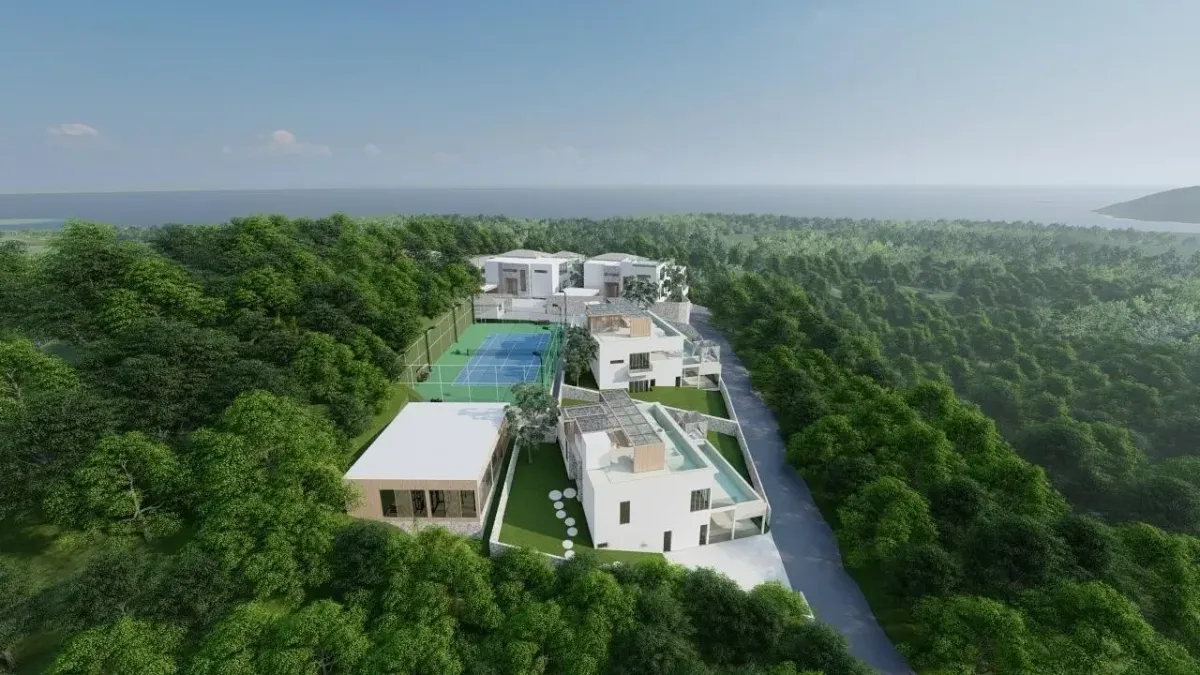
Quick answer: true frontage in Phuket is rare and expensive, with condominiums starting around $200K and villas well above $500K on a registered lease. Expect a substantial premium over comparable inland stock, and expect yield to compress rather than rise, because the price goes up faster than the nightly rate does. The two checks that matter are the actual distance to the sand and what can legally be built between you and it. Start with the Phuket buying guide.
Beachfront is the category where the gap between what is advertised and what is delivered is widest in this market. “Walk to beach” routinely means 400 metres through traffic. “Sea view” routinely means a horizon line visible above rooftops from one corner of a balcony. If you are buying for the setting and will use the property yourself, some of that matters less. If you are buying for rental performance or resale liquidity, the definitions are the investment.
Beachfront, sea view and walk-to-beach are three products
They are priced as if they sit on one spectrum, and they behave as three separate assets.
| Product | What it means | How it behaves |
|---|---|---|
| True frontage | The plot meets the beach, with direct access | Highest price, thinnest buyer pool, strongest prestige |
| Elevated sea view | An outlook from height, not access | Often the best rate-to-price ratio, if the view is protected |
| Walk to beach | A few hundred metres, no view | Prices as ordinary stock and should be bought as such |
| ”Beach access” | A right of way, sometimes shared | Verify it is registered rather than customary |
The distinction that costs buyers money is between an outlook that is protected and one that is merely current. A sea view over vacant land is a view you are renting from whoever owns that land, and the day they build, the premium you paid disappears without any change to your title. Ask what the plots in front are zoned for and what has been permitted, in writing, before you pay for an outlook.
Where genuine frontage exists
Phuket’s west coast is where the beaches people book are, and frontage on them is largely spoken for by resorts built decades ago. What remains for private buyers is limited and area-specific.
| Area | Character of the frontage | What to verify |
|---|---|---|
| Mai Khao | Long, low-density, resort-lined northern beach | Access rights and what the neighbouring resort controls |
| Bang Tao | Wide beach with a full resort ecosystem behind it | Whether the “frontage” claim survives a site visit |
| Surin | Short, premium, almost no room left to build | Which building is genuinely on the sand |
| Nai Harn | Lifestyle beach at the southern end | Inventory is sporadic and turns over slowly |
| Kata and Karon | Established tourist beaches, older stock | Building age and what the reserve has funded |
Patong deserves a separate note: it has the deepest rental demand on the island and very little true frontage available to private buyers, so most of what is sold there as beachfront is a short walk rather than a plot on the sand.
Read the area guides for Mai Khao, Surin, Bang Tao and Nai Harn before you shortlist.
What the premium is actually paying for
Three things, and only one of them is the view.
Scarcity is the largest component. There is no mechanism by which more beachfront appears, so the supply is fixed while demand is not, and that is the whole of the long-term argument for the category.
Prestige is the second, and it is real rather than vanity: a genuinely beachfront address carries a resale story that an inland one cannot, which matters at exit in a market where the buyer is often overseas and working from photographs.
Rate is the third and the smallest. A beachfront unit does command more per night than an inland equivalent, and it does not command proportionally more. Prices roughly double or triple; nightly rates do not. That is the arithmetic behind the yield compression, and it is why beachfront is bought as a capital and lifestyle asset rather than as an income instrument.
Ownership: what a foreigner can actually hold
Beachfront condominium units can be held freehold within the 49% foreign quota, measured by total floor area, and that is the cleanest route into the category.
Beachfront land cannot be held freehold by a foreigner under any structure, so a beachfront villa is a registered lease of up to 30 years per registration, or a properly constituted Thai company. In this category the lease terms carry more weight than usual, because the asset’s value is concentrated in a location that will still be desirable when the term runs down. A short remaining lease on a beachfront plot is not a bargain; it is a correctly priced diminishing asset.
Coastal building rules are the other constraint. Development near the shoreline is regulated, setbacks apply, and the rules have tightened over time, which means older buildings sometimes sit closer to the water than anything new could. That is an advantage for an existing owner and a question for a buyer: confirm that what stands was permitted, because an unpermitted structure near the shoreline is a problem that does not go away with time.
The costs the brochure leaves out
Salt air, humidity and wind-blown sand are not atmosphere, they are a maintenance schedule.
| Item | What the sea does to it | Practical consequence |
|---|---|---|
| Air conditioning condensers | Corrode faster than inland | Shorter replacement cycle, budget for it |
| Sliding door tracks and hardware | Grit wear and seizing | Regular service or expensive replacement |
| Balcony coatings and railings | Combined UV and salt attack | Repainting on a cycle, not on failure |
| Pool plant and pumps | Harder water chemistry, more load | Higher running cost, shorter plant life |
| Soft furnishings and linen | Humidity and salt | Faster refresh than an inland unit |
In a condominium these costs sit partly in the common charge and partly with you, and the split is worth reading in the regulations rather than assuming. A beachfront building with a low common charge and no reserve is not cheaper to own, it is deferring the same bill to a special assessment later.
Erosion is the other line that belongs in the analysis. Some Phuket beaches have visibly narrowed over the past two decades and others have not, and the pattern is local rather than island-wide. Ask what the beach in front of a specific property looked like ten years ago, and look at what the neighbouring owners have had to build.
What the numbers look like in practice
The category is easiest to judge with the arithmetic set out rather than described.
Take two units at the same capital, one with frontage and one with an elevated sea view a few hundred metres back. The beachfront unit might carry a price 2 to 3 times the inland equivalent of the same size, while the nightly rate it achieves runs perhaps 30 to 50% above that inland unit rather than 200%. Occupancy is comparable in season, because both fill; it is the shoulder months that separate operators rather than positions.
Apply the ordinary cost stack to both and the gap widens further. Management at 18 to 25% of revenue is the same proportion either way, but the beachfront unit carries higher common charges, a heavier maintenance cycle and a shorter replacement schedule on anything mechanical. A 12-month model built on this basis routinely puts the sea-view unit ahead on net yield by a percentage point or more, on the same capital.
What the beachfront unit has instead is the asset itself. There is a fixed quantity of it, it does not depend on an operator’s competence to remain what it is, and over a 10 or 15 year hold that scarcity is the argument. Buyers who understand which of those two propositions they are buying are rarely disappointed; buyers sold the first while paying for the second usually are.
One further figure belongs in the plan. Buyer-side transaction costs run near 3 to 5% on a resale, and the marketing period for beachfront stock is measured in months rather than weeks because the buyer pool is small and often overseas. A holding period under 5 years rarely repays those two together in this category.
Buyer scenarios
The lifestyle owner buying the setting. Beachfront makes complete sense here and the yield question is largely beside the point. Prioritise the permanence of the position, the building’s maintenance standard and the practicalities of getting to the property, and treat any rental income as an offset rather than a return.
The yield-led investor. This is usually the wrong category. At the same capital, an elevated sea-view unit in a licensed building with a good operator generally produces a better net figure, because the entry price is materially lower while the achievable rate is not proportionally lower. Compare the two on annual net before committing to frontage.
The capital-growth buyer. Beachfront has a genuine scarcity argument, and it works over long horizons rather than short ones. The buyer pool is thin, so the exit takes time and the property has to be presentable to an international buyer who may never visit before offering. Budget a marketing period measured in quarters.
The buyer comparing a villa with a condominium. The condominium gives you freehold title, a shared cost base and a defined buyer pool at exit. The villa gives you space, privacy and a plot, held on a term of years with the whole maintenance stack unshared. At the same money these are different investments, and the honest question is whether you want the title or the land.
The one question to ask about the beach itself
Buyers examine the building carefully and the beach barely at all, which is the wrong way round in this category, because the beach is the asset and the building is the improvement.
Two things are worth establishing about any specific stretch. Whether it is public, which on almost all Phuket beaches it is, meaning your frontage buys proximity and outlook rather than exclusivity, and vendors, loungers and day visitors are part of the picture in high season. And whether it is stable, which varies beach by beach: some have narrowed visibly over the past two decades while others have held, and the difference shows in what neighbouring owners have been obliged to build along their boundary.
Walk the length of it. Look at the sea walls, the drainage outlets and the state of the sand at the ends rather than the middle. A beach that is well used and well maintained is an asset that holds its value; one that is being defended with concrete is telling you something the listing will not.
Red flags in a beachfront listing
| Red flag | What it usually means | What to check |
|---|---|---|
| ”Beachfront” with no distance stated | It is a walk, not a frontage | Metres to the sand, measured on site |
| A protected view over vacant land | The outlook is borrowed | Zoning and permits on the plots in front |
| Beach access described but not registered | It may be customary rather than a right | A servitude recorded on the title |
| A low common charge on a coastal building | Salt-air maintenance is being deferred | The sinking fund balance and recent works |
| A short remaining lease at a full price | You are paying for years you will not get | The registered term, and comparable freehold |
| Photographs at high tide only | The beach may be narrow or eroding | A site visit, and what the beach looked like a decade ago |
Insider tip: visit at low tide and in the wet season, not at sunset in February. The two questions that decide a beachfront purchase, how much beach there actually is and how the building copes with weather, are both invisible on a good day in high season.
Getting it right: the short version
Measure the distance yourself. Establish what can be built in front of you, in writing, before paying any premium for the outlook. Read the registered term on a villa lease as the main number in the deal. Budget the coastal maintenance stack rather than the inland one, and check the reserve that is supposed to cover it. Compare the annual net against a premium sea-view alternative at the same money before you commit, and buy frontage because you want it rather than because the yield model says so, since it usually will not.
Cross-read the rental yield reference, the condominium buying guide and the due diligence sequence before any deposit.
Have the frontage claim checked before you pay the premium
We measure the distance, pull the zoning on the plots in front, and compare the annual net against a sea-view alternative at the same money.
Frequently Asked Questions
Yes, and it is a small fraction of total inventory and priced accordingly. Much of what is marketed as beachfront is a walk of several hundred metres, so the useful question is metres to the sand rather than the adjective in the listing.
Sea view means you can see the water; beachfront means the property meets the beach with direct access. They differ in price, in maintenance cost and in how thin the resale pool is, and a sea view over undeveloped land can disappear without any change to your title.
The premium is large and varies by area, commonly a multiple rather than a percentage on comparable size and quality. What it does not do is raise the nightly rate proportionally, which is why yield compresses in this category.
Development near the shoreline is regulated and setbacks apply, and the rules have tightened over time, so some older buildings sit closer to the water than anything new could. Confirm with a Thai lawyer that what stands on a specific plot was permitted.
Not as freehold land, which no structure changes. Beachfront villas are held on a registered lease of up to 30 years per registration or through a properly constituted Thai company, and in this category the lease terms carry more weight than the specification.
Not automatically, and usually not on a yield basis. It has a genuine long-term scarcity argument and a thin buyer pool at exit. At the same capital, an elevated sea-view unit in a well-run licensed building often produces a better annual net.
Read Also:
Questions about this guide? Ask us on WhatsApp. The guide's title is already in the message, so you only need to write your question.
Ask on WhatsApp
Maksim Shchegolev
Founder, MORE Group
Founder of MORE Group. Four years in investment banking before moving to Phuket, where he has worked in the local property market since 2018. Oversees developer relationships and every engagement above $300K.
About MORE Group →Get a Focused Phuket Property Shortlist
Share budget, area and goal. We will reply with suitable live projects, not a generic catalogue.
