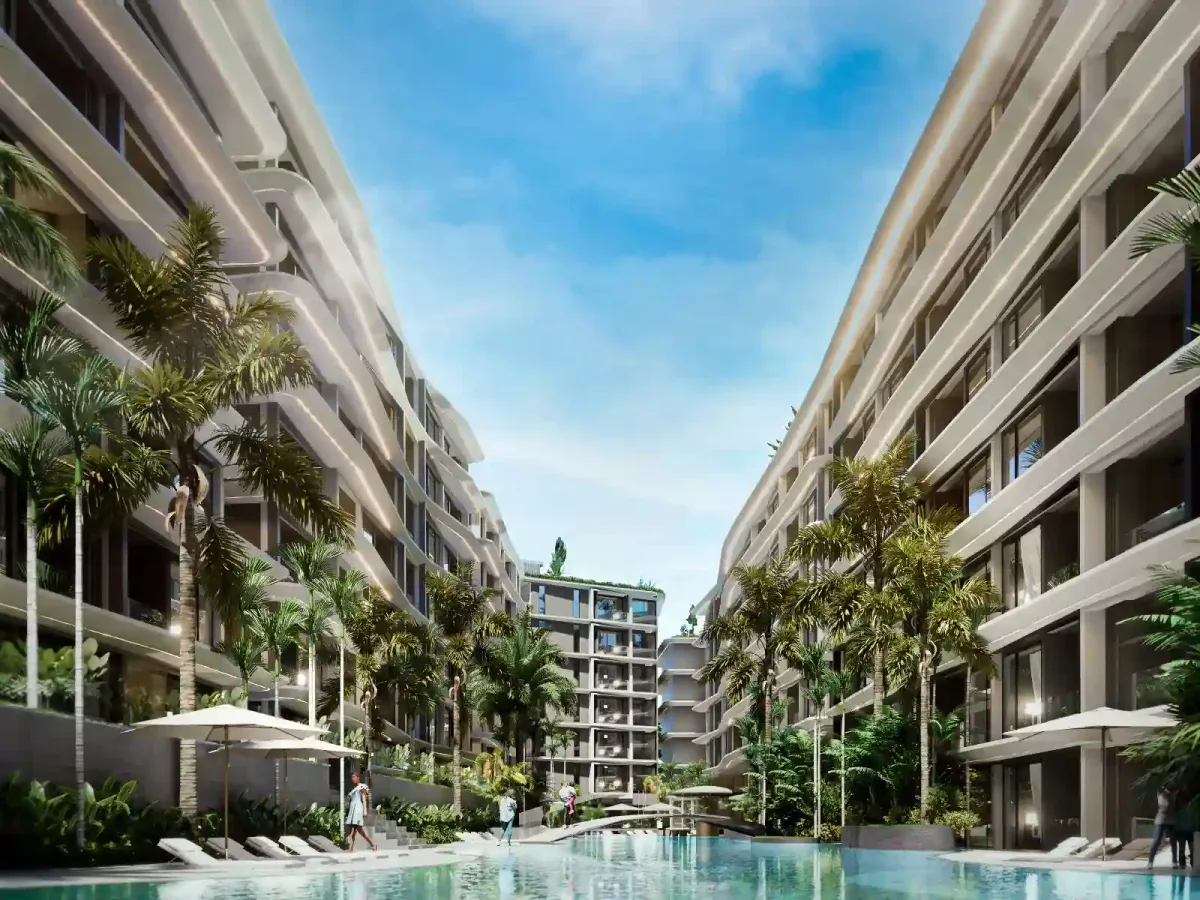
Quick answer: a $200,000 budget reaches 5,760 of the island’s 12,054 priced apartments, 47.8% of everything on our list, which makes this the deepest band on the market, at a 33 square metre median. It is available in every corridor except Patong, which holds 20 units below the line and not one of them a one-bedroom.
Two of the claims this answer used to make do not survive the records. The one-bedroom stock at this budget is not 35-55 sqm; in the three areas the page recommends it is 32 sqm in Bang Tao (1,695 units), 33 in Kata (454) and 34 in Karon (78), so the median unit sits just below the roughly 35 sqm line at which Phuket’s monthly tenants become available. And the two-bedroom value is not in Rawai and Nai Harn: under $200,000 Rawai holds 8 two-bedrooms and Nai Harn holds none. It is in Chalong, which holds 142 at a 56 sqm median, and in Bang Tao, which holds 137 at 55.
| Area | Units under $200K | 1BR count / median size | 2BR count / median size |
|---|---|---|---|
| Bang Tao / Choeng Thale | 2,014 | 1,695 / 32 sqm | 137 / 55 sqm |
| Layan | 905 | 271 / 43 sqm | 1 / 43 sqm |
| Rawai | 592 | 298 / 37 sqm | 8 / 59 sqm |
| Kata | 539 | 454 / 33 sqm | 17 / 60 sqm |
| Chalong | 376 | 234 / 28 sqm | 142 / 56 sqm |
| Wichit (Phuket Town) | 370 | 341 / 31 sqm | 29 / 49 sqm |
| Nai Yang | 294 | 253 / 37 sqm | 0 |
| Kathu | 222 | 193 / 28 sqm | 14 / 52 sqm |
| Nai Harn | 148 | 39 / 54 sqm | 0 |
| Kamala | 136 | 118 / 41 sqm | 16 / 57 sqm |
| Karon | 78 | 78 / 34 sqm | 0 |
| Patong | 20 | 0 | 0 |
The critical rule is unchanged and the table sharpens it: buy where $180K-$200K is competitive rather than the cheapest unit in a $400K+ project. Layan at 43 sqm and Nai Harn at 54 give the most floor area per dollar in the band; Chalong gives the only real two-bedroom choice. The gross and net yield bands this answer used to give are withdrawn: no Phuket letting series exists to have produced them, and the fee side is the part you can still quote: management at 15-25% of gross on a short let, CAM per square metre, platform commission, cleaning per changeover.
This is Phuket’s highest-volume price band for first-time foreign buyers. Competition is intense, marketing is loud, and the gap between good and mediocre projects is wider than brochures suggest. Zone selection matters more than sqm at this level.
Related: Best areas to buy in Phuket · Phuket rental yield guide
What does $200K actually buy in each Phuket zone?
The same budget buys quite different things depending on where you point it, and the trade is consistently space against address.
Bang Tao / Cherng Talay: the premium address, smaller unit
$160K-$200K buys a compact one-bedroom in a newer project in or near the Laguna corridor, typically 35-45 sqm. This is the strongest name on the island for foreign resale, and the price you pay for it is floor area.
What you get: Resort amenities (pool, gym, rooftop), optional managed rental programs, international resident community, and the deepest resale demand of any zone here.
Trade-off: Compact 1BR for personal use; lifestyle value lower than Kata at the same price, and premium buildings carry premium common area fees, which on a small unit is a larger share of your gross.
Kata / Karon: beach town character
$150K-$200K in Kata buys quality 1BR within 600m-1.5km of Kata Beach. $200K approaches 2BR in Karon. Tourist demand from British, German, and Australian guests is structurally strong.
What you get: Walkable restaurants, beach-town atmosphere, strong short-stay demand.
Trade-off: Older buildings mixed with new; inspect sinking fund and common-area maintenance.
Rawai / Nai Harn: maximum space
Rawai delivers the best sqm-per-dollar in any beachside zone. $130K-$180K accesses 2BR (65-80 sqm) with resort pools and Nai Harn beach 5-10 minutes by car.
What you get: Space, authentic local markets, strong long-stay expat demand plus peak-season tourists.
Trade-off: Less “resort brand” prestige than Bang Tao; driving required for west-coast nightlife.
Chalong: yield-focused entry
This is where the two-bedroom stock at this budget actually is: 142 units under $200,000 at a 56 sqm median, more than the rest of the island’s areas combined except Bang Tao. Not the 65-85 sqm this line used to claim: that size exists in Chalong but above the band, and the trade is the familiar one: hospital, retail and airport access instead of a beach, at 98,550 THB per square metre, the cheapest metre on the island.
Buyer scenario, pure investor, no personal use: a two-bedroom with professional management. Chalong is the realistic address for it at this budget (142 units under $200,000 against Rawai’s 8) and a 56 sqm unit keeps a twelve-month tenancy available as well as nightly letting. The net-yield target this scenario used to set is withdrawn; set your own from the fee schedule and the statements, and model the year again with the low season at half the peak’s bookings to see whether it still works.
Buyer scenario, European second home + rental: Kata 1BR walkable to beach; use 8-10 weeks personally, rent remainder with realistic owner-block calendar.
Buyer scenario, first purchase, Bang Tao name matters: Choeng Thale 1BR in proven developer project; accept smaller unit for address and resale liquidity.
Which projects fall in the under-$200K range in 2026?
| Project | Zone | Entry (indicative) | Notes |
|---|---|---|---|
| Ozone Oasis Condominium | Choeng Thale | from ~$161K | Large resort complex, 328 units |
| Andaman Boutique Residences | Patong hills | from ~$160K | Boutique scale, thoughtful design |
| Utopia Karon | Karon | from ~$100K | Brand-driven quality in established zone |
| Arise Vibe | Bang Tao area | from ~$150K | Lifestyle-focused newer project |
Contact MORE Group for current availability, foreign quota status, and phase pricing, launch discounts of 5-10% sometimes appear in low season (May-October).
How should you underwrite yield at this price point?
| Cost item | Typical range | Notes |
|---|---|---|
| Management fee | 15-20% of gross | STR programs; monthly lets differ |
| OTA commission | 15-18% Airbnb side | Direct bookings reduce this |
| Utilities / internet | $80-$200/month | Guest-paid vs owner-paid varies |
| Maintenance / sinking | $800-$2,500/year | Building quality drives spread |
| Furnishing amortisation | $5K-$15K upfront | Spread over 3-5 year model |
The two percentages this example used to produce are withdrawn along with the $22,000 gross they were computed from, which was not sourced to anything, and which, on a $180,000 purchase, implied a figure at the very top of anything ever claimed for this market. What the cost column above does support, without any revenue assumption at all: on a short let, management at 18%, maintenance at 3% and platform and ancillary fees around 15% together take roughly a third of gross before anything reaches you, and the CAM, insurance and reserve lines are owed whether the unit lets or not. Put your own gross in, from statements for a comparable unit in the same building, not from a brochure, and the arithmetic completes itself.
Read the full framework in Is Phuket property a good investment 2026.
What due diligence steps matter most?
At this level the building matters more than the unit, so weight the diligence accordingly.
- Foreign quota confirmed in writing by the juristic person, naming your unit, dated recently. Not a verbal assurance from a sales office.
- Two years of AGM minutes and the sinking fund balance. This is the single highest-value document request in the sub-$200K market, because it shows whether the building is funding its own maintenance or deferring it onto whoever owns the unit when the levy is voted.
- The common area fee schedule and its history. The current rate matters less than the trend. A building that has raised fees twice in three years will do so again.
- The short-term letting position, in the condominium regulations and in the building’s licensing, both in writing.
- Chanote title pulled and read by your own lawyer, with the transfer history and any registered encumbrance.
- Juristic debt certificate showing the unit clear of arrears, since unpaid fees follow the property rather than the seller.
- Independent physical inspection of the unit and of the parts of the building nobody puts on the tour.
- Twelve months of operating statements for a comparable unit in the same building if the purchase has an income thesis.
Full checklist: buying property in Phuket guide.
How do financing and payment timing work at this budget?
| Payment type | Typical use under $200K | Risk note |
|---|---|---|
| Cash at completion | Resale ready units | Verify title before final wire |
| 10/20/70 off-plan | New launches | Cap pre-EIA exposure |
| Developer instalments | Construction phase | Milestone certificates only |
| Home-country refinance | Equity release abroad | FX timing matters |
Never accelerate payments because sales agent claims “last unit” without quota confirmation in writing.
What furnishing budget should you plan post-handover?
| Item | Indicative budget (USD) |
|---|---|
| Basic furniture package | $5K-$12K |
| Kitchenware + linens | $1K-$3K |
| Smart lock + fibre setup | $1K-$1.5K |
| Decor / photography prep | $1K-$5K |
| Contingency | 10% |
Include furnishing in total cost of ownership when comparing Rawai 2BR at $160K versus Kata 1BR at $185K.
What the purchase actually costs, and what it returns
Two tables the sub-$200K buyer needs and rarely gets.
| Cost above the price, on a $175,000 unit | Amount |
|---|---|
| Transfer fee at 2% of assessed value, commonly split | $1,750 |
| Independent Thai lawyer | $1,500-$3,000 |
| Sinking fund, one-off at handover | $800-$1,700 |
| Twelve months of common area fees, usually payable up front at registration | $700-$1,300 |
| Utility meter deposits | $150-$450 |
| Furnishing to a lettable standard | $12,000-$22,000 |
| All-in before the property earns anything | roughly $192,000-$205,000 |
| Income line, well-let unit at this level | Annual |
|---|---|
| Gross at 8% | $14,000 |
| Management and platform commission, ~30% of gross | -$4,200 |
| Common area fees, insurance, utilities between guests | -$2,600 |
| Furnishing reserve, five-year cycle | -$3,000 |
| Net before tax | $4,200 |
| Less 15% Thai withholding for a non-resident owner | $3,570 |
That is roughly 2% on the all-in cost in a conservative year and considerably better in a strong one, which is why the occupancy and rate assumptions deserve far more scrutiny than the fee percentages. Run your own model at an occupancy you would accept after a poor high season, not at the figure in the brochure.
How do sinking funds and building age affect sub-$200K value?
- Last 3 years juristic person meeting minutes
- Sinking fund balance versus upcoming roof/pool works
- Current monthly common fee per sqm versus zone average
A cheap unit with imminent $15K special assessment is not cheap.
How does STR regulation affect under-$200K zone choice?
It affects it more at this budget than at any other, and in a way that cuts against the obvious choice.
Under the Hotel Act B.E. 2547 (2004), letting for stays of under 30 days is hotel business and the licence attaches to the premises rather than to your unit. Separately, the condominium’s own regulations may restrict or prohibit it whatever the licensing position says.
The uncomfortable pattern is that the zones offering the best value per square metre at this budget, Rawai, Chalong and the more residential parts of Kata, are also the zones whose buildings are more likely to be residential in character and more likely to restrict nightly letting. The resort corridors where nightly letting is normal and licensed cost more per square metre, which is precisely why the budget buyer was looking elsewhere.
So the sequence matters. Establish what the specific building permits before you fall for the price per square metre, because a unit bought for nightly yield in a building that only allows monthly letting is a different investment at roughly half the gross. The fallback in a restricted building, letting for 30 days or more to a long-stay tenant, is perfectly viable and should be modelled as the base case rather than discovered as a disappointment.
Read STR enforcement context alongside occupancy data for your target building, not just the area guide.
How do you compare two under-$200K units in different zones?
| Criterion | Weight | Kata example | Rawai example |
|---|---|---|---|
| Purchase price per sqm | 25% | Higher | Lower |
| Metre rate on our list | 25% | Kata 152,000 THB | Rawai 145,000 THB |
| Personal use appeal | 20% | High walkability | Needs car |
| Resale liquidity | 15% | Strong tourist brand | Value segment |
| Building quality / fees | 15% | Varies by age | Varies by age |
Winner depends on your weightings, not universal.
Why the building matters more than the unit here
Above $300,000 you are buying a specific apartment. Below $200,000 you are mostly buying a building, and the unit is a detail within it.
The reason is that the things that go wrong at this level are collective rather than individual. An underfunded sinking fund produces a special levy that lands on you whatever your apartment looks like. A juristic person that has deferred maintenance for five years produces a lobby, a pool and a lift that make your unit harder to let and harder to sell. Regulations that prohibit short letting apply to every owner. None of these are visible in a viewing and all of them are visible in the documents.
The unit-level factors that do matter are the ones that affect lettability rather than taste: which way it faces, how much noise reaches it, whether the walk to a beach is what the listing claims, and whether the layout suits the guest you intend to attract. Finish quality matters least, because you will be replacing the furnishings on a five-year cycle anyway.
The practical consequence for a shortlist: rank buildings first, then choose the best available unit inside the buildings that pass. Buyers who do it the other way round end up defending a nice apartment in a block nobody wants to buy into.
What handover defects matter most at this price point?
- AC drainage and noise between units
- Pool circulation and juristic maintenance schedule
- Water pressure on upper floors
- Balcony waterproofing (monsoon test)
- Foreign quota certificate ready at transfer
Snag list before final payment tranche on off-plan, same discipline as luxury segment.
Exit planning at entry level
First-time buyers at this price point often overweight sea view and underweight management quality. A garden-view unit in Kata with 4.9 review history and professional operator frequently beats sea-view unit with absentee self-management on both net income and resale. Under $200K, operations beat panorama.
Compare entry-level strategy with entry-level investment property Phuket and what $100K buys if budget flexes downward; compare condo vs villa if considering stretching above $200K for different product type.
Under-$200K is where disciplined buyers build track record: one clean purchase, one year of documented rental performance, then scale. Chasing three cheap units simultaneously multiplies due diligence risk faster than it diversifies return.
If your shortlisted unit passes quota, legal, and net yield checks, calendar timing is final optimisation, not reason to delay through another full sales cycle unless incentives are material and documented.
Keep printed copy of foreign quota letter and lawyer SPA comments with offer paperwork, under-$200K deals move fast and documentation discipline prevents expensive shortcuts.
Review juristic person meeting minutes for special assessments before final offer, under-$200K buyers feel 500 THB per sqm levy disproportionately because yield margins are thinner than premium segment. Ask manager for last two years fee history in writing, not verbal reassurance. Fee surprises destroy thin-margin yields faster than vacancy alone.
Frequently Asked Questions
Yes, and this band is the deepest on the island: 5,760 of 12,054 priced apartments, 47.8% of the market. One-bedrooms are available in every corridor except Patong, 1,695 in Bang Tao, 454 in Kata, 78 in Karon, at a 32 to 34 sqm median in those three. Two-bedroom value is in Chalong (142 units at a 56 sqm median) rather than Rawai, which holds 8. Success depends on matching zone and unit size to your letting model, not on forcing a Laguna beachfront address at entry price.
No yield can be quoted, at this budget or any other. Thailand keeps no letting register, so occupancy and achieved nightly rates for privately owned units are held only by whoever manages the building, and the two bands this answer used to give were never measured. The area comparison it closed on is unmeasurable for the same reason. What is comparable on the record is the metre rate and the unit size you get for the money: Rawai 145,000 THB per sqm with a 37 sqm one-bedroom median in this band, Kata 152,000 at 33 sqm, Bang Tao 161,000 at 32 sqm. Above roughly 35 square metres a monthly tenant becomes available, which is the difference that most affects a bad year.
Rawai offers more space per dollar and the records confirm it at this budget: a 37 sqm one-bedroom median against Kata's 33, at 145,000 THB per square metre against 152,000. That extra four metres is not cosmetic: it is roughly the difference between having a twelve-month tenant available and not. Kata offers livelier beach-town tourism and 454 one-bedrooms under $200,000 against Rawai's 298, so a deeper choice going in and a deeper comparable set coming out. Kata suits lifestyle-plus-rental; Rawai suits floor area and a resident tenant.
Treat high guaranteed returns with skepticism. Some genuine programs exist at 5-7% backed by actual rental income. Double-digit guarantees often embed yield in inflated pricing. Model independent market rents.
Common-area and sinking fund fees typically run $800-$2,500 per year depending on project tier. Add insurance, occasional repairs, and furnishing replacement over a 5-year hold model.
Low season (May-October) sometimes brings developer incentives. Off-plan early phases can save 10-15% versus completed pricing. The best time is when quota, title, and price align, not calendar alone.
Questions about this guide? Ask us on WhatsApp. The guide's title is already in the message, so you only need to write your question.
Ask on WhatsApp
Maksim Shchegolev
Founder, MORE Group
Founder of MORE Group. Four years in investment banking before moving to Phuket, where he has worked in the local property market since 2018. Oversees developer relationships and every engagement above $300K.
About MORE Group →Get a Focused Phuket Property Shortlist
Share budget, area and goal. We will reply with suitable live projects, not a generic catalogue.
