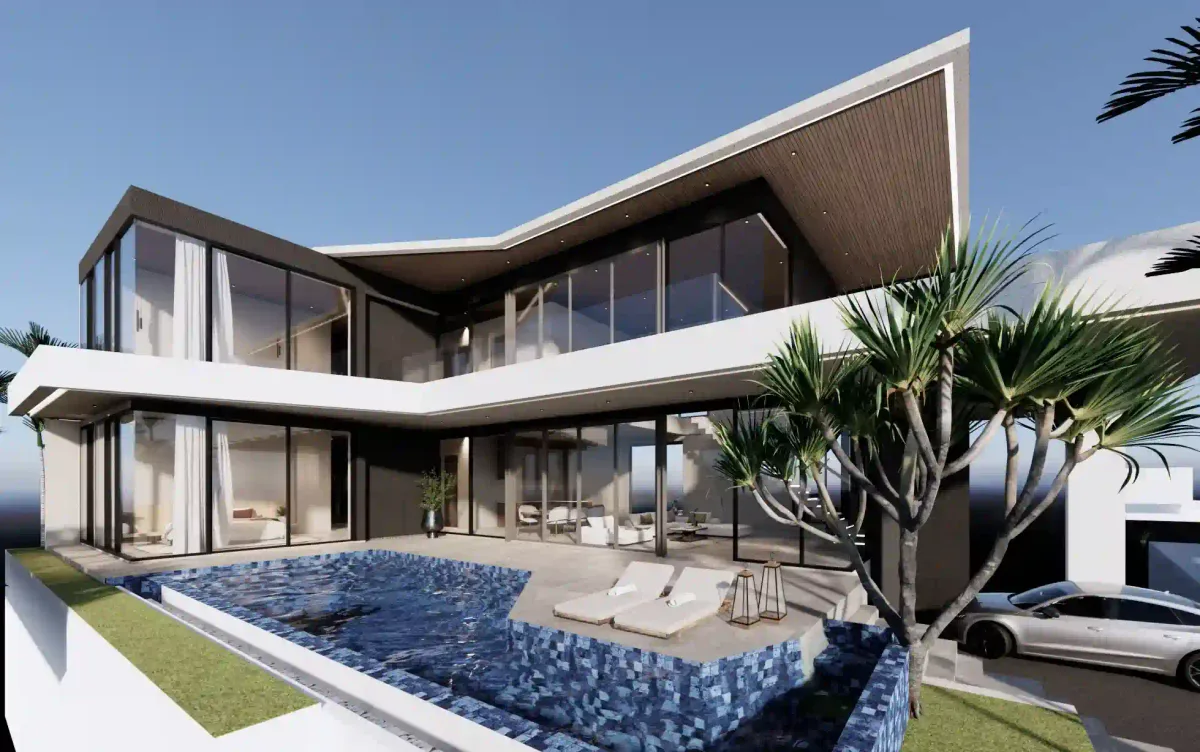
Is a $1M+ Botanica Villa in Phuket Worth It? Honest Review
Botanica Grand Avenue starts at 44,505,000 THB on MORE Group’s records, about $1.36M at the 32.7 THB/USD the corpus uses; Botanica MontAzure at 38,900,000, about $1.19M. Both figures move with the exchange rate and with the developer’s current list, so treat the THB as the number and the dollar as an indication. For buyers considering this price band, the question is not whether Botanica builds good villas, they demonstrably do. The question is whether a $1M+ villa in Phuket is the right vehicle for their objectives, whether those objectives are yield, capital appreciation, lifestyle value, or a combination. This review gives an honest answer.
Quick answer: a Botanica villa above $1M is a lifestyle asset with a rental contribution, not a yield instrument. Foreigners cannot hold land in Thailand, so what you own is a registered lease of up to 30 years per registration, or a company structure, and the terms of that document matter more than the finish. The brand premium buys real management and a recognisable resale story; it does not shorten the marketing period, and nobody publishes how long a Phuket resale takes at this level.
Short Version First
A $1M+ Botanica villa is not worth it if:
- Your primary objective is maximising rental yield percentage
- You are unlikely to use the property personally at least several weeks per year
- You need liquidity in under 5 years, luxury villa exit timelines are longer than condos
- You are stretching budget to reach $1.25M without comfortable reserve capital
Understanding the Asset Class
Condos: Higher liquidity (more buyers at lower price points), simpler ownership (freehold), professional management programs available, smaller physical asset, lower maintenance burden, optimised for yield percentage on capital.
Ultra-luxury villas: Lower liquidity (fewer qualified buyers), 30-year leasehold structure, owner-managed or via specialist villa management companies, large physical asset with corresponding maintenance, optimised for lifestyle value plus capital preservation, not yield percentage.
The yield figures this comparison used to rest on are gone, both of them: no Thai body records what privately owned homes earn, so neither the condo number nor the villa number was ever measured. The comparison survives on prices, which our records do hold. A Botanica Hythe one-bedroom has a median of 12,052,800 THB across 49 priced units at 60 square metres. A four-bedroom at Botanica Grand Avenue has a median of 64,467,000 across 26 units at 514 square metres. That is five times the capital for a house that has to be let as a whole, to a party large enough to want 514 square metres, in a market where the number of such parties in any given week is small.
This is not a flaw in the asset class. It is a structural feature of how ultra-luxury real estate works globally. The same is true of a comparable villa in Bali, Ibiza or the French Riviera, and this page no longer attaches a yield range to those either: none of those markets publishes what privately owned houses earn any more than Thailand does.
Botanica Grand Avenue price snapshot (2026), from MORE Group’s own records rather than from a projection. The scheme holds 55 priced villas in Layan, Thalang, running from 44,505,000 THB to 255,000,000 with a median price of 57,613,500 THB, a median size of 435 square metres and a median rate of 124,209 THB per square metre. Those are three separate medians and will not divide into one another. By size: three bedrooms, 20 units, median 45,099,000 at 382 sqm; four bedrooms, 26 units, median 64,467,000 at 514 sqm; five bedrooms, 9 units, median 182,000,000 at 1,053 sqm. Completion is Q3 2027 and the scheme is under construction, so nothing here is a standing asset you can inspect and let today. The payment schedule is 30/20/15/15/10/10 across construction milestones.
The rental half of this snapshot has been withdrawn in full: the gross yield band, the occupancy range, the nightly rates, and the optimistic and conservative net scenarios built on them. Every one of those numbers described what a privately owned Phuket house earns, and no Thai body collects that. The appreciation rate and the combined total return have gone with them, because Thailand publishes no transaction index for Phuket from which either could be computed.
What can be quoted before you sign, and what you should be asking for: the management agreement, where the fee is written down, typically 25 to 30% of gross on a villa programme; the annual running cost of pool, garden, utilities and insurance, which a manager will quote for a specific house; and, if any comparable Botanica villa is already letting, twelve months of that villa’s own profit and loss. That last document is the only thing that answers the income question, and its absence is itself informative.
What Rental Yield Can You Realistically Expect From a $1M+ Botanica Villa?
Nobody can tell you, and the two scenarios below are kept only to show you the shape of the sensitivity. Every nights-rented and nightly-rate figure in them is assumed, not observed, Thailand records neither for privately owned houses. The deduction lines are the opposite: those come from contracts and are real.
Assumed strong-execution case, 180 nights let, $800 blended nightly:
- Gross rental revenue: $144,000
- Less management at 25% of gross: -$36,000
- Less pool, garden, utilities and maintenance: -$35,000
- Less insurance, taxes and sundries: -$8,000
- Net: approximately $65,000
Assumed weak-execution case, 130 nights let, $650 blended nightly:
- Gross rental revenue: $84,500
- Less management at 25%: -$21,125
- Less operating costs: -$35,000
- Less insurance, taxes and sundries: -$8,000
- Net: approximately $20,375
Read the two nets, not the two percentages: the yield figures that used to close each block have been withdrawn, because a percentage on an assumed income only restates the assumption. What survives is the point. Fifty nights and $150 of nightly rate separate those two cases, and the net income between them differs by more than three times. The reason is in the deduction lines: $43,000 of them, pool, garden, utilities, maintenance, insurance and sundries, run whether the house lets or not, while only the management fee scales with what it earns. On a villa at this price the fixed costs are the story, and execution decides which side of them you land on. Ask a manager for a comparable villa’s real calendar before you assume either case.
Why the percentage matters less at this price than people expect.
This table used to show what a 5% net yield produces at four villa prices. The 5% has been withdrawn (it was not measured, here or anywhere) but the point it was making is arithmetic and survives without it. Put in whatever net percentage your own documents support and read across:
| Villa Price | Net income at 3% | at 4% | at 5% |
|---|---|---|---|
| $1.25M | $37,500 | $50,000 | $62,500 |
| $2M | $60,000 | $80,000 | $100,000 |
| $3.5M | $105,000 | $140,000 | $175,000 |
| $5M | $150,000 | $200,000 | $250,000 |
A percentage point is worth $12,500 a year on the entry villa and $50,000 on the $5M one, which is why buyers at this level argue about the management fee rather than about the yield: the fee is contractual and the yield is a guess. And for a buyer who spends several months a year in the house, the accommodation those months displace can rival the letting income outright, which is a return you can price today, and the letting income is not.
Does a $1M+ Botanica Villa in Phuket Appreciate in Value?
A note on the address, before the argument. Our records place Botanica Grand Avenue in Layan, Thalang, not in Bang Tao. The two adjoin on the same west-coast stretch and the Laguna estate sits between them, which is how the marketing name travels, but the plot is in Layan and the comparables you should be pulling are Layan comparables. Why land here is constrained:
- Physical constraint: west-coast beach frontage is finite, and the Laguna zone occupies a defined 1,000+ acre area with no expansion possible
- Infrastructure investment: Laguna Phuket continues expanding hotel and F&B infrastructure, anchoring demand
- International buyer expansion: ASEAN growth, the LTR visa program, and Phuket’s growing appeal as a base for digital nomads and remote workers broadens the buyer pool year over year
- Limited new supply of comparable villas: AAP Architecture-designed Botanica villas compete with a small number of equivalent-quality developers
Historical context: the 2019-to-2024 price increase this section used to quote for Bang Tao luxury villas has been withdrawn. Thailand publishes no transaction index for Phuket, so there is no series from which a five-year change could have been measured, and a figure assembled from asking prices at two dates is not one. The supply constraint underneath the argument is real and does not need the percentage: the Laguna estate occupies a defined area that cannot expand, and beach frontage is finite. That is a reason to expect scarcity to matter. It is not a rate.
The worked example that stood here, a $1M villa bought in 2018 and valued today at $1.4M to $1.6M, has been withdrawn. It was not a valuation of anything: it was the appreciation rate this page has just retracted, applied to a purchase price. Grand Avenue itself completes in Q3 2027 and has no resale history at all. What does exist is the record for Botanica’s finished schemes elsewhere on the island, and an agent can pull those completed transactions from the Land Office with dates and registered prices. That is the closest evidence available for how this developer’s stock resells.
The case that resonates with capital-preservation buyers is a structural one, and it survives without the two rates this sentence used to carry. You are holding a hard asset priced in a currency that is not your own, in a supply-constrained zone, with a use value you consume yourself every year you visit. Whether it also appreciates is unknowable from any published Phuket source, which is precisely why it should not be the reason you buy.
Lifestyle Dividend
Consider a buyer who uses the villa for six weeks a year, 42 nights. The accommodation those nights would otherwise cost is the one part of the return you can price exactly, today, without anyone publishing anything: open a booking platform, price a comparable four-bedroom villa in Layan or Bang Tao for your actual dates, and multiply. This section used to do that arithmetic for you at an assumed $800 a night. The assumption is gone rather than the method: an assumed rate produces an assumed dividend, and this is the one figure a buyer can replace with a real one in ten minutes.
For buyers using the villa for 8 to 12 weeks per year, common for semi-retired European or Australian buyers, the lifestyle dividend becomes a substantial part of the ownership economics:
| Personal use (weeks/year) | Nights | What to do with it |
|---|---|---|
| 4 weeks | 28 | Price 28 nights of a comparable Layan four-bedroom on any platform for your dates |
| 6 weeks | 42 | Same, for 42 nights. This is the figure to set against the year’s running costs |
| 8 weeks | 56 | Same again |
| 12 weeks | 84 | Beyond about this point the letting case stops mattering to you at all |
The dollar and effective-yield columns have been withdrawn: both carried the assumed $800 nightly rate through arithmetic. Your own quote replaces them and is worth more, because it prices the villa you would actually have rented, in the weeks you would actually have gone.
Set that number against the year’s running costs, roughly $43,000 of pool, garden, utilities, maintenance and insurance, from the operating lines above, before any management fee, and you have the honest version of the argument. For a buyer spending two or three months a year in the house, the accommodation displaced can exceed anything the letting programme would have netted, and unlike the letting it does not depend on a figure nobody publishes.
When It Is NOT Worth It?
Pure yield investors: If you are optimising for yield percentage on capital and have no intention of personal use, a $300K Botanica Hythe 1BR condo or a $200K mid-market Phuket condo will deliver a higher yield percentage than a $1.25M villa. The capital efficiency of luxury villas for pure yield is low.
Short-horizon investors: Luxury villas have longer transaction timelines than condos. Finding a qualified buyer for a $1.25M villa takes longer than finding a buyer for a $302K condo. If you need to exit in under 5 years, the friction costs (transaction fees, marketing time, price negotiation) may erode returns.
Stretched buyers: A buyer who is reaching maximum budget at $1.25M without comfortable reserve capital should think carefully. Operating costs for a luxury villa (pool maintenance, garden, security, occasional structural repairs) run $30,000 to $50,000 per year even without rental. Buying at the limit without operating reserve creates stress that undermines the lifestyle benefit.
Buyers without clear management plans: A luxury villa with poor management performs dramatically worse than one with professional management. Buyers who do not have a credible plan for villa management (either through a specialist company or personal involvement) will underperform the market.
Buyer scenarios: who should buy at $1M+?
Scenario A, Capital preservation HNWI: You allocate $1.25M-$2M into hard-currency real estate with low correlation to home-market equities. The yield is whatever a comparable villa’s statements say it is, and this page no longer supplies a figure to accept or reject; the thesis over ten years is land that cannot be made more of, in a zone that cannot expand.
Scenario B, Yield-first investor: Skip the villa. Two or three off-plan condos at $300K-$400K each likely beat villa yield percentage. Botanica Hythe or mid-market Laguna condos are the rational alternative.
Scenario C, Pre-handover flip: You buy early tranche, capture construction-phase pricing uplift, assign SPA before completion. Works when developer sales velocity is strong, verify assignment clauses in SPA before reserving.
Leasehold structure: non-negotiable due diligence
Before reservation, confirm: lease registered at Land Office, developer land title is clean, extension options are documented in SPA, and your lawyer reviews foreign ownership rules. Leasehold does not prevent resale, Thai and foreign buyers purchase lease assignments regularly, but it affects financing options (cash buyers dominate at $1M+).
Operating reserve rule: hold $50,000-$80,000 liquid beyond purchase price for first 24 months of pool, garden, insurance, and vacancy, even if rental projections look strong.
The Botanica Brand Premium: Is It Justified?
Probably, with qualifications, and the evidence is weaker than the phrase “evidence from the secondary market” suggests: no days-on-market series exists for Phuket. What can be said is that Botanica’s consistent architectural identity is recognisable in listing photographs, which is a real advantage in a market where most villa listings look alike. The developer’s 20-year track record and award recognition provides buyer confidence that supports pricing. However, the premium narrows in weaker market conditions, when buyers are price-sensitive, the Botanica brand provides less uplift than in a strong market.
The brand premium is most defensible for:
- Buyers intending to hold for 7+ years and sell in a market cycle peak
- Buyers in the Layan and Bang Tao corridor around the Laguna estate, where Botanica has its densest project presence and its brand is recognised
- Buyers of high-specification units (Grand Avenue entry and above) where the AAP Architecture design language is most distinctive
Red flags at this price point
| Red flag | What it usually means | What to check |
|---|---|---|
| ”30 plus 30 plus 30” stated without detail | Only the first term is registrable | The years annotated on the deed |
| A renewal clause expressing intention | Nobody is obliged to do anything | Who must act, by when, at what cost |
| Assignment subject to consent | You cannot exit without permission | An unconditional right to transfer the term |
| Rental projection with no cost stack | Villa costs are unshared and heavy | Pool, grounds, insurance, turnover, reserve |
| Resale comparables quoted as asking prices | Asking is not achieved | Villas that sold, with days on market |
| The lessor entity unexamined | Your counterparty for 30 years is unknown | A corporate search before signing |
Insider tip: at this level, ask what the last three comparable villas in the scheme actually sold for and how long each took. A brand with genuine resale depth can answer; one relying on reputation will offer asking prices instead, and the gap between the two is where a million-dollar decision is made.
Pros and Cons
What to consider:
- No net yield appears on this page, and any brochure that gives you one should be asked where it came from: Thailand publishes neither occupancy nor achieved rates for privately owned houses
- 30-year leasehold structure (standard in Thailand) requires legal understanding
- Villa management quality is the single largest variable in rental performance, plan this before buying
- Luxury villa resale is slower than condo resale, exit horizon matters
- $1.25M minimum entry limits the buyer pool for eventual resale
Frequently Asked Questions
Space, a private pool, a garden and a Cherng Talay or Layan address from an established local developer with completed projects you can walk through. What it does not buy is freehold land, because no foreigner can hold that in Thailand at any price.
No, and this is the point that matters most at this price. A villa is not a condominium unit, so the 49% foreign quota does not apply. You acquire a registered lease over the plot with the villa building owned outright in your name. A Thai company holding the land is presented as the alternative and is not one: shareholders recruited so the split reads Thai, with no business behind them, make it a nominee holding that Thai law does not permit.
Rarely as a primary income asset. A villa funds its own pool, garden and turnover cleaning alone, with full-service management at 25 to 30% of gross against 15 to 20% on a condominium, so the gap between gross and net is wide. Rental income offsets a meaningful share of holding costs; it does not usually produce a competitive return on capital.
A condominium at a comparable price gives freehold title within the quota, far lower running costs, and a resale market several times deeper. The villa gives space, privacy and a pool. Neither is wrong, but buying the villa while expecting the condominium's economics is a common and expensive mistake.
The lease renewal mechanics, specifically who grants the further terms, whether a successor to the land is bound, and what happens if that party sells or dissolves. Then the specification schedule as a contractual annex naming products and grades, and a delay penalty with a figure and a long-stop date. Walk a completed Botanica villa several years old to see how the specification actually ages.
Is a Botanica villa right for your investment plan?
MORE Group advises on Botanica Grand Avenue, Hythe and secondary-market villas at 0% buyer commission. Honest numbers, no pressure.
About MORE Group:
MORE Group is a Phuket-based real estate advisory and authorised Botanica partner covering Grand Avenue, Hythe, MontAzure, and secondary-market Forestique and Foresta II. We charge 0% buyer commission and read the lease, the management agreement and the developer’s delivery record rather than reproducing brochure figures. Since 2016 we have guided 500+ property transactions for buyers from 100+ nationalities. MORE Group is a property advisory firm in Phuket, Thailand, not a hotel or spa brand. Contact: info@moregroup.estate · +66 65 119 5327 · moregroup.estate.
Read Also:
Questions about this guide? Ask us on WhatsApp. The guide's title is already in the message, so you only need to write your question.
Ask on WhatsApp
Maksim Shchegolev
Founder, MORE Group
Founder of MORE Group. Four years in investment banking before moving to Phuket, where he has worked in the local property market since 2018. Oversees developer relationships and every engagement above $300K.
About MORE Group →Get a Focused Phuket Property Shortlist
Share budget, area and goal. We will reply with suitable live projects, not a generic catalogue.
