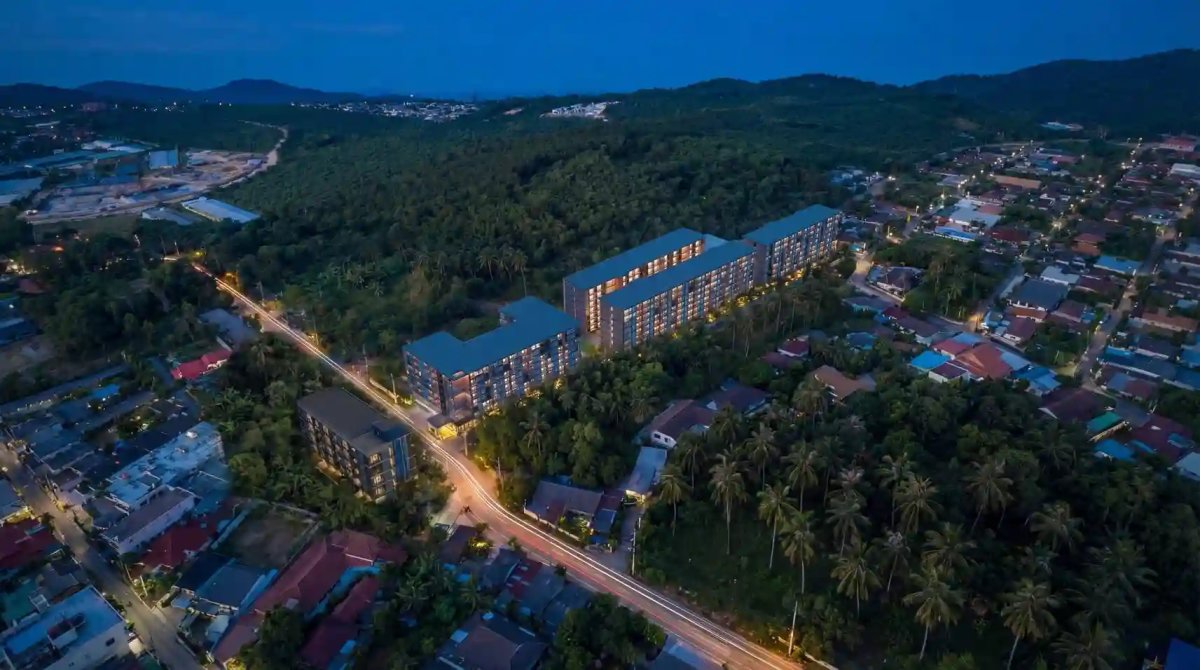
Phuket Town vs Chalong: South Phuket’s Off-the-Beaten-Path Comparison
Phuket Town and Chalong are the two cheapest tickets on the island, and for different reasons. Phuket Town, Wichit on our records, since the district called Phuket Town covers seven area labels and most of the south, is the island’s cultural and administrative capital: historic Sino-Portuguese architecture, an apartment median of 3,420,000 THB ($104,587) with entry at 2,490,000 ($76,147), a rapidly gentrifying Old Town district, and zero beach access. Chalong is the marine hub, Wat Chalong temple, the island’s main pier, a dense expat community and a practical midpoint location, with an almost identical median of 3,430,000 THB ($104,893) from 2,671,200 ($81,688). The metre, which is where the two actually separate, runs the other way from the cliché: 111,786 THB in Wichit against 98,550 in Chalong. Neither can be ranked on yield or appreciation, because neither is measured in Thailand, but both are genuinely the low end of the ticket, and that part holds.
Start with the best areas guide and Phuket buying guide before you shortlist south-island inventory.

The two markets side by side
First, a word about the names. Our records file every scheme under one of three districts (Thalang, Phuket Town and Kathu) and the Phuket Town district covers seven of our area labels, Chalong, Karon, Kata, Ko Kaeo, Nai Harn, Rawai and Wichit, which is effectively the whole south of the island. What a buyer means by “Phuket Town”, the administrative and commercial centre, is the label Wichit. So this comparison is Wichit against Chalong, and the two sit inside the same district rather than being separate markets in the file.
| Phuket Town (Wichit) | Chalong | |
|---|---|---|
| Priced apartments | 374 | 396 |
| Apartment median | 3,420,000 THB / $104,587 | 3,430,000 THB / $104,893 |
| THB per sqm | 111,786 | 98,550 |
| Entry | 2,490,000 / $76,147 | 2,671,200 / $81,688 |
| Priced villas | 1 | 292, median 29,800,000 THB |
| Schemes on file | 5 | 15 |
| Median walk to a beach | 120 min | 130 min |
| Finished priced apartments | 139 | 0 |
| Units under construction | 236 | 687 |
| Gross yield | Not published, here or anywhere in Thailand | Not published |
| Five-year appreciation | No index exists to measure it | No index exists |
| Core tenant | Long-stay residents working on the island | Residents, divers, medical staff, medium-stay visitors |
Three of those rows contradict what this page used to say.
The price-per-square-metre figures were both far too low and the ranking was backwards. This page had Phuket Town at about $2,000 per sqm and Chalong at $2,400, making the Town the cheaper metre. The file says Wichit is 111,786 THB (about $3,419) and Chalong 98,550 (about $3,014), both well above the old figures, and Wichit is the dearer of the two by 13%. The medians are almost identical, which means the same money buys a smaller unit in the Town, not a bigger one.
The entry prices were also below anything on the file. Nothing in Wichit is priced under 2,490,000 THB and nothing in Chalong under 2,671,200.
And the appreciation comparison had Chalong ahead. No index measures that, but the one dimension that is countable points the other way: Chalong has 687 units under construction against Wichit’s 236, so it is Chalong that faces the heavier new supply.
Buyer scenarios: Town vs Chalong
Scenario A, resident base near beaches: you plan six- to twelve-month stays, want pier access and Rawai within a short drive. Chalong starts at 2,671,200 THB on our file, with 396 priced apartments to choose from and 292 priced villas alongside them: the villa book is what really separates Chalong from the Town, which has one. The short-stay income band this scenario used to give is withdrawn; build the income side from a twelve-month asking rent on the long-stay portals instead, which for this tenant profile is the relevant figure anyway: the method is in our rental yield guide.
Scenario B, income-first investor on a hard budget ceiling: your capital is the constraint and the property will never be used personally. Wichit enters at 2,490,000 THB and holds 374 priced apartments at a 3,420,000 median. The occupancy figure this scenario used to claim is withdrawn (nothing measures it) but the structural point survives and is the reason to look here: a tenant pool of people who work on the island renews rather than turns over, so the management load is a fraction of what coastal short-stay demands. Wichit also holds 139 finished priced apartments, which is where the letting evidence for that thesis would actually come from. The trade is a thin resale audience, so the hold has to be long enough for income to be the return rather than the exit.
Scenario C, Family or professional relocating for work: Your priority is the hospital, the schools and the commute rather than the beach. Phuket Town puts all three within a short drive; Chalong puts you closer to the water and further from the administrative centre. For most working households the decision comes down to where the job is, and the property should follow that rather than the other way round.
Scenario D, Retiree wanting a quiet base with beach access: Chalong, almost without exception. The established expat community, the medical infrastructure and the ten to fifteen minutes to Rawai and Nai Harn are the whole proposition, and the entry price leaves room to buy a larger unit than the same money would take on the west coast.
Phuket Town: Overview
This is Phuket’s administrative, commercial, and educational centre. The island’s two main hospitals are here. The university campus is here. Government offices, courts, banks, and markets are here. For anyone who actually lives on Phuket long-term rather than visiting on holiday, Phuket Town is where things get done.
Prices reflect the absence of tourist demand rather than any weakness in the place. The figures this paragraph used to give were both too low and wrong in rank: on our file Wichit prices at 111,786 THB per sqm (about $3,419) with entry at 2,490,000 THB ($76,147) across 374 priced apartments. That is not the cheapest metre on the island, Chalong is cheaper at 98,550, and so is Kathu at 108,214, but the median ticket of 3,420,000 THB is among the lowest anywhere, which is the part of the old claim that holds.
The gentrification story is real. Walking Street, Thalang Road, and the surrounding Old Town streets have transformed significantly over the past decade. New boutique hotels, co-working spaces, wine bars, and art galleries have moved in. Property values in the Old Town specifically have increased more than the broader Phuket Town average, and the trend continues.
Rental demand here comes from a different pool than the coast: long-term renters working in education, healthcare, government or business. Monthly asking rents are modest, check the current ones yourself on the long-stay portals, which is the one letting figure in this market you can actually read before buying. The year-round occupancy figure this paragraph used to give is withdrawn; Thailand keeps no letting register, so nobody has measured it here or anywhere else on the island. Short-term tourist rentals are lower volume than coastal areas, though Airbnb in Old Town has grown as “authentic Phuket” experiences gain traction.
The gross and net yield claims this paragraph used to make are withdrawn. What is structurally true, and does not need a percentage, is the cost side: a twelve-month tenancy means one changeover a year rather than dozens, no platform commission, and an agency fee instead of an operator share of gross. On a small unit that difference is large in absolute terms, and it is the real argument for this market.
The hard truth: Phuket Town is not for holiday home buyers. There’s no beach. The area doesn’t have resort infrastructure. If you’re buying for personal use as a retreat, or for short-term tourist rentals during high season, the distance to any beach (30-40 minutes minimum) is a significant limitation. The value proposition here is investment yield + long-stay personal use, not sun-and-sea lifestyle.
The five-year appreciation figure this paragraph used to give is withdrawn, no transaction index covers Phuket property, so nothing has measured it here or in any other area. The reasoning behind it is still worth stating: this market has no tourist demand driver, which is exactly why its running costs are low and its tenancies are long. The Old Town premium is real and concentrated in a small number of heritage buildings, none of which is on our price file.
Chalong: Overview
The expat community in Chalong is substantial and well-established. Medical professionals at the nearby hospitals, retired Europeans, diving and water sports professionals, and people in property and business are the core residents. The area has the infrastructure to match: international-standard restaurants, supermarkets, a hospital (Health Wellness Clinic and Bangkok Hospital branches), yoga studios, motorbike shops, and a hardware district that’s essential for villa owners.
Chalong is more practical than premium, and unusually for the south it is a villa market as much as an apartment one: 292 priced villas at a 29,800,000 THB median, against Wichit’s single villa. Apartments run 396 priced units from 2,671,200 THB at a 3,430,000 median, and the metre is 98,550 THB (about $3,014), the cheapest of any labelled area on the island, and 13% below Wichit rather than above it as this page previously stated. Less glossy marketing than Bang Tao or Kamala, which means better value per square metre and a thinner resale audience.
The location is genuinely central to south Phuket. Rawai and Nai Harn beach are 10-15 minutes away. Kata and Karon are 15-20 minutes. Patong is 25 minutes. Big Buddha is visible from many properties. For personal use as a base to explore south Phuket, Chalong is arguably the most practical non-beach location on the island.
Rental demand follows the resident and medium-stay model: monthly renters, diving and water sports people, medical visitors, professionals. Short-stay occupancy relative to the coast is not something anyone measures, and the gross yield band this paragraph used to give is withdrawn. Note also what Chalong cannot show you: not one of its 396 priced apartments sits in a finished scheme, so there is no building here from which an owner could hand you twelve months of statements. That is the single biggest practical difference from Wichit, which holds 139 finished units.
The appreciation figures for Chalong and for the Town are both withdrawn: no index measures either. The characterisation underneath them is reasonable and needs no number, a resident-driven market moves less on tourist sentiment in both directions. What is countable is the supply: 687 units under construction in Chalong against 236 in Wichit.
Head-to-Head: Investment Returns
Yield: not comparable, in either direction. Thailand keeps no letting register, so neither area has a measured yield and the bands this line used to set against each other were both invented. Chalong genuinely has the more varied tenant pool, being closer to the beaches; what that is worth is the part nobody knows.
Appreciation: unmeasured on both sides. On the one countable dimension the old ranking inverts: Chalong has 687 units under construction against Wichit’s 236, so Chalong’s exit competes with roughly three times the new supply.
Quality of life (personal use): Chalong is more liveable for most expat profiles, proximity to beaches, water sports, the medical infrastructure, and restaurant variety. Phuket Town is better for those who specifically want the cultural, historic, and urban experience.
Liquidity: Both markets are thinner than the coast. Chalong has slightly more transaction volume and a broader buyer pool (expats + investors). Phuket Town’s buyer pool is narrower.
Risks and red flags in both markets
Neither market is dangerous; both are thin, and thin markets punish specific mistakes.
The first is buying either area on a coastal rental model. A yield projection built on holiday nightly rates does not apply here: international tourists stay near beaches, and a unit thirty to forty minutes from one produces single-digit holiday occupancy. Both markets work on monthly tenancies and medium stays, which is a lower gross with far lower operating cost and much less seasonality. If the model you were shown quotes Patong or Kata nightly rates, it describes a different island.
The second is the exit, which is the real cost of the discount. Your buyer in either area is another investor running the long-stay model or a resident who wants to live there, not an international holiday buyer. That pool is smaller and slower, and a sale takes months rather than weeks. Buy a format that pool actually wants, which means one and two-bedroom units with parking rather than studios or unusual layouts, and plan a holding period that does not depend on a quick sale.
The third is the building rather than the area. Away from the developer-marketed coast, stock varies far more in quality and in how it has been run. Ask the juristic person for the CAM rate now and three years ago, the sinking fund balance, whether there has been a special assessment, and read the minutes of the last two owners’ meetings. Deferred facade or lift work in a building with a thin sinking fund means a levy is coming, and it will land on you.
The red flag to watch for is a south Phuket discount presented without the quota position. The 49% foreign allowance is measured against the building’s total floor area rather than its unit count, and it is consumed when buyers register rather than when they reserve. In a smaller building the absolute allowance is a small number of square metres, and a cheap unit that cannot register in your name is not cheap. Ask for it as a dated figure in square metres against your specific unit before any deposit.
What each area costs to hold
The running cost is where a cheap unit either stays cheap or stops being cheap, and it behaves differently in these two markets than on the coast.
Common area maintenance is charged per square metre per month and paid whether the unit is let or empty, so on a $60,000 apartment it consumes a materially larger share of gross income than the same rate does on a $300,000 one. Ask for the current rate and what it was three years ago, and apply it to the actual floor area rather than to an average.
The sinking fund is the second line and the one that decides whether a building ages well. A contribution is required under Thai condominium law, and what matters is whether the fund holds enough against the works the building actually faces. In older south Phuket stock the honest question is what has already been renewed once and what has not.
Management costs less here than on the coast because the model is different. A twelve-month tenancy needs finding once a year rather than servicing weekly, which is why long-term management commonly runs 8-12% of rent against 20-35% for short-stay. That gap is why the cost side here is so much lighter than on the coast, whatever either model grosses. It convert into net figures closer to coastal stock than the headline suggests.
And transaction costs apply twice, buying and selling, on a base that is small enough for them to matter. Legal fees, bank charges and FET issuance cost broadly the same whatever the ticket, so on a $60,000 purchase held three years they consume a meaningful share of the total return. Over ten years they become marginal, which is the argument for the longer hold in both districts.
Our Verdict
Chalong is the better all-round choice for most buyers on the things that can be checked: more practical infrastructure, closer to beaches, a real villa market (292 priced villas against Wichit’s one) and a cheaper metre at 98,550 THB against 111,786. The yield and appreciation claims that used to head that list are withdrawn: neither is measured. Wichit is the right choice if you value the urban and cultural setting, if the 2,490,000 THB entry matters, or if you want letting evidence: it holds 139 finished priced apartments and Chalong holds none.
If beach lifestyle is your priority at all, neither area is right, look at Rawai, Nai Harn, or Kamala instead. For foreign quota mechanics and transfer steps, keep the buying guide open while you compare districts, south Phuket discounts evaporate quickly when a unit cannot register in your name.
South Phuket rewards patient capital: lower headlines than Bang Tao, but fewer bidding wars and more room to negotiate on older stock with verified titles and clean quota registers. Many investors scout both districts on 60-day visa exempt entry before choosing between urban culture and pier-side expat life.
Frequently Asked Questions
Neither has a measured one, and the bands this answer used to compare are withdrawn: Thailand keeps no letting register. What can be checked is where letting evidence exists at all, Wichit, the label the records use for Phuket Town proper, holds 139 finished priced apartments; Chalong holds none of its 396, so no owner statement can come out of that corridor.
It depends which measure you mean, and the two disagree. On the ticket they are within 10,000 THB of each other: a 3,420,000 THB median in Wichit against 3,430,000 in Chalong, with entry at 2,490,000 and 2,671,200 respectively, so Wichit is marginally cheaper to get into. On the metre Chalong is clearly cheaper, 98,550 THB per sqm against Wichit's 111,786, a 13% gap, which means the same money buys more floor area in Chalong. The old answer here put Phuket Town at $2,000 per sqm and Chalong at $2,400, both far too low and in the wrong order.
Chalong is more practical for families, proximity to the south Phuket beaches, better restaurant variety, medical facilities, and a larger established expat community. Phuket Town has schools and the university, but beach access requires a significant drive.
Yes, on the same terms in each. Condominiums can be held freehold within the building's 49% foreign floor-area allowance. Neither Phuket Town nor Chalong is a resort corridor, so quota is less often exhausted here than on the west coast, but it should still be confirmed in writing for your specific unit.
Unmeasured on both sides (no transaction index covers Phuket property) so the figures this answer used to compare are withdrawn. The countable dimension runs the other way from the old claim: Chalong has 687 units under construction against Wichit's 236. If capital growth is your primary measure, note that nobody can evidence it anywhere on the island, including in Cherng Talay, Laguna or Kamala.
| Priority | Lean | Why |
|---|---|---|
| Lowest entry price | Phuket Town | The cheapest square metre on the island with real infrastructure behind it |
| Steadiest occupancy | Phuket Town | Tenants working on the island, renewing rather than turning over |
| Deeper tenant mix | Chalong | Residents plus some short-stay demand near the pier; neither area has a measured yield |
| Beach access without beach prices | Chalong | Rawai and Nai Harn in 10-15 minutes |
| Cultural and urban living | Phuket Town | Old Town, the food, the walkability |
| Family or retiree base | Chalong | Medical infrastructure, expat community, practical everyday supply |
| Fastest resale | Neither | Both are thinner than the coast; plan a longer hold |
Both markets move more slowly than the west coast, which is precisely why their numbers go stale unnoticed. We track achieved rents, quota positions and building running costs in the south, and we will say when the discount stops covering the disadvantage.
Read Also:

Maksim Shchegolev
Founder, MORE Group
Founder of MORE Group. Four years in investment banking before moving to Phuket, where he has worked in the local property market since 2018. Oversees developer relationships and every engagement above $300K.
About MORE Group →Get a Focused Phuket Property Shortlist
Share budget, area and goal. We will reply with suitable live projects, not a generic catalogue.
