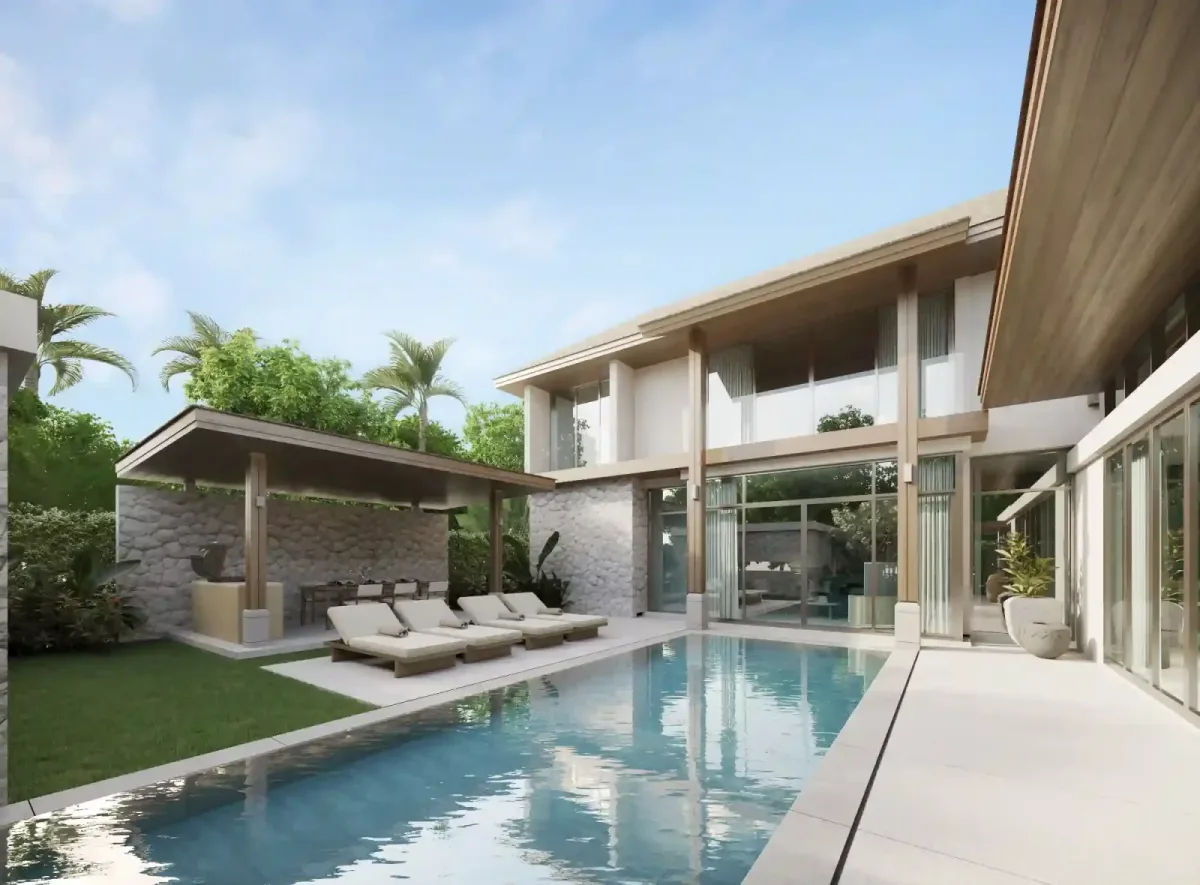
Yes, you can, here are projects that actually work
Freehold condos (49% quota), leasehold villas, company structures, we only send options that match your passport and budget.
Freehold condo quota
49% per building
Villa ownership
30-yr leasehold+
Minimum practical budget
~$80K condo
Mortgage for foreigners
rare, we advise
Buyer commission
0%
Legal review
included
Buy Phuket property →
Commercial landing for foreign buyers
Freehold condos under $100K →
Lowest foreign freehold entry
Mouana Grande Chalong Bay villas →
Villa buyer route, payment plan and availability check
We filter by foreign quota, ownership type and transfer feasibility for your passport.
Can Foreigners Buy Property in Thailand? The 2026 rules in one page
Quick answer: yes, with one hard limit. A foreigner of any nationality can own a condominium unit freehold, in their own name, as long as foreign owners together hold no more than 49 percent of the building’s total floor area; that rule is the Condominium Act of 1979 and it has not changed in 2026. A foreigner cannot own land, so a house or villa is either a registered 30-year lease of the land with the building owned outright, or land held by a Thai company with the buyer as a minority shareholder. The purchase money for a freehold condominium must come from abroad in foreign currency and be documented on a Foreign Exchange Transaction form. No visa is granted by buying, and no property is unlocked by holding one.
The rules as they stand in September 2026
| Question | Answer in 2026 | Where it comes from |
|---|---|---|
| Condominium freehold | Yes, up to 49 percent of the building’s saleable floor area held by foreigners in total; the rest Thai-owned | Condominium Act B.E. 2522 (1979), section 19; unchanged, no amendment passed |
| The 75 percent quota talked about since 2024 | Proposed for resort zones, never submitted to Parliament as a bill; the law is still 49 percent | Government statements 2024 to 2025; no Royal Gazette notice |
| Land | No freehold in a foreign individual’s name, at any price | Land Code B.E. 2497 (1954) |
| Lease of land or a villa | Registered lease of up to 30 years; renewals are contract promises, not registered rights | Civil and Commercial Code section 540 |
| The 99-year lease announced in May 2025 | Still a proposal in 2026; the maximum registrable term remains 30 years | Rights Over Leasehold Asset Act, amendment not enacted |
| Thai company holding land | Legal only with genuine Thai shareholders and business; nominee arrangements are prosecuted, with enforcement stepped up in 2025 and 2026 | Foreign Business Act, Land Code section 96 |
| Money for a freehold unit | Must arrive from abroad in foreign currency, at least the purchase price, with a Foreign Exchange Transaction record from the receiving Thai bank | Bank of Thailand rules, Land Office practice |
| Transfer fee | 2 percent of the appraised value; the 0.01 percent relief to 30 June 2027 is for Thai individual buyers of homes up to 7 million THB and does not reach a foreign buyer | Land Office; Cabinet decision of 30 June 2026 |
| Visa or residence from buying | None. Thailand has no property-linked residence programme; the LTR counts Thai property only inside a US$1 million wealth test | Board of Investment LTR rules |
Does nationality change anything?
| Buyer | What is different | What is identical |
|---|---|---|
| American | FBAR and Form 8938 reporting of the Thai bank account used for the FET; the Thailand and United States tax treaty governs rental income | Quota, land ban, lease term, FET |
| British | No home-country property reporting; UK capital gains tax on a later sale if UK-resident, with treaty credit for Thai tax paid | Same |
| Australian | Foreign income reporting to the ATO; no restriction on the Thai side | Same |
| Singaporean, Hong Kong, Gulf residents | Banks may ask for source-of-funds letters on transfers above about $50,000; no restriction on the Thai side | Same |
| EU citizens | Home-country wealth or property registers in some states (France, Spain); the Thai rules do not vary by passport | Same |
The Thai side of the law does not distinguish between nationalities; the differences are entirely in what your own tax authority wants to know. The one group with a genuinely different position is Thai citizens abroad and their foreign spouses, for whom land can be registered in the Thai spouse’s name with a declaration that the money is the Thai spouse’s separate property.
Phuket buyers: start with our step-by-step Phuket buying guide, FET certificate guide and verified project catalog. Buyers looking at the other markets on this site can compare Koh Samui villas, Pattaya condos and Bangkok condos, where the same rules apply. Get a free shortlist →
What Foreigners Can and Cannot Own in Thailand
| Property Type | Foreign Ownership | Title Type | Notes |
|---|---|---|---|
| Condominium unit | ✓ Yes, freehold | Chanote (individual) | Max 49% of building |
| Villa / House structure | ✓ Yes, structure only | Building permit | Land must be leased |
| Land plot | ✗ No direct ownership | n/a | Leasehold or company structure |
| Leasehold condo/villa | ✓ Yes | Lease agreement | 30+30+30 years |
| Thai company-owned land | Via Thai company | Chanote | Legal risk if misused |
Frequently Asked Questions
Yes, with one significant limit: land. A foreigner may own a condominium unit freehold within the 49% of a building's total floor area reserved for foreign ownership, but cannot hold freehold title to land at any price. A house or villa is therefore a registered lease over the plot with the building owned in your name, or land held through a Thai company.
It is measured against the building's total floor area, not the number of units, and it is consumed as foreign buyers register. So a building can be largely unsold and have no quota left, and a large unit consumes as much of it as several small ones. Ask for a dated letter from the juristic person stating remaining quota in square metres for your specific unit.
Where the company has genuine substance, yes: real Thai shareholders with an actual economic interest, a real business purpose, and proper accounts. Where it exists purely to hold a residence for a foreign buyer, with shareholders who contribute nothing and do nothing, it is a nominee arrangement rather than a structure, and the exposure sits with the foreign buyer.
For freehold registration by a non-resident, yes. The purchase funds must arrive from overseas in foreign currency, evidenced by an FET record issued by the receiving Thai bank. It must carry your name, the correct amount and a reference to the property, and it is needed again when you eventually repatriate sale proceeds.
No. Thailand has no property-linked residence programme, and ownership grants no visa or residence right of any kind. The long-stay routes are assessed entirely separately, and any seller implying otherwise is either mistaken or misrepresenting the position.
Looking for the right property in Phuket?
Comparing options? Our experts give honest, no-pressure analysis.
Option 1: Freehold Condo Ownership: The Most Secure Route
The 49% Foreign Quota Rule
Every registered condominium in Thailand has a foreign quota: a maximum of 49% of the building’s total floor area can be owned by foreign nationals. The remaining 51% must be held by Thai nationals or Thai juristic persons.
What this means in practice:
- In a 100-unit building, up to 49 units can be foreign-owned
- Once the quota fills, you cannot purchase freehold, only leasehold
- The quota is tracked per building, not per development
- Developers often reserve freehold units for foreign buyers from launch
Price reality check: Foreign-quota freehold units in Phuket typically command a 5-15% premium over equivalent leasehold units in the same building, reflecting the stronger legal protection.
Funds Transfer Requirements
To register a freehold condo purchase, foreign funds must be transferred into Thailand in foreign currency and converted to Thai Baht. The receiving bank issues a Foreign Exchange Transaction (FET) form, formerly called a Tor Tor 3. This document is mandatory for Land Department registration and later allows you to repatriate funds when selling.
Transfer requirements:
- Minimum: the purchase price in foreign currency
- Bank: any Thai commercial bank
- Currency: any major foreign currency (USD, EUR, GBP, AUD, etc.)
- Documentation: passport, source of funds for amounts over $50,000
Option 2: Leasehold: 30-Year Terms with Renewals
How Leasehold Works in Thailand
| Factor | Details |
|---|---|
| Initial term | 30 years (maximum registerable under Thai Civil Code) |
| Renewal options | 30+30 = additional 60 years (not guaranteed by law) |
| Total typical structure | 30+30+30 = 90 years |
| Registration | Mandatory at Land Department for terms over 3 years |
| Renewal enforceability | Contractual right, not automatic legal right |
| Inheritance | Leases can be inherited and transferred |
The key limitation: Thailand’s Civil Code caps the legally registerable lease term at 30 years. Renewal clauses for the second and third 30-year terms are contractual, not automatically enforceable if a developer goes bankrupt or the property changes ownership. This is why choosing a reputable developer and having proper legal documentation matters enormously.
Leasehold Pricing vs Freehold
In Phuket, leasehold condos typically sell at $80,000-$250,000 for studio to 1-bedroom units, and leasehold villas range from $200,000-$800,000+ depending on area and size. Freehold condos run $100,000-$500,000 for comparable units.
Option 3: Thai Company Structure for Land Ownership
Requirements:
- Thai nationals must hold at least 51% of shares
- Company must have genuine business activity (not just a shell for property)
- Annual financial statements and corporate maintenance required
- Risk: if Thai shareholders are nominee shareholders (fronts), this violates the Foreign Business Act
Our assessment: The Thai company structure is appropriate for genuine business investors, not for personal residential purchases. The Land Department and Revenue Department have intensified scrutiny of nominee arrangements since 2022.
Transfer Costs and Taxes
| Fee | Rate | Who Pays |
|---|---|---|
| Transfer fee | 2% of appraised value | Usually split 50/50 |
| Specific Business Tax (SBT) | 3.3% of sale price | Seller (if held less than 5 years) |
| Stamp duty | 0.5% of sale price | Seller (if SBT exempt) |
| Withholding tax | Progressive scale | Seller |
| Legal/lawyer fees | 0.5-1% | Buyer |
Note: In practice, many developers in Phuket cover the transfer fee for off-plan purchases. Always confirm fee responsibility in the Sale and Purchase Agreement. The widely reported cut of the transfer and mortgage fees to 0.01 percent, extended by the Cabinet on 30 June 2026 until 30 June 2027, applies to Thai individual buyers of homes priced and appraised at no more than 7 million THB; a foreign buyer should budget the full 2 percent.
Extended buyer scenarios by goal and structure
Scenario 1: European retiree seeking simplicity
You want a 1-bedroom freehold condo for 4-6 months per year, minimal corporate complexity, and clear inheritance to children.
| Step | Action |
|---|---|
| Structure | Freehold condo within verified 49% quota |
| Budget | €90K-€250K equivalent |
| Critical document | FET certificate on every inbound tranche |
| Area | Phuket west coast: Kamala, Rawai, Bang Tao |
| Read next | Phuket buying guide |
Avoid nominee company shortcuts marketed as “full land ownership.” Freehold condo title registered in your passport name is the cleanest path.
Scenario 2: Asian investor prioritising rental yield
You underwrite net cash flow and may never occupy the unit. Building operator quality matters as much as location.
| Step | Action |
|---|---|
| Structure | Freehold with hotel rental program |
| Budget | $120K-$450K |
| Due diligence | Occupancy data, fee stack, OTA listing history |
| Read next | Rental yield guide |
Compare at least three buildings in the same corridor before accepting a developer’s gross yield slide.
Scenario 3: Villa buyer accepting leasehold
Freehold quota is irrelevant; you want a pool villa and accept land lease structure.
| Step | Action |
|---|---|
| Structure | Registered 30-year lease plus building ownership |
| Budget | $300K-$1.2M |
| Legal focus | Renewal clauses, landowner identity, registration at Land Office |
| Risk | Renewal is contractual, not automatic under Thai law |
Have a Phuket property lawyer review the lease register entry, not only the developer’s English summary.
Scenario 4: Off-plan buyer with 24-month horizon
You can wait for keys and want staged payments tied to construction progress.
| Step | Action |
|---|---|
| Structure | Off-plan freehold SPA with milestones |
| Budget | $150K-$600K |
| Due diligence | EIA, building permit, developer financial depth |
| Read next | Off-plan Phuket guide |
If the developer cannot produce permit references and a juristic person budget for common areas, treat headline discounts as compensation for risk, not a bargain.
Scenario 5: American buyer with USD income
You earn in dollars, may open Thai accounts for HOA and rent, and need US tax alignment.
| Step | Action |
|---|---|
| Structure | Freehold condo, USD-priced project if available |
| Compliance | FBAR/FATCA review with US CPA |
| Read next | USA Desk and Americans guide |
Thai law treats Americans identically to other foreigners; the extra layer is US reporting, not Thai ownership class.
Legal risks foreigners underestimate
Unregistered sub-leases. Leases under three years can avoid Land Office registration; longer terms must be registered to bind successors. An unregistered 30-year promise on paper may not survive a change of landowner.
Power of attorney abuse. Remote buyers rely on POA for transfer day. Use a lawyer’s POA template, limit scope to the transaction, and never grant blank banking authority.
Off-plan refund mechanics. If construction stalls, your recovery depends on SPA refund clauses and developer solvency, not brochure renderings. The off-plan guide covers milestone and delay language.
FET mismatch. Partial payments in baht from a Thai friend, or inbound transfers without proper FET wording, can block registration even when the full price was effectively paid.
Repatriation on sale. Outbound remittance of sale proceeds requires inbound FET history. Keep certificates for every purchase wire.
Foreign quota verification checklist
- Request Foreign Ownership Certificate or juristic letter naming your unit
- Confirm quota is tracked by unit, not just “49% remaining in tower B”
- Cross-check unit area against building’s total sellable area calculation
- Verify seller is registered owner on Chanote extract
- Confirm no pending litigation against juristic person or developer
- For resale, confirm buyer can be foreign without converting Thai-quota unit
- Archive email confirmation from licensed agent and lawyer in one folder
Proof of funds and banking (FET summary)
| Step | Detail |
|---|---|
| Open Thai account | Bangkok Bank, SCB, or Kasikorn, confirm FET issuance |
| Wire from abroad | USD, EUR, GBP, or other major currency |
| Reference field | Include purchase purpose text your bank accepts |
| Per-tranche FET | Each qualifying inbound transfer may need its own form |
| Land Office day | Lawyer presents FET bundle with SPA and passport |
Full walkthrough: proof of funds and FET guide.
Resale and exit considerations
- How many foreign-quota resales occurred in this building in the last 24 months?
- Average days on market for comparable units?
- Does the hotel program restrict resale or change fees on transfer?
Browse verified project reviews for buildings with international resale depth rather than one-off launch hype.
The short answer, and the four routes
Yes, with limits that depend entirely on whether land is involved.
| Route | Available to a foreigner? | What you hold | Main constraint |
|---|---|---|---|
| Condominium unit, freehold | Yes | Title in your own name at the Land Department | Only within 49% of the building’s total floor area, measured by area and consumed as foreigners register |
| Condominium unit, leasehold | Yes | A registered lease, typically 30 years | The term runs down, and your buyer acquires only what remains |
| House or villa | Yes, but not the land | The building outright, plus a registered lease over the plot | Foreign freehold of land is not available at any price |
| Land via a Thai company | Only indirectly | Shares in a company that holds the land | Must have genuine business substance; a nominee shell is not lawful |
Everything else follows from that table. The condominium route is the only one that gives a foreigner something close to outright ownership, which is why it is the default recommendation for anyone who does not specifically need a house.
What a Thai company structure actually requires
This is the route most often mis-sold, so it is worth being precise about where the line sits.
A Thai company owning land is entirely lawful where the company has real substance: genuine Thai shareholders with an actual economic interest, a real business purpose, proper accounts, and the compliance obligations that follow. Many legitimate businesses hold Thai land this way.
What is not lawful is a company formed solely to hold a residence for a foreign buyer, with Thai shareholders who hold their shares nominally, contribute no capital and play no role. That is a nominee arrangement, and the exposure sits with the foreign buyer rather than with the agent or the formation service who proposed it.
The practical test to apply: ask who the Thai shareholders will be, what they are contributing, and what role they will play. If the answer is that they are provided by the service and will sign whatever is required, you have your answer. A Thai lawyer acting for you, rather than for the seller, should be the one making this assessment before any money moves.
Company ownership also brings annual accounting and filing obligations that continue for as long as the structure exists, and those costs are part of holding the property rather than part of buying it.
Ongoing obligations after you own it
Ownership brings duties that are easy to miss when the purchase is complete and the excitement subsides.
Rental income earned in Thailand is taxable in Thailand, regardless of where you live or where the tenant pays from. The Land and Building Tax applies annually at low residential rates but is not nil. If you let, the TM30 obligation to report foreign guests to immigration falls on the property owner or possessor, and a management company usually handles it but does not absolve you of it. And if you spend 180 days or more here in a calendar year you become Thai tax resident, which changes the treatment of income you bring into the country under rules revised in 2024.
None of these is onerous. All are cheaper to set up correctly at the outset than to regularise later.
One more that catches families out: Thai succession law applies to Thai-situated assets, and a foreign will may or may not be effective for the Thai property depending on how it is drafted. A short Thai will covering the Thai asset specifically is inexpensive and removes a great deal of difficulty for whoever inherits.
Combined risk and compliance checklist
Read Also:
Questions about this guide? Ask us on WhatsApp. The guide's title is already in the message, so you only need to write your question.
Ask on WhatsApp
Maksim Shchegolev
Founder, MORE Group
Founder of MORE Group. Four years in investment banking before moving to Phuket, where he has worked in the local property market since 2018. Oversees developer relationships and every engagement above $300K.
About MORE Group →Get a Focused Phuket Property Shortlist
Share budget, area and goal. We will reply with suitable live projects, not a generic catalogue.
