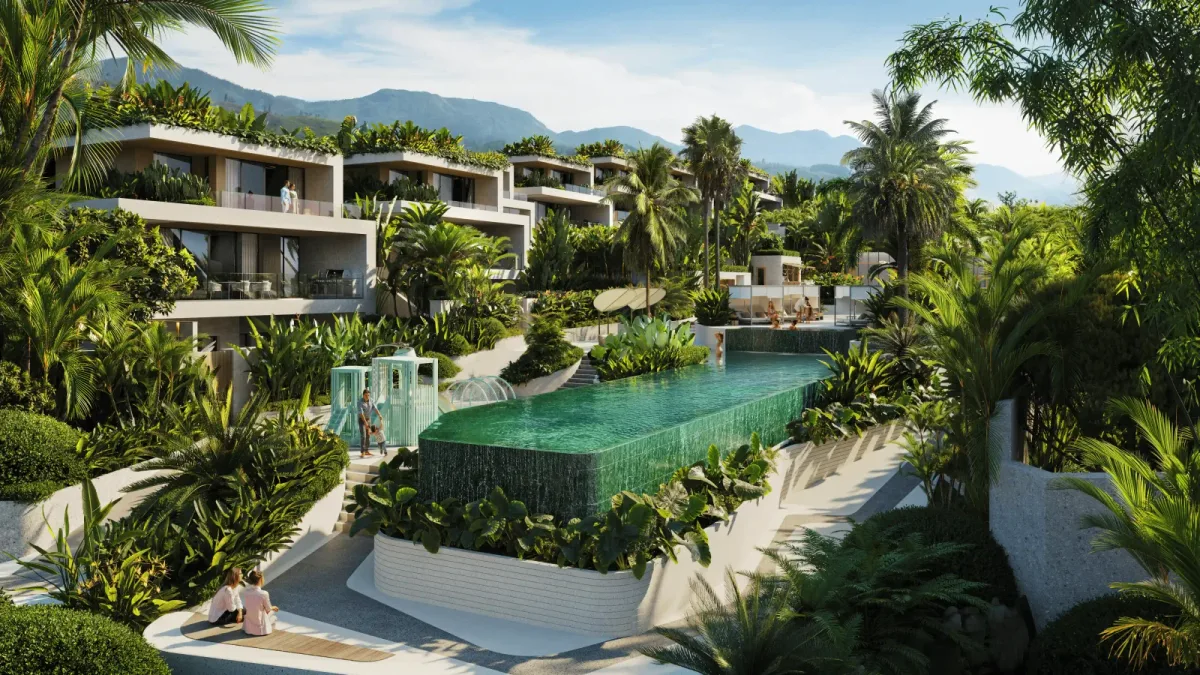
Freehold vs Leasehold Thailand Property: Which Is Right for You? 2026
The freehold-leasehold price differential on Phuket’s west coast has widened over the past few years, reflecting foreign demand concentrating on Chanote-titled units inside the limited 49% quota. Check the gap on the specific building rather than assuming a market-wide figure, because it is the developer’s own valuation of tenure. Q4 2025
Broader context: Phuket Property Legal & Taxes Master Guide 2026.
What Freehold Means in Thailand
The 49% foreign quota: Under Section 19 of the Thailand Condominium Act B.E. 2522, freehold units are available to foreigners only up to 49% of a building’s total floor area. This quota is tracked per building at the Land Department. Once full, no further freehold sales to foreigners are permitted until an existing freehold unit is resold. According to Knight Frank Thailand’s 2025 data, approximately 35% of Phuket condominium buildings have fully allocated foreign quotas, up from 22% in 2021 (Knight Frank Phuket Residential Review, H2 2025).
When Freehold Units Are Worth the Premium
The freehold premium, typically 5-20% over a comparable leasehold unit, is justified when:
- You plan to hold the property for 10+ years (the premium amortizes over time)
- You intend to resell to foreign buyers (who also need freehold for full security)
- You want the cleanest legal structure for estate planning
- You’re buying in a market where freehold quota is scarce (increases the unit’s scarcity value)
What Leasehold Means in Thailand
The 30+30+30 Year Structure
Thailand’s Civil and Commercial Code (Sections 537-571) caps the legally registerable lease at 30 years. The Royal Institution of Chartered Surveyors (RICS) Thailand chapter classifies registered Thai leasehold as a “secure interest” for valuation purposes, though it notes the distinction from Western-style freehold in their RICS Valuation Standards for Thailand guidance. However, developers typically structure leases as 30+30+30 (90 years total) with:
- First 30 years: Registered at the Land Department, legally binding and enforceable
- Second 30 years: Pre-agreed contractual renewal, enforceable against the original lessor/developer
- Third 30 years: Pre-agreed right of renewal, weakest protection; depends on successor ownership
The critical limitation: If the developer sells the land to a new owner, or goes into receivership, the contractual renewal obligations for the second and third terms become more complex to enforce. A lease registered at the Land Department for the first 30 years does protect against new ownership, registered leases bind subsequent owners in Thailand.
Leasehold for Villas: The Standard Structure
Since foreigners cannot own land freehold, villas are always sold as leasehold in the land component. You own the building structure (sometimes via a separate title) and lease the land for 30+30+30 years. This is the market standard and does not indicate a problematic arrangement, it’s simply how Thai law works for villa buyers. Full ownership rules for foreigners are in our can foreigners buy property in Thailand guide.
Leasehold Pricing Reality
In the same development, leasehold units typically sell at a 10-20% discount to freehold equivalents on current west-coast pricing. For a $200,000 freehold unit, the leasehold equivalent might be priced at $165,000-$180,000. This discount reflects the time-limited nature of the interest. Major developers including Sansiri, Laguna Resorts and Hotels, and Banyan Group price their leasehold inventory consistently within this band.
However: for rental investors with a 5-15 year investment horizon, this discount improves yield, you’re generating the same rental income at a lower purchase price. The exit in year 12 is simpler when 18 years of the lease remain than at year 25 when only 5 years remain.
How the gap behaves over time
The freehold-leasehold discount is often quoted as a fixed percentage, and that is the least useful way to think about it, because the two interests diverge as the years pass.
On day one, a newly registered thirty-year lease and a freehold title look similar to a buyer: both give you the use of the property, both can be let, both can be sold. The discount at that point reflects the tenure difference in principle rather than in practice.
By year ten the picture has changed. Your buyer is acquiring twenty years rather than thirty, and their own holding period has to fit inside it. By year eighteen or twenty the pool narrows sharply, because a purchaser thinking about a ten-year hold is looking at a lease that expires shortly after they would want to sell. The decline is not linear; it accelerates as the remaining term crosses the point where the next buyer’s plans no longer fit.
That has two practical consequences. The first is that a leasehold purchase should be priced against the years you will actually hold, not against a market-wide discount. The second is that the renewal wording is worth more attention than the headline price, because it is the only thing that arrests the decline, and its value depends entirely on who gave it and whether a successor owner of the land would be bound.
Where both tenures are offered in the same development, the gap between them is the developer’s own valuation of tenure. If that gap is unusually small, either the leasehold is overpriced or the developer expects the difference not to matter. On resale it will.
Why the choice is usually made for you
Buyers approach this as a preference and it is more often a constraint, which is worth knowing before you spend time weighing the two.
For a condominium, the choice exists only while the building’s foreign allowance lasts. Once it is consumed, freehold is not on offer at any price, and what will be presented instead is a registered lease. That is lawful and it is a materially different asset, and the moment it happens is usually late in the process, when a buyer has already committed emotionally and sometimes financially.
For a house or a villa, there is no choice at all. Land cannot be held freehold by a foreigner in Thailand, so a villa purchase is always a lease over the plot with the building in your own name, or a Thai company holding the land. Any marketing that describes a villa as freehold for a foreign buyer is describing something that does not exist, and that alone tells you what to think about the rest of the presentation.
So the practical sequence is: establish what is actually available for the specific unit before comparing, rather than deciding on tenure in the abstract and then discovering which one you are being offered.
Transfer Costs: Freehold vs Leasehold
Government fees differ significantly:
| Fee | Freehold Transfer | Leasehold Registration |
|---|---|---|
| Transfer fee | 2% of appraised value | 1% of total lease value |
| Specific Business Tax | 3.3% (if sold within 5 years) | Not applicable |
| Stamp duty | 0.5% (if SBT exempt) | 0.1% of total lease value |
| Withholding tax | Progressive (seller) | Not applicable |
| Approximate total | 3-5% of transaction | 1-1.5% of transaction |
Key insight: Leasehold transactions are significantly cheaper to execute. For a $200,000 property, you might pay $8,000 in government fees for freehold vs. $2,000 for leasehold registration. This difference partially offsets the freehold premium. Budget the full stack in our Phuket property taxes and fees guide before you compare net returns.
What to establish before choosing either
Whichever tenure you take, the same four questions decide whether the purchase works, and each has a document behind it.
On freehold, the question is whether the allowance is actually available for your unit. Thai law reserves 49% of a building’s total floor area for non-Thai ownership, measured by floor area rather than by unit count, and it is consumed when buyers register at the Land Department rather than when they reserve. A deposit reserves the unit; it reserves nothing in quota terms. Ask the juristic person for a dated letter stating the remaining allowance in square metres against your specific unit, and ask again before each major payment.
Then the contract’s silence, which is where the risk usually sits. A well-drafted agreement says what happens if the allowance runs out before your transfer: whether a registered lease is substituted, at what price adjustment, and whether you may withdraw and recover what you have paid. A contract that says nothing on the point leaves you carrying the consequence of the developer’s own sales pace, and you will find that out on transfer day rather than before it.
On leasehold, the question is who is bound. Renewal undertakings beyond the registered term are contractual rather than registered, so establish who gives them, whether a successor owner of the land would be bound, and what happens if that party sells or ceases to exist. Have counsel you appointed answer that, not counsel introduced by the sales side.
And on either route, where the purchase money comes from abroad, registering freehold in a foreign name depends on funds arriving in foreign currency with a Foreign Exchange Transaction record from the receiving Thai bank. A lease does not require it, which is part of why leasehold sometimes looks simpler, and the simplicity is bought with a weaker interest rather than being free.
Which Is Better for Rental Investment?
For investors with a horizon under 7 years, leasehold frequently wins on cash-on-cash return. For those building long-term wealth or planning to pass the asset to heirs, freehold is the stronger play. The Royal Institution of Chartered Surveyors (RICS) recommends that foreign buyers in Southeast Asian markets model both scenarios with conservative assumptions before committing.
Pros and Cons
Freehold
Pros: Maximum legal security | Indefinite ownership | Broader resale market | Stronger inheritance position | No renewal negotiations
Cons: 5-20% price premium | Limited by 49% foreign quota (may not be available) | Higher transfer fees | Not available for land/villas
Leasehold
Pros: Lower entry price | Higher rental yield on investment | No quota restriction | Standard for villa buyers | Lower transfer costs
Cons: 30-year initial term (renewal contractual) | Narrower resale market | Renewal risk if developer/lessor changes | Value declines as term shortens | Not registerable beyond 30 years at a time
Risks checklist: what to verify before choosing
- Foreign quota availability. Ask the developer for the exact current quota percentage and get it confirmed by the Land Department. A verbal “we have quota” is not enough, buildings near 49% can fill unexpectedly.
- Leasehold renewal language. DFDL Thailand advises that only the first 30-year term is registered at the Land Department. The 2nd and 3rd renewals are contractual promises. Ensure they specify automatic renewal, fixed fees, and what happens if the lessor entity changes.
- Transfer fee allocation. Freehold transfers cost 6.3% in government fees (transfer fee 2%, specific business tax 3.3%, stamp duty 0.5%, withholding tax variable). Negotiate who pays, in many Phuket deals, the split is 50/50 between buyer and seller.
- Inheritance planning. Freehold units can be inherited by foreign heirs under Thai succession law, but the heir must still meet the 49% quota requirement and remit funds from abroad. Without proper planning (a Thai will or testamentary document), probate can take 6-12 months. Consult a firm like Tilleke and Gibbins or Baker McKenzie for cross-border estate structuring.
- Leasehold depreciation in valuation. Bangkok Bank and Kasikorn Bank do not lend against leasehold property held by foreigners. If you plan to refinance or need liquidity, freehold is the only bankable option.
- Developer track record. Renewal undertakings are only as good as the party giving them, so the developer’s financial position matters more here than on a freehold purchase. Check if the developer is SET-listed, how many completed projects they have, and whether the management entity is legally separate from the development entity.
Bottom line: freehold gives you the strongest legal position and broadest exit options. Leasehold gives you access to villa products and lower entry prices. Neither is inherently “better”, the right choice depends on your budget, product preference, and risk tolerance.
The Condominium Act B.E. 2522 (as amended in 2008) provides the legal foundation for both structures. Freehold is codified under Section 19, granting foreign nationals the same ownership rights as Thai nationals within the 49% quota. Leasehold falls under the Civil and Commercial Code, Sections 537-571, which caps registered lease terms at 30 years. Any promise of “90-year leasehold” means three consecutive 30-year terms, but only the first is registered and legally enforceable. The Department of Lands (Krom Thi Din) will not register a lease longer than 30 years in a single filing.
Get a free Phuket property consultation
MORE Group shortlist and due-diligence support.
Frequently Asked Questions
Leasehold is safe when purchased from reputable developers with properly drafted lease agreements registered at the Land Department. The registered lease protects you even if the land changes ownership. The main risk is with poorly drafted renewal clauses for the 2nd and 3rd 30-year terms, a qualified Thai lawyer should review these before purchase.
Yes. Leasehold interests can be transferred (sold) to another buyer for the remaining term of the lease. The new buyer effectively steps into your position for the remaining years. Selling with 25+ years remaining is straightforward; selling with less than 15 years remaining becomes progressively more difficult and deeply discounted.
If the lease is not renewed, the right to occupy the property reverts to the landowner. In practice, most developments structured as 30+30+30 complete the first renewal without issue, it is in the developer's interest to maintain the relationship. However, if the developer is no longer operating, renewals with new landowners may require renegotiation.
No, leasehold does not restrict your ability to rent the property to tenants. You can sublet under a leasehold interest (as long as the lease agreement permits subletting, which is standard). Your rental income is identical whether you hold freehold or leasehold.
Villas in Phuket are exclusively available as leasehold, foreign nationals cannot own land freehold. The choice for villa buyers is therefore between buying leasehold from reputable developers with strong renewal documentation vs. not buying a villa at all. With a properly structured 30+30+30 lease from a credible developer, leasehold villa investment in Phuket is a well-established and widely accepted practice.
The 49% foreign quota limits non-Thai ownership to 49% of a building's total floor area. If the quota is full when you want to purchase, you cannot buy freehold, only leasehold in that building. Some popular developments consistently have full foreign quotas; in others, quota availability fluctuates as freehold units are resold. Developers often hold the majority of freehold quota for launch buyers.
Read Also:
Questions about this guide? Ask us on WhatsApp. The guide's title is already in the message, so you only need to write your question.
Ask on WhatsApp
Maksim Shchegolev
Founder, MORE Group
Founder of MORE Group. Four years in investment banking before moving to Phuket, where he has worked in the local property market since 2018. Oversees developer relationships and every engagement above $300K.
About MORE Group →Check Your Phuket Purchase Route Before Reservation
Send your budget and buyer status. We will flag ownership, FET and payment steps to verify.
