Dominion Rawai: Boutique Pool Villas in South Phuket
Dominion Rawai Phuket: studios from ฿4.99M near Nai Harn Beach. Q1 2026 delivery, expat long-stay hub, 5–7% gross yield. Full project review 2026.
Verify before you reserve
Check availability before you reserve
Project pages can go out of date quickly. Request the latest unit list, payment schedule and foreign buyer notes for this off-plan project.
Current availability
Get live stock, reserved units and developer prices, from ฿5M.
Foreign quota check
Ask us to confirm remaining foreign freehold quota before reservation.
Payment schedule
Compare deposit, construction milestones, transfer timing and cash flow.
Last checked
Content updated August 2026. Ask for current availability before paying a deposit.
Rawai is arguably the most undervalued real estate district in Phuket. While marketing budgets flow north toward Bang Tao’s beach clubs and Surin’s boutique restaurants, Rawai quietly draws the island’s most committed long-term residents: Europeans who moved here for the lifestyle and stayed for a decade, retirees who want Nai Harn Beach on demand without Patong’s noise, digital nomads who need fast internet and a yoga studio more than a rooftop bar. Dominion Rawai is built directly for this market, a pragmatic, well-finished condominium that lets a buyer enter south Phuket freehold for ฿4,990,000 and start earning rental income from day one.
This review goes deep on what that actually means: the tenant pool, the realistic yield model, the near-completion advantage, and the honest risks.
Get current Dominion Rawai pricing and unit availability
MORE Group provides independent advice on south Phuket property at 0% buyer commission.
Why Rawai: South Phuket’s Long-Stay Capital?
Rawai has been home to Phuket’s longest-established Western expat community for over twenty years, and the street-level evidence is easy to read. The restaurants are owner-operated bistros, French bakeries and Indian curry houses rather than beachfront tourist traps; the yoga studios have ten-year-old client bases; the dentists speak six languages; the Saturday walking street is attended by residents rather than coach parties. That social infrastructure is the reason tenants here sign for six months and then renew, instead of treating the address as a long hotel stay.
Nai Harn Beach is five minutes away by motorbike from most Rawai addresses: a wide bay, relatively clean water, and a fraction of the crowds at Kata or Karon. The headland walk between Nai Harn and Rawai runs through forest and opens onto views across the Andaman towards the Phi Phi islands. Tenants who choose Rawai over inland Chalong are paying a premium for exactly this, and they know it.
The seafood market on the Rawai seafront road is an island institution: locals, expats and day-trippers buy the catch directly off the boats and have it cooked at the restaurants next door. It reads like a lifestyle detail, but for a tenant weighing Rawai against Boat Avenue in Bang Tao it works as evidence that the area has a real local economy rather than a purely tourist one. That distinction carries disproportionate weight with the retirees and remote workers who drive rental demand here.
Access is better than the “far south” reputation suggests. The Chalong circle, the central junction of Phuket’s road network, is five minutes away; from there the airport is thirty-five minutes, Kata fifteen, and the big-box retail corridor ten. Songthaew service covers tenants without a vehicle. Rawai feels removed from tourist congestion while remaining one of the more centrally connected residential districts on the island.
None of that makes Rawai better than the north coast: it makes it different. Bang Tao offers the Laguna complex, beach clubs and higher average rents during peak weeks. Rawai offers lower costs, quieter streets, a resident community and twelve-month occupancy from people who moved here rather than tourists passing through. The two serve different buyers and different tenants. Dominion Rawai is positioned unambiguously for the second market and priced for it.
Unit Analysis: Where the Investment Case Lives
Studio Units: The Entry-Level Value Play
At ฿4,990,000 to ฿7,855,200 for 32-43 sqm, Dominion’s studios are among the cheapest freehold entry points in the entire Nai Harn-Rawai corridor. Context matters here: most new condominium stock in south Phuket with comparable quality finishes and proximity to Nai Harn starts at ฿6M+ for a studio. The ฿4.99M floor is a genuine anomaly worth examining.
The studio investment case rests on yield per baht invested. At ฿4,990,000 entry and long-term rental at 18,000-22,000 THB/month, the gross yield calculation runs approximately 4.3-5.3%, modest on paper, but that is the conservative scenario. Studios in Rawai also attract short-stay demand from travellers who prefer apartment living over hotels for visits of 1-3 weeks. A managed hybrid model (long-stay during shoulder seasons, short-stay in peak November-March) can push gross yield toward 6-7%.
The floor-area economics are attractive at the top of the studio range: a 43 sqm unit at ฿7.85M represents roughly ฿183,000 per sqm, still below the ฿200,000+ per sqm typical for premium Bang Tao or Surin product. For buyers focused on capital preservation as much as yield, this discount to the north-coast premium market is the long-term thesis.
One-Bedroom Units: The Core Rental Product
At ฿9,666,000-฿10,958,400 for 53-60 sqm, Dominion’s one-bedroom units are sized generously for south Phuket; 60 sqm is large enough for a couple to live comfortably without feeling cramped, which is exactly what the target tenant demographic demands. European retirees and digital nomad couples moving to Rawai for 6-12 months want a proper living room, a workspace, and a full kitchen. The 53-60 sqm range delivers all three.
Long-term rental demand for 1BR units in Rawai is consistently the strongest segment in the area. This is the product type that experiences the least vacancy: a well-finished 1BR near Nai Harn will rarely sit empty for more than 2-3 weeks between tenancies. The price point (฿276K-฿313K) positions these units against comparable product in Kata, Karon, and Bang Tao, where equivalent sizing runs ฿320K-฿400K. The Rawai discount is real, and it does not come with a lifestyle penalty.
Two-Bedroom Units: The Underpriced Anomaly
Dominion’s pricing structure contains one genuinely unusual data point: the 2BR units (57-64 sqm, ฿8,664,000-฿10,125,960) are priced below the 1BR range in both floor-space cost and total price. At ฿248K-฿290K for a two-bedroom unit, buyers are getting a second bedroom at effectively no incremental cost over the 1BR. This creates strong value-per-tenant appeal for couples and small families who want an office or guest room.
The rental case for 2BR units leans toward longer leases: 6-12 month contracts are the norm for couples or small families. Monthly rates run 35,000-55,000 THB for a well-furnished 2BR in Rawai, comparable to 1BR rates in Bang Tao, but attracting tenants who stay longer and cause less wear and tear.
Who Lives in Rawai: The Tenant Profile?
The largest group of long-stay tenants in Rawai is retired Europeans and Australians (predominantly French, German, British and Swedish) aged fifty-five and above. They arrive on tourist or retirement visas, stay anywhere from three months to a year, and treat Rawai as a second home. Their requirements are specific and they do not compromise on them: walkability to local markets, proximity to a beach they actually like, access to international healthcare (Bangkok Hospital operates a south Phuket clinic in Chalong), and a community they can belong to. As tenants they are the most reliable cohort in the market: they pay on time, they look after the unit, and many renew year after year.
Remote workers make up the second significant group. Thailand’s long-term visa options, including the Long-Term Resident visa introduced in 2022, have driven a sustained increase in location-independent professionals choosing Rawai as a base. They are typically between their late twenties and mid-forties, and what they need is fibre internet, a quiet place to work and a neighbourhood where they can live an ordinary life rather than feel like a tourist. Rawai’s residential character, its co-working options and its café culture all pull in that direction. Tenancies of two to six months are typical, with a proportion converting to twelve.
The third group is established expat couples and families, often with one partner working in Thailand or commuting to Bangkok, who chose Rawai for lifestyle reasons. Several international schools are reachable via Chalong, which makes the area viable for households with children. These tenants generally sign twelve-month leases, ask little of the landlord, and represent the strongest security profile of the three.
What Rawai’s tenant pool does not contain is package tourists, stag groups or weekend visitors, and that is largely by design: distance from the airport and the absence of resort infrastructure filter them out. For an investor this cuts both ways. There is little scope for peak-week short-stay premiums, but also far less risk of damage, noise complaints and the management overhead that comes with high-churn occupancy.
Rental Income Model: What Dominion Rawai Actually Earns
Long-Term Lease Strategy (Recommended for Most Buyers)
Long-term leases of 6-12 months are the backbone of Rawai’s rental market. Based on current (mid-2026) market conditions for quality finished condominium stock in the Rawai-Nai Harn corridor:
| Unit type | Monthly rent (THB) | Annual gross | Yield on entry price |
|---|---|---|---|
| Studio (32-40 sqm) | 18,000-24,000 | 216,000-288,000 | 4.3%-5.8% |
| Studio (40-43 sqm) | 22,000-28,000 | 264,000-336,000 | 3.4%-4.3% at ฿7.85M |
| 1BR (53-60 sqm) | 28,000-45,000 | 336,000-540,000 | 3.5%-5.6% |
| 2BR (57-64 sqm) | 35,000-55,000 | 420,000-660,000 | 4.1%-7.6% |
Occupancy in Rawai for quality long-term rental stock typically runs 85-92% annually, with vacancy concentrated in May-July (low season, tenant changeover period). This is significantly higher annual occupancy than pure short-term rental strategies achieve in the same market.
Net yield after management fees (typically 8-12% for long-term management) and CAM charges (estimate 50-80 THB/sqm/month for Dominion’s class of building) realistically runs 3.8-5.5% for most unit types. This is not the 8-10% gross yields sometimes quoted in developer marketing, but it is reliable, predictable income from tenants who do not trash your unit or file noise complaints.
Hybrid Short-Stay / Long-Stay Strategy (Advanced)
More experienced investors or those with established property management relationships can pursue a hybrid model: short-stay Airbnb in peak season (November-March), transitioning to long-term leases for the remaining months. In Rawai, peak-season short-stay rates for a quality 1BR run 2,500-4,500 THB/night, but occupancy during peak weeks is lower than in beachfront Bang Tao because Rawai is not the first destination tourists book. Peak-season gross can reach 7-9%, but managing the transition between strategies requires an active management company and carries higher maintenance costs.
For a first investment or a buyer who wants minimal management overhead, the long-term lease model is the better starting point in Rawai.
Compare Dominion Rawai with other south Phuket investment options
MORE Group tracks the full south Phuket market: Rawai, Nai Harn, Chalong, Kata.
Near-Completion Advantage: Why Timing Matters Now
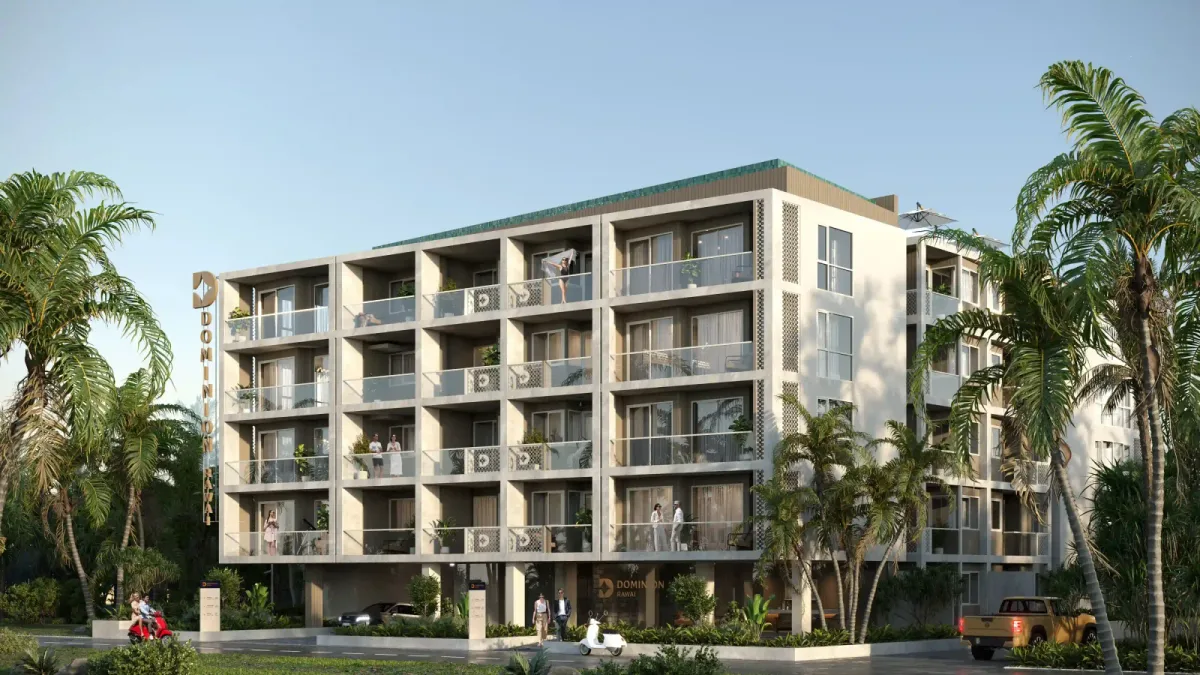
The most common fear in a Thai off-plan purchase is that the developer runs out of capital halfway through construction. At Dominion that risk is largely behind the buyer: the building is up, the fit-out is complete or nearly so, and the developer has demonstrated that it can deliver.
It also changes what you are buying. Instead of approving a staged forty-square-metre show unit furnished to make it feel larger, you can walk through the specific unit you intend to purchase, look at the actual tile finish, run the actual taps and check the actual view from the actual floor. Buyers tend to underrate how much that removal of information asymmetry is worth until they have bought off-plan without it.
The income arithmetic moves too. An off-plan purchase two years from completion earns nothing for twenty-four months and then ramps up over another three to six while the first tenancy is established. Buying at Dominion now, rental income can start within sixty to ninety days of transfer, as soon as the unit is furnished and listed. At 28,000 THB a month for a one-bedroom, that is roughly ฿336,000 of year-one income a buyer of a 2028-delivery project would not see.
Foreign quota stops being theoretical at this stage as well. The developer knows how much quota is left, so the question “will there be quota available when I am ready to transfer?” has a concrete answer rather than a hopeful one: either your specific unit is inside it or it is not.
How Dominion Rawai Compares to South Phuket Alternatives?
Within Rawai and Nai Harn itself, projects in immediate proximity to Dominion typically price studios at ฿5.5M to ฿8M and one-bedrooms at ฿9M to ฿14M for comparable quality. Dominion’s studio floor at ฿4.99M is the strongest single argument in that comparison: same location, same tenant pool, meaningfully lower entry. The two-bedroom pricing anomaly, below the one-bedroom range, is unusual for the area and worth examining on its own terms.
Move ten to fifteen minutes inland to Chalong and studios can be found at ฿2.5M to ฿4M, but rents fall in step. A unit that is not within cycling or motorbike distance of Nai Harn cannot command beach-corridor rates, so the location premium at Dominion converts fairly directly into higher rent rather than being absorbed as cost.
Against the north coast the per-square-metre gap is stark: roughly ฿150,000 to ฿180,000 per sqm at Dominion versus ฿220,000 to ฿350,000 for comparable quality around Laguna and Bang Tao. The yield profiles differ as well. North Phuket peaks harder on short-stay rates in high season, while Rawai returns better annual occupancy under a long-stay model. Neither is wrong; the question is which strategy the buyer is actually equipped to run.
Explore more options in the Phuket project directory or compare area fundamentals in the best areas to buy in Phuket guide.
Buyer Profiles: Who This Project Suits
Three kinds of buyer tend to do well here. The first is the lifestyle investor who intends to use the unit: six to eight weeks a year, with the rest let out. That fits Rawai’s long-stay model better than it would fit a short-stay market, because long-stay tenants often prefer the shoulder periods and are relaxed about an owner taking December to February. A 53 to 60 sqm one-bedroom is large enough for personal use without feeling like a hotel room.
The second is the investor who already holds Bang Tao short-stay product and wants something that does not move in sync with it. Rawai’s long-stay demand holds up in low season precisely when Bang Tao occupancy dips, so a unit here works as a counterweight rather than as more of the same.
The third is the buyer planning ahead for retirement: typically somewhere between forty-five and fifty-eight, expecting to move to Thailand within five to ten years. Buying now builds equity, generates income through the remaining working years, and fixes a specific property to move into later. Rawai’s retiree community, healthcare access and pace of life are the lifestyle half of that thesis; the Phuket rental yield guide covers the income modelling side in detail.
The buyer this does not suit is the one whose whole case rests on peak-season nightly rates above 4,000 THB. Rawai will underperform Bang Tao beachfront product on that measure, and if the investment only works at 8% or more gross from short-stay alone, the money belongs further north.
Due Diligence Checklist
Before placing a reservation deposit:
- Request written confirmation of completion status and available handover dates
- Confirm foreign freehold quota availability for your specific unit in writing from the juristic office, not the sales agent
- Obtain the current price list with VAT, transfer fee split, and sinking fund amounts stated explicitly
- Verify the project’s Condominium Licence (or equivalent permit) is issued, buildings cannot legally transfer units without it
- Check developer registration and company background through the Thai DBD
Before signing the Sale and Purchase Agreement (SPA):
- Engage a Thai property lawyer to review the SPA, do not rely on developer-provided “standard templates”
- Verify the defect liability period (minimum 1 year recommended), process for reporting defects, and developer’s response obligations
- Confirm the FET (Foreign Exchange Transaction) certificate process if you are purchasing as a foreign national using overseas funds, this document is required for freehold registration
- Review CAM fee structure, sinking fund amount, and any special assessments in the juristic person budget
- Model full year-one ownership cost: transfer fee (approximately 3% of registered value for buyer’s share), CAM, sinking fund top-up, furnishing budget, management fee
Before committing to a rental strategy:
- Interview 2, 3 property management companies operating in Rawai and obtain written rental income projections with stated occupancy assumptions, not gross yield percentages without volume
- Visit comparable units currently rented in the area to benchmark actual achieved rents versus projections
- Understand any building rules on short-term rental (some condominiums restrict minimum lease periods)
Cross-reference with Phuket property market prices 2026 and the buying property in Phuket guide before finalising.
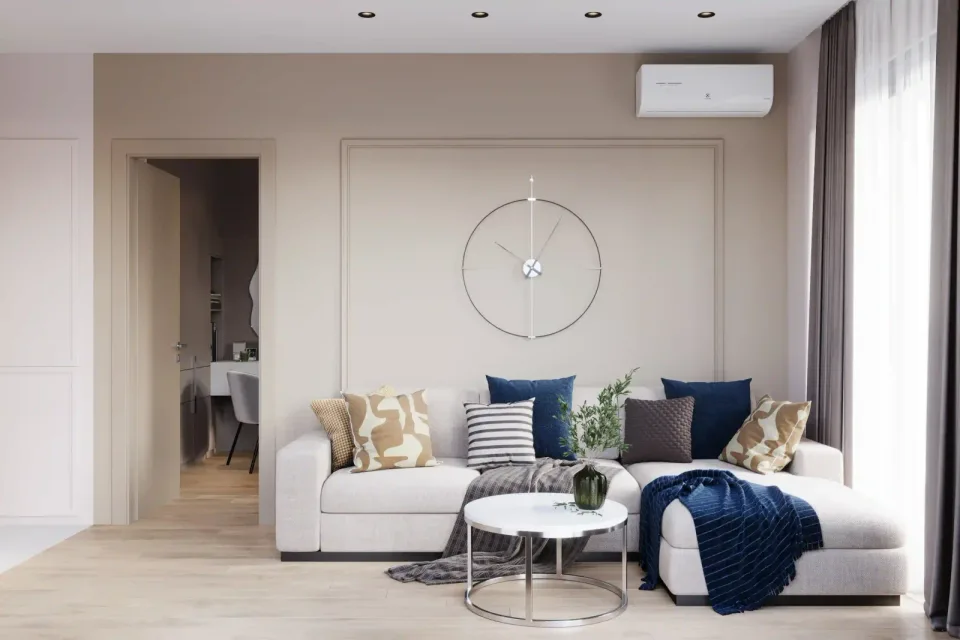
Two-bedroom unit, contemporary interior finishes
Ownership and Legal Structure
Units inside the 49% of total floor area that Thai law permits non-Thai nationals to hold are available on freehold Chanote title. That is the strongest form of ownership open to a foreigner in Thailand: clean, transferable, inheritable, and mortgageable with Thai banks subject to qualification.
The quota itself is worth understanding precisely, because it is routinely described wrongly. Thai condominium law caps foreign ownership at 49% of the aggregate saleable floor area of the building, not at 49% of the units, and in a project with a mixed unit mix those two numbers are not the same. It is consumed at registration rather than at reservation, so a deposit reserves nothing in quota terms. At or near completion the developer or the juristic person can state exactly how much foreign-quota floor area remains and which specific units it covers. Ask for that in writing; never take it as read.
Transfer costs for a foreign buyer generally comprise a transfer fee of about 2% of registered value, commonly split equally between buyer and seller by contract, a 0.5% mortgage registration fee where a mortgage is involved, and either specific business tax or stamp duty depending on how long the developer has held the unit. Roughly 3% of registered value is a sensible provision for the buyer’s share.
Where the purchase money comes from abroad, the receiving Thai bank issues a Foreign Exchange Transaction record for each inbound transfer at or above the reporting threshold, and a credit advice letter for smaller amounts. That documentation has to be produced at the Land Department for freehold registration in a foreigner’s name, so keep every original: they are not straightforwardly replaceable.
Frequently Asked Questions
Studio units at Dominion Rawai start from ฿4,990,000 (approximately $152,599 USD), making it one of the most affordable freehold entry points in south Phuket's Rawai-Nai Harn corridor. One-bedroom units begin at ฿9,666,000 and two-bedroom units from ฿8,664,000. The 2BR pricing below the 1BR range is an unusual feature worth examining as a value opportunity for buyers needing two rooms.
Dominion Rawai was scheduled for Q1 2026 completion. As of mid-2026 the project is at or near handover stage, buyers can inspect the actual unit before transfer rather than relying on a show unit. This near-completion status eliminates construction risk and enables rental income to begin within 60-90 days of transfer. Confirm current completion status and available handover dates in writing from the developer.
Yes. Condominium units are available freehold (Chanote title) for non-Thai nationals within the 49% of total floor area quota mandated by Thai condominium law. Foreign buyers need to transfer purchase funds from overseas and obtain Foreign Exchange Transaction (FET) certificates from their bank, these documents are required for freehold registration at the Land Department. Confirm current quota availability for your specific unit in writing before placing a reservation deposit.
Long-term leases in Rawai (6-12 months) produce 5-7% gross yield for most unit types. Studios lease at 18,000-28,000 THB per month; one-bedroom units at 28,000-45,000 THB per month; two-bedroom units at 35,000-55,000 THB per month. Net yield after management fees (8-12%) and monthly CAM charges realistically runs 3.8-5.5%. Rawai's long-stay tenant pool produces 85-92% annual occupancy, higher than pure short-term rental strategies achieve in the same area.
Rawai offers lower entry prices (20-35% below comparable Bang Tao product on a per-sqm basis), more stable year-round occupancy from expat and long-stay demand, and a quieter residential character. Bang Tao achieves higher peak-season nightly rates in short-term rental but greater seasonal volatility and lower annual occupancy for most non-beachfront units. Rawai suits investors prioritising stable long-stay income; Bang Tao suits investors targeting high-season STR premiums. Both strategies can perform well; the choice depends on your management approach and income preference.
Live developer data · Phuket specialist reply
Check Availability, Quota and Floor Plans
Send your contact and budget. We will reply with current stock, payment plan and foreign buyer notes.
MORE Group Editorial
Phuket Real Estate Experts
The MORE Group team has helped 500+ European and American buyers purchase property in Thailand. We provide legal support, 0% commission, and on-the-ground expertise with 8 years in the Phuket market.
About MORE Group →Check Availability, Quota and Floor Plans
Send your contact and budget. We will reply with current stock, payment plan and foreign buyer notes.