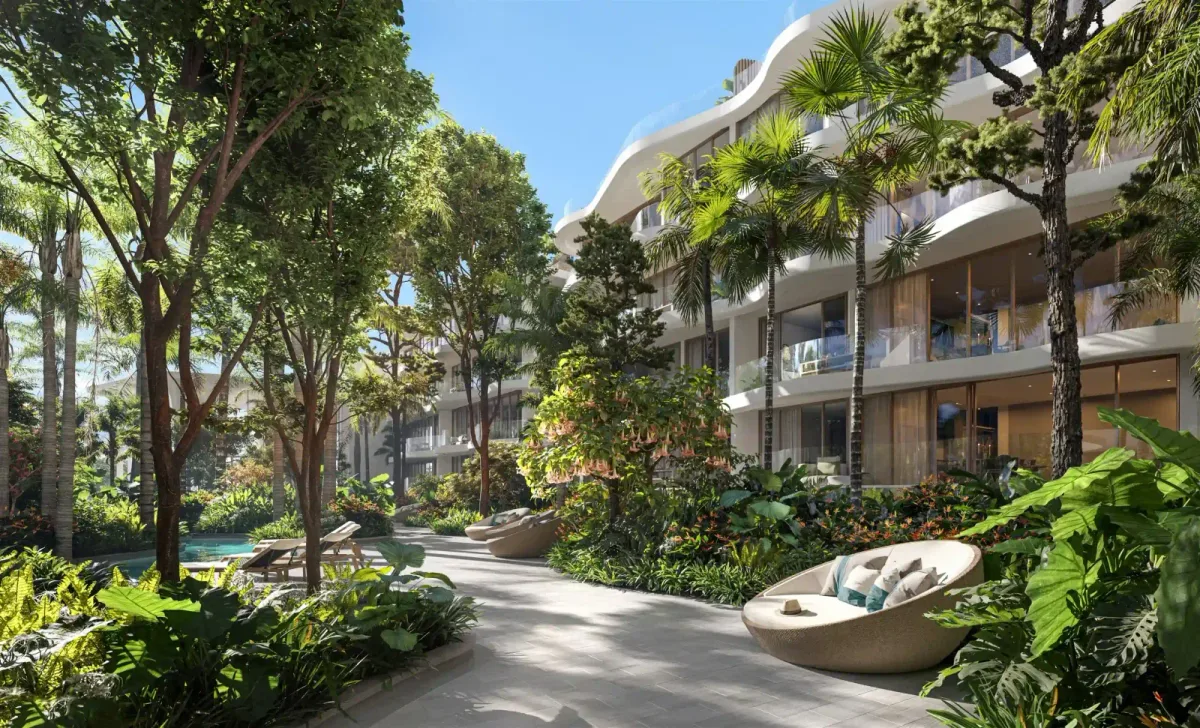
Is Buying Off-Plan Banyan Group in Phuket Worth It? Honest Review
The short answer is that it depends on what you are paying the brand premium for, and whether that premium survives to your resale.
Buying off-plan from an established hospitality group removes most of the risk that makes off-plan frightening elsewhere. There are completed phases you can walk through, operating hotels on the same estate, an estate management structure that already exists, and a company with something to lose. Completion risk here is not the concern it is with a single-project developer.
What you are taking on instead is a pricing question, and it has three parts.
You pay the premium at purchase. Brand, estate infrastructure, and the rental programme are all in the entry price. Whether the next buyer pays the same premium is the question that decides your return.
The fee stack is permanent. Estate charges, management, and any brand-mandated refurbishment cycle continue for as long as you own it, and they are not optional in the way an independent manager’s fee is.
The estate keeps releasing. Your resale competes with the developer’s next phase, and a developer with new inventory has pricing tools an individual seller does not.
So: worth it for a buyer who values the operating certainty and intends a long hold, and harder to justify for a buyer whose case rests on a resale gain within a few years. This review takes each of those apart rather than settling it in a sentence.
This sits inside the off-plan vs resale master guide.
What “Off-Plan Banyan Group” Means in 2026
| Project | Price Range | Delivery | Stage |
|---|---|---|---|
| Skypark Elara Lakelands | $265K-$1.52M | Oct 2026 | Under construction |
| Residences at Garrya | From 16,360,000 THB, about $500K | Q2 2027 | Under construction |
| Banyan Tree Oceanus | $4.9M-$12.0M | Dec 2028 | Off-plan |
| Banyan Tree Varuna | $3.3M-$7.5M | 2028 | Off-plan |
| Banyan Tree Sirena | Premium TBA | 2026 | Off-plan |
Additionally, Laguna Lake Residences Aster ($338K-$1.11M, Dec 2027) is a co-branded Laguna + Banyan Group project. For this analysis, we focus primarily on the three main Banyan Group off-plan products: Skypark Elara, Garrya, and Oceanus.
Case FOR Buying Off-Plan Banyan Group
Real examples:
- Cassia Phuket, bought off-plan in 2016-17 at roughly 4M-7M THB, is quoted on the secondary market in 2026 at roughly 5.75M-13.5M. Two asking-price ranges nine years apart are not a measured return, and the compounded rate this page used to derive from them has been withdrawn: the earlier figure is a launch price list and the later one is what sellers are asking, with no completed transactions in between. What would settle it is the Land Office record for the building, which an agent can pull.
- Skypark Elara holds 62 priced units on MORE Group’s list from 8,290,000 THB, about $254,000, median 11,200,000 at 57 square metres, in one-, two- and three-bedroom formats. The launch figure for the original Skypark that used to sit here was quoted in pounds and could not be traced to a price list; it has been removed rather than converted.
For Skypark Elara, purchased in 2024-2025 at launch pricing, delivery at October 2026 means a potential 12-24 month construction window. The completion-value projection this sentence used to run has been withdrawn: it applied an appreciation rate no Phuket source publishes to a launch price. What a buyer can establish for Skypark Elara specifically is the developer’s launch price list against its current one for the same unit type, which is a fact about two price lists rather than a forecast.
2. What the brand actually gives you, and what it does not
The brand is a distribution channel, and that part is real and describable: a Banyan Tree, Garrya or Cassia unit sits inside a group reservation system and on the OTA listings the group maintains, alongside the hotel. An unbranded condominium in the same postcode is found by a guest searching a platform; a branded one can also be found by a guest searching the brand.
What cannot be said is what that is worth. The rate premium and the occupancy premium this section used to assert have been withdrawn: no Phuket achieved rate is published, so no premium over an unbranded comparable has ever been measured, and “permanent” was an assertion about a figure nobody holds. Nor is the channel itself unconditional: it runs while the management agreement runs, and that agreement has a term, a fee and a termination clause. Read all three, and ask what share of the building’s bookings came through the group channel last year against the OTAs. That is a number the operator has.
3. Interest-Free Payment Plans Reduce Capital Exposure
Garrya and Skypark Elara both offer interest-free payment plans with 20% across 5 stages. This means:
- Garrya’s cheapest priced unit on our list is 16,360,000 THB, so a 20% stage on it is about 3,272,000 THB, roughly $100,000
- Remaining 80% ($344K) spread across construction milestones and completion
- No interest charged on deferred amounts
This is the one part of an off-plan purchase you can value exactly, and the value is personal to you: whatever your own capital earns elsewhere, multiplied by the deferred balance and the months it stays deferred. The page previously assumed 4-6% and turned it into a 3-5% compounded bonus. Use your own rate, because the whole point of the calculation is that it is yours.
4. Laguna Phuket is a Safe Developer Environment
Banyan Group and Laguna Property have the strongest developer credentials in Phuket:
- Laguna Resorts and Hotels PLC: SET-listed since 1993, 30+ year track record
- Banyan Group: SGX-listed, international hospitality group with 24+ country presence
- Zero major development failures in the Laguna Phuket estate to date
- $2 billion Lakelands masterplan announced February 2024, institutional scale commitment
Off-plan risk in Thailand is real for smaller or less-established developers. For Banyan Group / Laguna Property joint ventures, the developer risk is as low as it gets in the Thai property market.
5. Newer Specification, Modern Design
Off-plan projects deliver in 2026-2028 with building specifications that the completed Cassia (2019) and Angsana buildings simply don’t have. Contemporary wellness design (Garrya), smart home integration, energy efficiency, modern pool and amenity design, these are structural advantages over older secondary-market stock.
Case AGAINST Buying Off-Plan Banyan Group
| Metric | Garrya 1BR (off-plan) | Cassia 1BR (secondary) |
|---|---|---|
| Price | From 16,360,000 THB, about $500K (35 priced units, median 37,050,000) | Not on our price list; ask an agent for current resale asks |
| Size | 57 sqm at the smallest, 115 at the median | Older stock, generally smaller |
| Status | Delivering Q2 2027 | Income generating now |
| Gross yield est. | Not published for Phuket; withdrawn | Not published; withdrawn |
| Net yield est. | As above | As above |
| Income evidence available | None. The building does not exist yet | Owners hold twelve months of statements. Ask for them |
The multiple between the two tickets that used to open this paragraph has gone with the Cassia price: we hold no priced Cassia units, so the ratio was arithmetic on a figure that is not on our records. Whether the two produce comparable yields is not knowable either, and the rows above no longer pretend otherwise. What is left is what is different and checkable: a wellness brand, beachfront proximity, a newer building, and a completion date in Q2 2027 against a building that is letting today.
That last difference is the sharpest one on the page. Cassia is the only Banyan Phuket product where a buyer can ask a selling owner for twelve months of real statements. Garrya has no letting history at all and cannot have one before 2027.
Buyer scenarios. Scenario A, income now: Cassia, because it is the only Banyan Phuket product where the income question can be answered with a document rather than an estimate. Scenario B, brand and beachfront, income later: Garrya, accepting that nothing about its letting can be verified before 2027 and that the deferred-payment benefit is the one return you can compute today. Scenario C, capital preservation at the top of the range: Banyan Tree Oceanus, bought for the asset and the brand rather than for a yield, with the hotel management fee of 30-40% of gross read before signing.
2. Long Timelines Before Income Begins
Off-plan means no rental income until delivery. The dead-capital period:
- Skypark Elara: ~6-12 months at time of writing (Oct 2026 delivery), minimal drag
- Garrya: ~15-18 months from March 2026, meaningful drag
- Oceanus: ~33 months from March 2026, significant drag
Price the dead-capital period at whatever your capital genuinely earns elsewhere, over however many months the schedule defers. That is arithmetic on two numbers you already have, and the 5% this sentence used to assume was ours rather than yours. This does not eliminate the investment case, but it must be factored into total return calculations.
3. Yield Projections Are Estimates, Not Guarantees
Developer yield projections are marketing tools, and this page no longer reproduces Garrya’s. What is worth knowing is the shape of what sits behind any such projection, because you can interrogate it: an assumed rate premium for the brand, an assumed occupancy, and an assumed booking flow through the group’s own reservation network. Ask which three numbers were used. A developer who will not say has told you what the projection is worth.
If the wellness programming turns out average, the rate premium does not materialise, or Phuket sees a tourism softening in 2027-2028, the outcome sits below whatever the projection assumed, which is the risk you are actually taking. This page quotes no replacement figure, and treats the Oceanus developer forecast the same way: as a sales position rather than evidence. It makes the risk look equally conservative.
No off-plan yield projection should be treated as a fact of any kind, guaranteed or otherwise. The finished stock (Cassia, Angsana Oceanview) has something off-plan structurally cannot: owners with a letting history, whose statements are the only Phuket income evidence that exists in documentary form.
4. Competition from New Lakelands Supply
The Laguna Lakelands masterplan will add thousands of new units to the Laguna area through 2028 and beyond. This supply increase may:
- Moderate rental rate growth as more units compete for the same guest pool
- Apply price pressure on older existing projects (Cassia, original Skypark)
- Create a temporary supply glut during the 2027-2028 delivery wave
For off-plan buyers in 2026 the risk is real and the mitigation offered for it is not measurable. The claim that the group’s distribution and the Laguna address will hold occupancy through new supply has been withdrawn: no Phuket occupancy is published, so neither the level nor the resilience of it can be stated. What is checkable is the supply itself. Ask how many units Lakelands adds, in what formats, on what delivery dates, and compare that against the 4,589 priced apartments Bang Tao already carries on our records across 48 schemes.
Who this suits and who it does not
Suits a buyer holding ten years or more. A brand premium is paid once, at purchase, and can only be recovered once, at sale. Whether the rent covers the gap in the meantime is not knowable in a market with no published letting figures, which is itself the argument for a long hold: a short hold has to be right about the resale, and a long one has more chances to be.
Suits a buyer who will use the property. Estate infrastructure, service standards and the operator’s presence are consumable benefits. An owner who is here regularly gets them; an owner who is not is paying for someone else’s guest experience.
Suits a buyer who wants delivery certainty above price. If the thing keeping you awake is whether the building gets finished, this is what a strong developer sells and it is worth paying for.
Does not suit anyone underwriting on a yield. Not because branded off-plan loses that comparison (nobody can run it, in either direction) but because the comparison cannot be made at all with the figures that exist. A buyer who needs a return number before committing should be looking at a finished building with an owner’s twelve months of statements, which is a different purchase from this one.
Does not suit a buyer who may need to exit inside five years. Off-plan means no income for the construction period and a resale into a market that includes the developer’s own later phases.
Does not suit a buyer with no reserve beyond the purchase. Off-plan carries a balance at handover, furnishing costs where the unit is not delivered furnished, and a period before income begins. A buyer stretched to the price is exposed at exactly the point they have least flexibility.
Pros and Cons
Pros
- A hospitality group with completed phases on the same estate, so delivery is an established record rather than a projection
- Estate infrastructure, security and management already operating, not promised for a future phase
- Brand distribution that an independently let unit cannot replicate
- Wellness positioning gives the product a distinct guest segment rather than competing purely on rate
- Laguna’s estate boundaries constrain future supply, which is what has underpinned pricing here
What to consider:
- Premium pricing at $8,300/sqm (Garrya) is the highest mid-market cost-per-sqm in Laguna
- Income generation delayed 15-36 months depending on project
- Any yield projection you are shown is a model; the wellness brand’s rate premium depends on operational execution and is not measured anywhere
- Cassia carries no priced units on MORE Group’s list, so the secondary-market alternative cannot be priced from our records, ask an agent for current resale asks and, more usefully, for an owner’s letting statements
- New Lakelands supply may moderate future rental rate growth in the area
Contract Red Flags on Banyan Off-Plan Stock
The brand strength does not extend to the contract, and a strong developer with a weak clause is still a weak clause. Six things to have your own lawyer test.
The contracting entity. Group structures place projects under subsidiaries and joint ventures, so the company signing your agreement may not be the one whose reputation you are relying on. Check its corporate record and its paid-up capital, and ask in writing whether the parent stands behind it.
The delay clause. What completion date is stated, what extension the developer may take as of right, and what remedy exists beyond it. Many contracts permit six to twelve months of extension before anything engages, and buyers discover this at month twenty-five rather than at signing.
The specification schedule. Attached as an annex with materials and finishes named, or described in adjectives. At this price the difference between the brochure finish and the delivered one is a large number.
Payment against milestones. Whether each release is tied to verified construction progress or to a calendar date. A date-based schedule transfers the delay risk to you while the site stands still.
The rental programme terms, if one is offered. The fee basis, whether platform commissions sit inside it, the owner-usage cap and blackout dates, the lock-in period, and what happens at the end of the term. These belong in your decision before the reservation, because your leverage over them disappears once you have committed to the unit.
Assignment before completion. Whether you may sell the contract before handover, at what fee and by what process. On a two-year build this is the only exit available if circumstances change.
Insider tip: pairing a finished unit that lets today with an off-plan one that delivers in two years is a coherent structure, because the first covers the holding cost of the second. It only works if the first one’s income is a document rather than an estimate, so buy the finished unit on statements. Cassia is the usual candidate in Laguna; it is not on our price list, so treat any figure quoted for it as an asking price until an agent shows you the comparables.
What the brand does and does not reduce
The reason to consider a branded off-plan purchase over an unbranded one is risk reduction, and it is worth being precise about which risks actually fall.
Reduced: the probability of non-delivery. A group with decades of operating history, hotels it runs itself and a track record of completed phases is a materially safer counterparty than a single-project company. This is the largest risk in off-plan buying and it is the one the brand genuinely addresses.
Reduced: the marketing period at resale. A recognisable name gives your eventual buyer something they can check without engaging a surveyor, which shortens their diligence and reduces the number who drop out. In a market where a sale takes months, that is worth real money.
Reduced: operational uncertainty after delivery. An operator who runs hotels already has distribution, staffing and rate management in place, rather than assembling them.
Not reduced: delivery timing. Strong developers slip too, and the contract’s delay clause governs regardless of who signed it.
Not reduced: the price you paid. Brand premium is paid at purchase and recovered, if at all, at sale. Whether it raises the rent proportionally is not measurable, and the comparison against unbranded equivalents that used to close this line has been withdrawn for the same reason. What the premium does not do is reduce the ticket, and the ticket is the part you can see: Garrya’s list starts at 16,360,000 THB where Skypark Elara’s starts at 8,290,000.
Not reduced: supply from the same developer. A group building successive phases nearby is competing with you at resale, and the brand you paid for is on both.
Not reduced: anything specific to your unit. Quota, floor, aspect, the juristic office and the building’s letting position are all unaffected by the name on the entrance.
Milestone cash-flow planning for off-plan buyers
| Milestone | Typical % | Planning note |
|---|---|---|
| Reservation | 5-10% | Refundable window, use for lawyer review |
| Contract | 10-20% | Quota letter should exist before this wire |
| Construction | 40-50% split | Align with build photos / engineer reports |
| Transfer | 20-30% | Budget transfer tax + furniture |
Pair this with Bang Tao area context and Banyan Group developer review when you compare Garrya against Skypark Elara or Oceanus.
Brand premium vs unbranded Laguna resale
Document your hold period in writing before you choose: appreciation-led off-plan needs 3-5 years patience; income-led secondary needs 12 months of statements, not renderings.
Before reservation on any Banyan off-plan unit, request the latest construction progress report and independent lawyer comments on delay clauses in the same week, lag between pretty renders and job-site reality is where buyer regret starts.
Secondary-market sanity check: pull two Cassia resale comps and one Angsana nightly calendar for the same bedroom count. If off-plan math cannot beat those real baselines on net yield or appreciation thesis, downgrade the project, brand alone is not a business plan.
Interest-free milestones help liquidity, but they do not remove completion risk. Keep six months of personal runway beyond the last scheduled payment so a delay becomes an inconvenience, not a forced sale.
Wellness branding at Garrya is an ADR bet; if you do not believe the operator will execute programming that guests pay for, price it like a standard beach condo with a longer dead-capital window. Oceanus buyers should frame returns as trophy diversification first, yield second. Skypark Elara remains the default first Banyan off-plan test case when you want earlier delivery with a lower absolute ticket. Write your milestone calendar before you fall in love with a view photo. Patience is part of the return calculation on every Banyan off-plan ticket in 2026.
Looking for the right property in Phuket?
Our experts send a shortlist within 2 hours. 0% buyer commission.
Frequently Asked Questions
There is no typical figure, and this page no longer prints one. Thailand keeps no transaction index for Phuket, so nothing measures what an off-plan unit was worth at launch against what it is worth at handover: the 35-50% band and the Cassia percentages that used to sit here were assembled, not observed. What you can do instead takes an afternoon: ask the developer for the launch price list and the current price list for the same unit type in the same building, and read the difference yourself. That is two documents rather than a forecast. Skypark Elara delivers in October 2026 and Garrya in Q2 2027, so on both the capital sits idle for a shorter window than on a 2028 handover, which is a fact about the calendar and the one thing here that does not need a market figure.
Both use an interest-free staged structure: 20% of the purchase price at each of five stages, reservation, contract, and three construction milestones. On Garrya's cheapest priced unit on our list, 16,360,000 THB, each stage is about 3,272,000 THB, roughly $100,000. No interest is charged on the deferred portion, so you hold most of your own capital through the build. What that is worth is your own alternative return on the deferred balance over those months, multiplied by the balance and the months: a figure you already know and we do not. Check the schedule in the SPA rather than here, because the split is contractual and the developer can change what it offers between launches.
Yes, significantly. Both Banyan Group (SGX-listed, Singapore) and Laguna Property parent Laguna Resorts and Hotels PLC (SET-listed, Thailand since 1993) are publicly listed institutional entities. They have delivered 19+ projects in Laguna Phuket without a major failure. This institutional credibility places their off-plan risk well below smaller or independent Thai developers, though it does not eliminate all risk entirely.
The question splits on evidence rather than on return. Garrya is unbuilt, so nothing about its income can be verified before Q2 2027, and its list on our records starts at 16,360,000 THB with a median of 37,050,000 at 115 sqm. Cassia is finished and letting, so a selling owner can hand you twelve months of statements, which is the only form in which a Phuket income figure exists at all. Cassia carries no priced units on our list, so ask an agent for current resale asks rather than taking a figure from this page. Buy Garrya if you can wait and want the newer building and the brand; buy Cassia if you need the income question answered with a document.
Delivery delays are always possible in construction. The contractual remedies depend on the specific purchase contract terms, but Banyan Group / Laguna Property contracts typically include penalty clauses for significant delays and buyers retain their deposits in escrow. Given the institutional nature of these developers and their brand reputation, serious delays that aren't communicated are extremely unlikely, but always review the specific contract terms with a licensed Thai property lawyer before signing.
Read Also:
Questions about this guide? Ask us on WhatsApp. The guide's title is already in the message, so you only need to write your question.
Ask on WhatsApp
Maksim Shchegolev
Founder, MORE Group
Founder of MORE Group. Four years in investment banking before moving to Phuket, where he has worked in the local property market since 2018. Oversees developer relationships and every engagement above $300K.
About MORE Group →Get a Focused Phuket Property Shortlist
Share budget, area and goal. We will reply with suitable live projects, not a generic catalogue.
