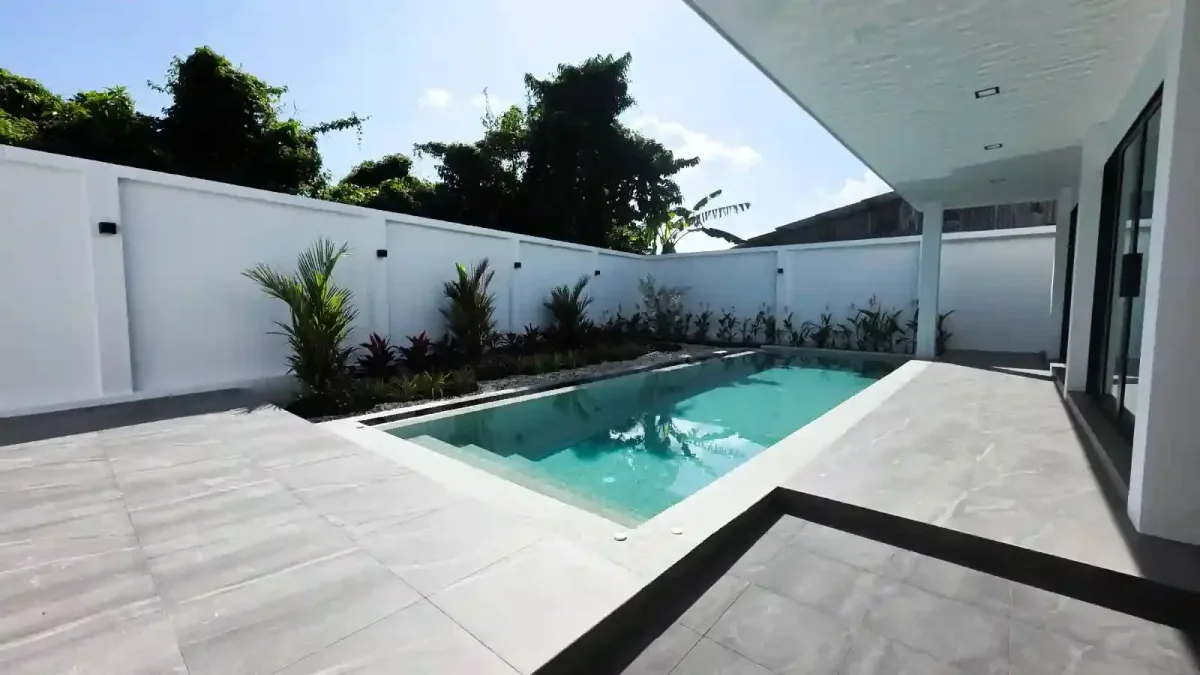
Prices and the direction of the market belong to the market outlook; this page is about what a holiday home costs to run and how it is used.
Three current holiday-home options in Layan
| Option | Type | Price from | Status or difference |
|---|---|---|---|
| Serene Condo Layan | Studio condo | 3,240,000 THB | Off-plan, Q4 2028 completion |
| Sun Hills Layan | Studio condo | 3,339,000 THB | Off-plan, Q4 2027 completion |
| Pirak Cherngtalay | 1-bedroom boutique condo | 5,527,500 THB | Off-plan Layan positioning |
A holiday home in Phuket can be one of the best lifestyle purchases you ever make, and still be a mediocre investment if you buy the wrong corridor for your usage pattern. Phuket attracted over 9.8 million international visitors in 2025 (Tourism Authority of Thailand annual data), making it Southeast Asia’s most visited resort island and creating deep short-term rental demand that holiday-home owners can tap into. This guide gives a reality-check model: what gross yield can look like, what disappears to management, and what annual costs remain even when the calendar is empty. For ownership mechanics, start with Buying property in Phuket. For yield benchmarks, read Phuket rental yield guide.
Reality check: can it pay for itself?
Sometimes partially. Rarely cleanly, if you count all-in costs honestly. Use net, not billboard gross.
Example math (illustrative, not a promise)
The condo math below is illustrative. Villa buyers should compare pool villas from $300K to $500K with their higher carrying costs.
Assumed, not observed: a $200,000 condominium and a 9% gross yield, present only so the deduction stack has something to work on: no Thai body publishes achieved returns for privately owned units, so it is here to give the deduction stack something to work on, and you should replace it with a gross taken from a manager’s statements:
| Line item | Amount (USD / year) |
|---|---|
| Gross rent, assumed at 9% of $200k, not observed | $18,000 |
| Management (example 20% of gross) | $3,600 |
| Net after management only | $14,400 |
This still excludes OTA fees, housekeeping, vacancy, utilities, HOA, insurance, repairs, and taxes, so net can fall further.
| Additional cost bucket | Typical planning notes |
|---|---|
| HOA / common fees | Often ~$50-150+/month depending on tier |
| Insurance | Variable by coverage |
| Maintenance + sinking fund share | Ask for HOA fund health |
| Furniture wear (short-stay) | Budget annual refresh |
Break-even analysis: what “break-even” even means
Break-even should mean: net rental income ≥ carrying costs including HOA, insurance, management, taxes, and realistic vacancy. It should not mean “rent covers HOA sometimes.”
| Scenario | Likely outcome |
|---|---|
| Strong operator + strong micro-location + allowed short-stay | Income can offset a meaningful share of costs |
| Strict owner-occupier building | Income may be limited, lifestyle purchase |
| You block peak weeks constantly | Revenue collapses, obvious but common |
Three price-point stress tests (illustrative)
These are models, not promises, use them to sanity-check marketing.
The three yield assumptions this table used to carry have been withdrawn, and with them the gross rents derived from each, a stress test that varies the price while holding an invented yield constant is not testing anything. What the table does usefully is show how the fee scales, so it is rebuilt to run on your own gross:
| For every $10,000 of gross rent | At 15% management | At 20% | At 25% | At 30% |
|---|---|---|---|---|
| Reaches you before other costs | $8,500 | $8,000 | $7,500 | $7,000 |
Multiply by whatever gross a manager’s statements give you for a comparable unit in the building. Then subtract the juristic charge, utilities, insurance, platform commission, tax, and the vacant nights: every one of which you can quote in advance, unlike the gross itself.
When a holiday home is a good financial idea (and when it is not)
Seasonality: the silent break-even killer
| Season | What changes |
|---|---|
| High season | Higher nightly rates, but also higher competition for staff/cleaning |
| Shoulder | Transitional pricing, often where operators earn skill |
| Low season | Rates and occupancy can fall, your model must survive this |
The revenue split this paragraph attributed to the Tourism Authority of Thailand has been withdrawn: TAT publishes arrivals, not the rental revenue of privately owned homes, so the attribution did not hold. The occupancy comparison between the west coast and Cape Panwa or Ao Po has gone with it for the same reason.
The structural point stands and does not need either. Bang Tao and Kamala have reasons for a guest to be there when the beach is closed, the Laguna estate, Boat Avenue, Central Phuket Floresta and the international schools, while the eastern shore has few. That is why a unit’s address matters most in the months when the weather does not cooperate, and it is visible in whether a building has any monthly product at all.
For holiday-home buyers, this means micro-location is everything. A unit 500 metres from Bang Tao Beach in a building with an on-site restaurant and co-working space is a different product from a cheaper unit 2 km inland with no facilities, whatever the inland unit’s brochure says about a “higher guaranteed return” on paper. The ADR premium this sentence attributed to Knight Frank Thailand has been withdrawn: the firm publishes residential market commentary rather than per-building rate data, so the attribution did not hold. That amenities support a higher rate is not in dispute; how much is a question for two listings in the same postcode, which you can compare yourself today.
If you want deeper yield methodology, read Phuket rental yield guide before you choose a unit tier. For corridor selection, compare best areas in Phuket to buy property.
A Phuket holiday home purchased at $250,000 in Bang Tao with professional short-stay management has a cost stack you can price today: management around 20%, OTA fees around 15%, the juristic charge, insurance, and whatever vacancy allowance you are willing to defend. The gross rental range and the planning yield this sentence used to open with have been withdrawn. No net yield follows from it here, because the income side is not published for privately owned Phuket homes. The pattern worth understanding is how quickly personal use erodes the offset: an owner who blocks out a substantial part of the peak season is removing the weeks that carry the year, and the proportion of carrying costs the property covers falls disproportionately rather than in line with the nights taken. The break-even figure this sentence used to attribute to Colliers has been withdrawn, along with the 5% appreciation rate it assumed: a break-even period is an income and a growth rate expressed in years, and neither is published for Phuket, so no source can supply one. MORE Group insider tip: the building juristic person rental policy matters more than ADR projections. Three Bang Tao buildings we work with changed their short-stay rules in 2024. For owners who had not verified the position in writing before purchase, that did not reduce a yield by some margin: it removed the letting model they had bought for, which is why the licence and the house rules belong in the due diligence pack rather than in the assumptions.
Annual costs owners forget (until they happen)
| Cost | Why it surprises people |
|---|---|
| Peak-season utility spikes | AC + guest behavior |
| Special assessments | Weak sinking fund |
| Operator extras | “Minor” fees accumulate |
| Refurbishment | Tropical humidity is not optional |
Airbnb / Booking management: options and tradeoffs
| Approach | Pros | Cons |
|---|---|---|
| Professional operator / hotel program | Marketing + housekeeping scale | Higher fees; less flexibility |
| Boutique manager | More customized | Quality varies, reference check |
| Self-managed remote | Lower fee potential | Time zone pain; guest issues |
Always confirm building rules before you assume short-stay is allowed.
Best corridors for holiday-home income (planning lens)
| Area | Revenue potential (gross, planning) | Complexity |
|---|---|---|
| Patong | The island’s busiest resort calendar in peak; asking rates are visible on the platforms | Noise + competition |
| Kamala | Balanced | View + access diligence |
| Bang Tao | Premium rates possible | Premium fees |
| Rawai | Strong monthly-stay behavior | Different guest avatar |
Project anchors people compare (verify live pricing)
| Project | Indicative price (USD) |
|---|---|
| Skypark Aurora Laguna | ~$136,500 |
| Vibe Residence | ~$154,000 |
| Wyndham La Vita | ~$114,000 |
| Utopia Dream | ~$117,960 |
| The Marin Phuket | ~$160,080 |
| Ozone Oasis | ~$116,147 (handover Q3 2026) |
Key risks (honest)
- Seasonal demand: occupancy falls materially between May and October. The Phuket Hotels Association surveys its member hotels and publishes the result, which is the closest public proxy there is, and it measures hotels rather than privately owned condominiums. For arrivals, Airports of Thailand publishes monthly passenger traffic for Phuket International; read September against January there rather than taking a ratio from this page.
- Wear and tear: guests are harder on interiors than owners. Tropical humidity accelerates furniture deterioration, budget 5-8% of furnishing value annually for replacement.
- Policy risk: rental rules can tighten in some communities. The Hotel Act B.E. 2547 technically requires a hotel license for stays under 30 days, though enforcement varies by municipality.
- Currency: your home currency may move against THB/USD assumptions. The Bank of Thailand’s managed float policy means THB volatility is moderate but not negligible, the baht traded in a 12% range against USD over 2023-2025.
Holiday Home Ownership Models Compared
| Model | Best for | Typical annual cost | Income potential | Flexibility |
|---|---|---|---|---|
| Freehold condo (self-managed) | Hands-on owners, 8+ weeks use | $3,000-$6,000 (HOA + maintenance) | High (if licensed for short-stay) | Full calendar control |
| Freehold condo (hotel program, e.g. Wyndham, Best Western) | Passive owners, under 6 weeks use | $1,500-$3,000 net of rental offset | Moderate (after 25-35% operator fee) | Limited by blackout dates |
| Leasehold villa (Botanica, Laguna) | Lifestyle buyers, families | $5,000-$12,000 (maintenance + staff) | Not published; a villa lets to fewer, longer bookings than a condo | Full (no building restrictions) |
| Fractional / co-ownership | Budget-conscious, 2-4 weeks use | Share of above | Lowest (limited rental window) | Lowest (scheduled rotation) |
Sources: Management fee ranges from Wyndham Hotels & Resorts franchise disclosure, Best Western Asia-Pacific operations manual, and Botanica Luxury Phuket owner agreements.
Tax and structure (where to go deeper)
Rental income can trigger withholding and reporting questions for non-residents under the Thailand Revenue Code. The Thailand Revenue Department applies progressive tax rates on assessable income, with a 15% flat withholding rate commonly applied to non-resident rental income at source. Buyers should consult both a Thai tax advisor and their home-country accountant, double taxation treaties exist between Thailand and over 60 countries including the UK (HMRC-BOI DTA), Australia, Germany, France, and the United States. Bangkok Bank, Kasikorn Bank (KBank), and Siam Commercial Bank (SCB) can provide certified income statements for foreign tax credit claims. Confirm professionally. See Thailand property tax for foreigners.
Should you buy, or just rent luxury villas for 4-8 weeks/year?
This is the uncomfortable comparison every holiday-home buyer should do. Buying builds optionality (calendar control, customization, long-term market exposure) but adds liquidity friction and carrying costs.
| Factor | Buy | Rent annually |
|---|---|---|
| Upfront capital | Large | None (beyond travel) |
| Flexibility | You own the schedule | You can switch areas yearly |
| Income potential | Possible if rules allow | None |
| Maintenance brain damage | HOA + wear | Minimal |
If your primary joy is variety (new beach every year), buying may be emotionally misaligned, unless you also want long-term exposure to Phuket as a market.
Legal due diligence checklist (before you “fall in love” with the view)
| Item | Why it matters |
|---|---|
| Foreign quota status | Without quota, the deal may not close as planned |
| Building license / permits | Especially for off-plan holiday inventory |
| Rental rules | Determines whether income is realistic |
| Management agreement | Fees, termination, owner-stay blackouts |
Link these steps to Buying property in Phuket and ownership nuances in Freehold vs leasehold.
Pros and cons
Pros: lifestyle + potential income; mature tourism; strong operator ecosystem; condos can be rent-ready.
Cons: net yield is easy to overestimate; management fees bite; peak weeks conflict with owner use; buildings differ wildly.
Risks and red flags checklist
Before committing, stress-test these scenarios, each one has burned real buyers:
- Seasonal vacancy gap. The Phuket Hotels Association publishes occupancy for its member hotels, which is the only regularly published occupancy series on the island and is not a measure of privately owned units. Whatever figure you take from it, your model has to survive the monsoon months rather than average them away, because the fixed costs do not fall with the demand.
- Management lock-in. Some developers bundle mandatory management contracts at 25-30% commission with 3-5 year lock-in. Compare at least three independent operators before signing.
- Building rules vs Airbnb. Not every condominium juristic person allows short-stay rentals. If the building’s rules prohibit stays under 30 days, your Airbnb income model is dead on arrival. Verify in writing.
- Owner-use conflicts. Blocking 6-8 peak weeks for personal use can reduce rental income by 30-40%, because you’re removing the highest-ADR nights. Model your actual usage pattern, not the “I’ll only come in low season” fantasy.
- Currency risk. The Bank of Thailand data shows THB has swung 8-12% against major currencies in recent years. Your rental income is in THB; your mortgage or opportunity cost may be in EUR/USD/GBP.
- Sinking fund health. Ask for the last 3 years of juristic person financial statements. Buildings with under-funded sinking funds hit owners with special assessments, sometimes 50,000-200,000 THB per unit for major repairs.
- Resale liquidity. Holiday homes in secondary locations (away from beaches, far from airport) can sit on market for 12-24 months. Stick to corridors with proven resale volume: Bang Tao, Kamala, Kata, select Rawai.
As a rule: if the developer’s brochure only shows gross yield and never mentions management fees, vacancy, or owner-use restrictions, walk away. The transparency of the pitch correlates with the quality of the operator.
Buying steps (holiday-home specific)
| Step | Action | MORE Group standard |
|---|---|---|
| 1 | Net model with owner-blocked weeks | Include HOA, vacancy, mgmt |
| 2 | Written short-stay policy from juristic person | No verbal sales promises |
| 3 | Three operator quotes with 24-month occupancy | Sister unit data only |
| 4 | Quota + permits on off-plan stock | Hold deposit until confirmed |
- Model net with your blocked weeks.
- Verify short-stay legality in the building.
- Compare three operators with references.
- Read Freehold vs leasehold if you flirt with non-condo products.
How Branded Residence Programs Change the Holiday-Home Math
For holiday-home buyers, this changes three variables:
Built-in rental distribution. Branded programs list on global OTAs and in hotel GDS from day one, against the three-to-six-month ramp-up an independent manager needs to build a booking base. That is a real structural difference; the occupancy figures this page attached to it were not sourced to any published Knight Frank release we can cite, and are withdrawn. Ask both operators for owner statements from equivalent zones.
Standardized management fees. Rather than negotiating with a boutique operator, branded programs publish fee schedules, typically 30-40% of gross, with housekeeping, OTA commissions, and guest services bundled. Wyndham Hotel Group franchise disclosure documents show a 35% base commission structure for Thai hotel residences with optional tiered packages.
Tradeoffs you must understand. Branded contracts often include mandatory owner-use caps (4-12 weeks per year with blackout restrictions during peak season), compulsory exit conditions if you sell without reassigning the program, and renovation standards that require brand-approved suppliers. Before signing, read: the rental pool agreement, the blackout schedule, and the exit clause for resale.
| Branded vs Independent | Branded program | Independent boutique |
|---|---|---|
| Occupancy | Not published | Not published |
| Management fee | 30-40% (fixed) | 20-30% (negotiable) |
| Distribution speed | Immediate (hotel GDS) | 3-6 months ramp |
| Owner-use flexibility | Lower (blackouts) | Higher |
| Resale audience | Wider (brand recognition) | Narrower |
If you plan to use the property six to ten weeks per year, an independent operator offers more calendar control at a similar net fee burden. If you plan fewer than four weeks of personal use, the branded program’s distribution scale often outweighs its higher commission, particularly in the first three years of a new building when independent operators have no track record to show guests.
Two-Year Net Yield Trajectory: Why Year One Rarely Reflects Steady State
The year-one and year-three yield figures attributed here to resort condominiums that opened in 2022 and 2023 have been withdrawn, and so has the nine-cell trajectory table beneath them. No such series is collected: what a new building earns in its first year against its third is known only to the operators running it, building by building.
The mechanism the section describes is real and does not need the numbers. A new listing starts with no reviews, no platform ranking history and no repeat guests, and all three accumulate. So year one is structurally the weakest year of a building’s letting life, and comparing two buildings at different ages on their current performance compares their maturity rather than their quality.
The practical consequences, none of which require a figure:
- Ask what year the building is in before you read any statement it produces. A first-year figure and a fourth-year figure are not the same measurement.
- Three years is the shortest window over which two buildings can be compared fairly, which is also roughly when the round-trip transaction cost stops dominating the outcome.
- A seller exiting in year one or two is selling before the listing has a record, which is a reason their asking price should reflect that rather than a reason to assume the building underperforms.
The year-one and year-three yield figures this section used to give have been withdrawn, along with the occupancy comparison between branded programmes and independents and the break-even attributed to Colliers resort residential data: none of the three could be traced to a published series, and Thailand collects no occupancy or achieved-rate data for privately owned homes from which they could have been computed.
What survives is the shape of the decision, and every term in it is knowable before you buy. A new building has no review history, so its first year is its weakest whatever the brochure projects. A hotel programme charges 30 to 40% of gross against an independent’s 20 to 30%, and both numbers are in the agreement. Personal use in the peak fortnight is the most expensive thing you can do with the asset, and the manager will price it for you. The variables that decide a hybrid owner’s outcome are therefore how much of the peak you take, whether the manager will run both channels at all, and the juristic fee per square metre per month. Get those four in writing and the arithmetic is yours to do.
Build ramp-up into your underwriting or you will benchmark against a peak that has not arrived yet.
Want an owner-calendar + net-yield model?
We help you align usage with rules,0% buyer commission.
Frequently Asked Questions
Sometimes it offsets a large share of costs, but all-in break-even is less common than marketing suggests. Model net after HOA, management, vacancy, and taxes.
None of the figures in circulation, including the ones this page used to quote. They are discussed rather than measured: no Thai body collects occupancy or achieved nightly rates for privately owned condominium units. Plan from a full year of statements on a unit of the same size in that building, and treat the absence of that document as the answer to whether the letting story holds.
Short-stay management often ranges around 15-25% of revenue depending on operator scope, sometimes more when full turnkey.
HOA/common fees, insurance, utilities, maintenance, furniture replacement, and periodic repairs. HOA alone is commonly discussed around $50-150+/month for many condos, premium projects can be higher.
Phuket has deep international tourism and operator scale, good for liquidity. Your outcome still depends on micro-location, building rules, and management quality.
Buying based on gross yield banners and ignoring net cash flow, owner usage conflicts, and HOA/fund health.
Questions about this guide? Ask us on WhatsApp. The guide's title is already in the message, so you only need to write your question.
Ask on WhatsApp
Maksim Shchegolev
Founder, MORE Group
Founder of MORE Group. Four years in investment banking before moving to Phuket, where he has worked in the local property market since 2018. Oversees developer relationships and every engagement above $300K.
About MORE Group →Get a Focused Phuket Property Shortlist
Share budget, area and goal. We will reply with suitable live projects, not a generic catalogue.
