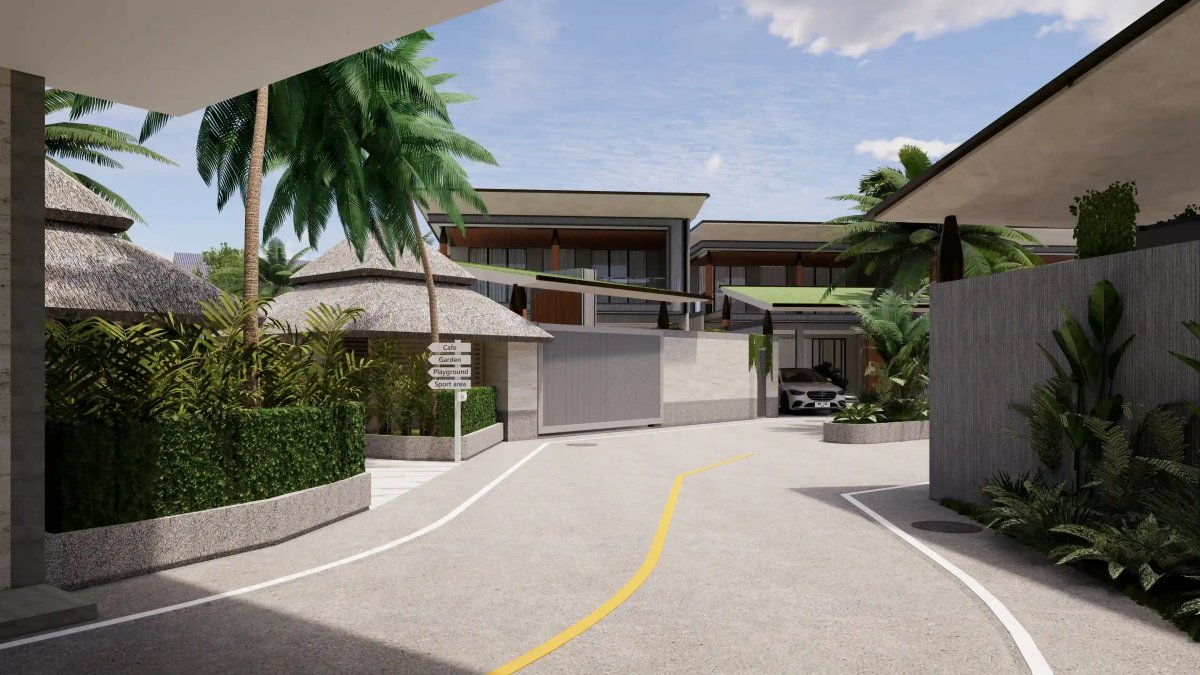
Where exactly is Koh Kaew on the island?
Unlike west-coast beach towns, Koh Kaew is not primarily a “walk to sand” tourism product. Its appeal is often view, marina adjacency, new supply, and relative value, not classic beach-holiday positioning.
| Reference point | Approximate relationship |
|---|---|
| Phuket Town | 15-25 min by car (traffic-dependent) |
| Phuket International Airport | 25-35 min |
| Bang Tao (west coast) | 35-50 min across island |
| Patong | 40-55 min |
For island-wide context, start with Best Areas in Phuket to Buy Property and the Phuket Property Complete Guide 2026.
What is the “Central Park” mixed-use narrative?
Whether any single project fully delivers that vision is a case-by-case question. What matters for buyers is the direction of travel: developers are betting that east-coast living can absorb more resident-grade demand as Phuket’s population and workforce become less one-dimensional than “beach only.”
| Mixed-use element | Buyer benefit if delivered | Risk if delayed |
|---|---|---|
| Retail cluster | Daily services without west-coast drive | Ghost commercial, weak footfall |
| Green space | Resident appeal, family buyers | Maintenance cost, underuse |
| Residential towers | New stock at lower $/sqm | Oversupply in same price band |
| Marina adjacency | Lifestyle anchor for yacht owners | Niche demand only |
Why does east-coast pricing look cheaper than the west coast?
| Factor | West coast (Bang Tao, Kamala) | Koh Kaew (east) |
|---|---|---|
| Tourism footfall | High, seasonal | Lower, resident-led |
| Nightly-rate potential | Strong for holiday stock | Weaker unless premium product |
| Entry price per sqm | Higher | Often 20-40% lower (project-dependent) |
| Resale buyer pool | International holiday investors | Domestic, expat resident, long-stay |
Cheap is not automatically good. Cheap can be compensation for weaker holiday demand, or an early-stage bet if the area matures. Model net rental conservatively; do not import Bang Tao nightly rates. See Phuket Rental Yield Guide for west-coast benchmarks.
What buying an inland area actually means
A development-thesis purchase has a different risk shape from a coastal one, and the difference is worth stating before the infrastructure arguments.
The demand is local rather than imported. Coastal Phuket sells to tourists and to international buyers, and its demand can arrive from anywhere. An inland area’s demand comes from people who live and work here, which makes it steadier and much less elastic. It does not surge, and it does not collapse in the way tourism-dependent demand can.
The upside depends on things outside your control. Roads, schools, retail, employment. You are not buying a property whose value rests on what it is; you are buying one whose value rests on what happens around it, and on a timetable set by other parties.
Liquidity is thinner and stays thinner for longer. The foreign buyer pool that makes a coastal resale straightforward is not here yet, and whether it arrives is precisely the thesis. Until it does, your buyer is a domestic one with different preferences and different price expectations.
The holding period is the whole strategy. A coastal unit can be bought and sold on a five-year view. An inland development thesis needs longer, and a buyer who cannot commit to that is taking the risk without the compensation.
Sized as a longer-horizon position, with rental income covering the holding costs while the thesis either plays out or does not, this is a coherent purchase for the right buyer. Sized as an equivalent to a coastal unit at a lower price, it is not, and the difference will show up at the point of sale rather than at any moment before it.
What infrastructure stories support the long-cycle bet
Take each one and ask the same question: has it been built, has it been funded, or has it been announced. Those are three very different levels of certainty, and Thai project timelines slip enough that the distinction is the whole of the analysis.t?
Treat infrastructure as supporting evidence, not a solo reason to buy. A road can help; it does not replace management quality, tenant fit, and sensible pricing. The Phuket Property Market Outlook 2026 frames island-wide supply and demand, apply it to east-coast projects individually.
What are the pros and cons for investors in 2026?
Airport and central access: Depending on exact location, east-coast commuting patterns can suit owners who work in town-facing roles or who prioritize transport links over beach repetition.
Future upside (speculative): If mixed-use clusters mature, early buyers may benefit from a more “complete neighborhood” than today, especially on a 5-10 year horizon.
Marina-adjacent lifestyle: For yacht-interested owners, marina proximity can be a lifestyle anchor even without a classic beach walk.
Cons: what Koh Kaew is not (yet)
No flagship beach: If your investment thesis requires beach tourism footfall, Koh Kaew is usually the wrong comparison set versus Bang Tao, Kata, or Kamala.
Harder holiday rental in many assets: Short-stay demand is not automatically interchangeable with west-coast supply.
Slower international recognition: Resale markets can depend more on domestic and resident expat demand than on global “beach brand” buyers.
Execution risk in mega-developments: Large projects can face delivery pacing, commercial leasing risk, and amenity activation timelines.
What should you check before buying in Koh Kaew?
- Pin the exact micro-location: marina-adjacent, hillside, or main-road exposed.
- Model net rental conservatively with long-stay assumptions unless product is truly holiday-grade.
- Review developer track record and project escrow realities.
- Inspect access roads and traffic peaks: east-side commuting can surprise newcomers.
- Stress-test exit: who buys if you need to sell in year three?
- Compare total cost-in including CAM: see Buying Property Phuket Guide.
Insider tip: Hillside inventory delivers dramatic bay views that photograph well, but elevation demands premium operational polish, transport communication, luggage handling, storm-season access. Premium views without premium ops get punished in reviews faster than in flatter locations.
Red flag: A project marketing “Bang Tao yields” from an east-coast postcode without occupancy data is a signal to walk away or demand evidence.
Who this area suits
Koh Kaew works for a specific buyer and works poorly for the buyer the island is usually marketed to, so it is worth separating them.
Suits a resident rather than a holidaymaker. Proximity to Phuket Town’s services, hospitals and everyday commerce makes daily life practical in a way the west-coast resort corridors are not. For someone actually living here year-round, that is a real advantage and it is undervalued by a market that prices beach proximity.
Suits long-let income rather than short-stay. The tenant pool is residents, professionals and long-stay expatriates rather than tourists, which produces a steadier year at lower rates and with far less operational burden. For an absent owner that model frequently preserves more of the gross than nightly letting does.
Suits a long horizon. The case rests on the island’s development spreading inland over years, and that is a slow thesis rather than a two-year trade.
Does not suit a short-stay yield strategy. The tourist guest pool here is thin, and a unit underwritten on west-coast nightly rates has been modelled against the wrong market.
Does not suit a buyer who may need a quick exit. The foreign buyer pool is narrower than on the coast, and a sale takes longer.
Does not suit anyone buying for the beach. It is inland, and a drive.
How does Phuket Town proximity change daily life?
The practical difference is that errands stop being expeditions. Hospitals, government offices, banks, supermarkets and the schools are all within a short drive rather than across the island, which for a year-round resident changes the shape of an ordinary week more than any amenity inside a building ever does.
Still, proximity is not the same as “tourist demand.” A rental strategy must reflect whether your likely guest is a holiday flyer or a longer-stay resident, because the operating playbook differs.
What could change the Koh Kaew narrative by 2028-2030
An area bought on a development thesis needs the thesis stated, so that you can tell whether it is playing out or failing.
What would confirm it. Retail and services arriving rather than being announced. Schools and medical facilities opening within a practical radius. Road improvements completed rather than approved. A shift in who is buying, from investors to occupiers, which is the clearest signal that an area has become somewhere people live rather than somewhere people speculate.
What would undermine it. Infrastructure that stays announced. Supply arriving faster than the demand it was built for, which shows up as completed stock sitting unsold and developers discounting. And a competing corridor absorbing the growth instead, since the island’s development has repeatedly concentrated in one area at a time rather than spreading evenly.
What to actually watch. Approved projects rather than marketed ones, because the pipeline that will define the area in three years is being permitted now. Completion and absorption in the buildings already finished, which tells you whether demand is real. And journey times to the places residents actually go, since an area’s practical location changes when a road opens and not when it is planned.
The honest framing for a buyer is that this is a longer-horizon position than a west-coast purchase, and it should be sized accordingly rather than treated as an equivalent asset at a lower price.?
Investors should treat narratives as scenarios, not promises, then buy only when the price compensates for uncertainty.
What product types are actually for sale in Koh Kaew in 2026?
| Product type | Typical buyer | Rental angle |
|---|---|---|
| Marina-view mid-rise | Owner-occupier, yacht interest | Long-stay, not holiday core |
| Hillside 1-2 bed | Value investor, view premium | Mixed; ops matter |
| Mixed-use tower unit | Resident + investor | Depends on retail activation |
| Villa / low-rise estate | Family, long-stay | Weak classic Airbnb |
Price-per-sqm sanity check: When a east-coast listing looks 30% cheaper than Bang Tao, normalize for view, build year, developer tier and CAM. A lower sticker with higher CAM and weak occupancy can produce worse net cash than a west-coast unit at higher $/sqm.
How should you model rental scenarios for Koh Kaew?
| Scenario | Occupancy assumption | ADR assumption | Who it fits |
|---|---|---|---|
| Long-stay monthly | 70-85% annual | Lower nightly equivalent | Resident demand |
| Premium short-stay | 50-65% annual | Higher nightly | Exceptional product only |
| Owner-use heavy | 40-50% rented | N/A | Lifestyle-first |
Worked illustration (not a promise): A $150,000 two-bed with $900/month long-stay gross ($10,800/year) minus $1,200 CAM, $1,500 utilities, 15% management and $1,000 misc delivers roughly $5,500 pre-tax owner cash, about 3.7% gross-to-net compression versus headline 7.2% gross. That may still work for a long-hold buyer if purchase $/sqm was low enough.
What infrastructure and commute realities affect daily value?
| Destination | From central Koh Kaew (indicative) | Planning note |
|---|---|---|
| Phuket Town | 15-25 min off-peak | Hospital, schools, services |
| Airport | 25-35 min | Flight-day buffer in high season |
| Central Festival / retail | 20-30 min | Weekly errands |
| Bang Tao beach | 35-50 min | Weekend leisure, not daily |
Buyers who underestimate commute friction often regret hillside purchases without reliable transport, especially families with school runs.
What is MORE Group’s practical filter for Koh Kaew deals?
- Price discount vs west coast is at least 15-20% on like-for-like sqm after CAM normalization.
- Developer has delivered habitable product in Thailand before: not only renders.
- Tenant thesis is explicit: long-stay, marina lifestyle or owner-use: not imported Patong ADR.
- Exit buyer is identifiable: local professional, marina user or island relocator.
- Total cash plan includes 12 months CAM + utilities without rental income.
If two of five fail, we usually redirect buyers to Best Areas in Phuket to Buy Property rather than force an east-coast narrative.
What questions should you ask on a Koh Kaew site visit?
Answers matter more than a glossy east-coast “emerging market” slide deck.
Bottom line: Koh Kaew belongs in the conversation when price, space and long-cycle narrative matter more than beach tourism economics. If your spreadsheet needs Patong occupancy to work, buy closer to Patong, or underwrite honestly for long-stay east-coast demand. It does not belong when you need immediate holiday liquidity, walk-to-sand lifestyle or west-coast ADR without evidence. Use Phuket Property Market Outlook 2026 for island-wide context, then stress-test your specific east-coast project against west-coast comparables line by line. Buy east only when the discount compensates for thinner demand, and when you have verified CAM, developer delivery and a tenant thesis that does not pretend Patong is next door. Patience is the product here, not instant gratification.
Looking for the right property in Phuket?
Our experts send a shortlist within 2 hours. 0% buyer commission.
Frequently Asked Questions
Koh Kaew is a sub-district on Phuket's east coast, associated with areas near marina and east-side mixed-use development, facing toward Phuket Town across the bay rather than classic west-coast beach tourism strips.
Often yes for comparable new-build product, because west-coast beach zones price in stronger international short-stay tourism demand. Lower price can reflect different tenant dynamics and liquidity, not only a bargain.
Some premium, well-managed products can perform, but many assets behave more like resident or long-stay markets. Do not assume west-coast holiday rates without market-specific evidence.
The case is frequently long-cycle: mixed-use development, infrastructure improvement, and affordability relative to beach premiums, balanced against weaker classic tourism positioning and uncertain short-term resale depth.
Buyers who require immediate high holiday yields, beach walkability, or the strongest international resale liquidity may prefer established west-coast markets, if their budget allows.

Maksim Shchegolev
Founder, MORE Group
Founder of MORE Group. Four years in investment banking before moving to Phuket, where he has worked in the local property market since 2018. Oversees developer relationships and every engagement above $300K.
About MORE Group →Get a Focused Phuket Property Shortlist
Share budget, area and goal. We will reply with suitable live projects, not a generic catalogue.
