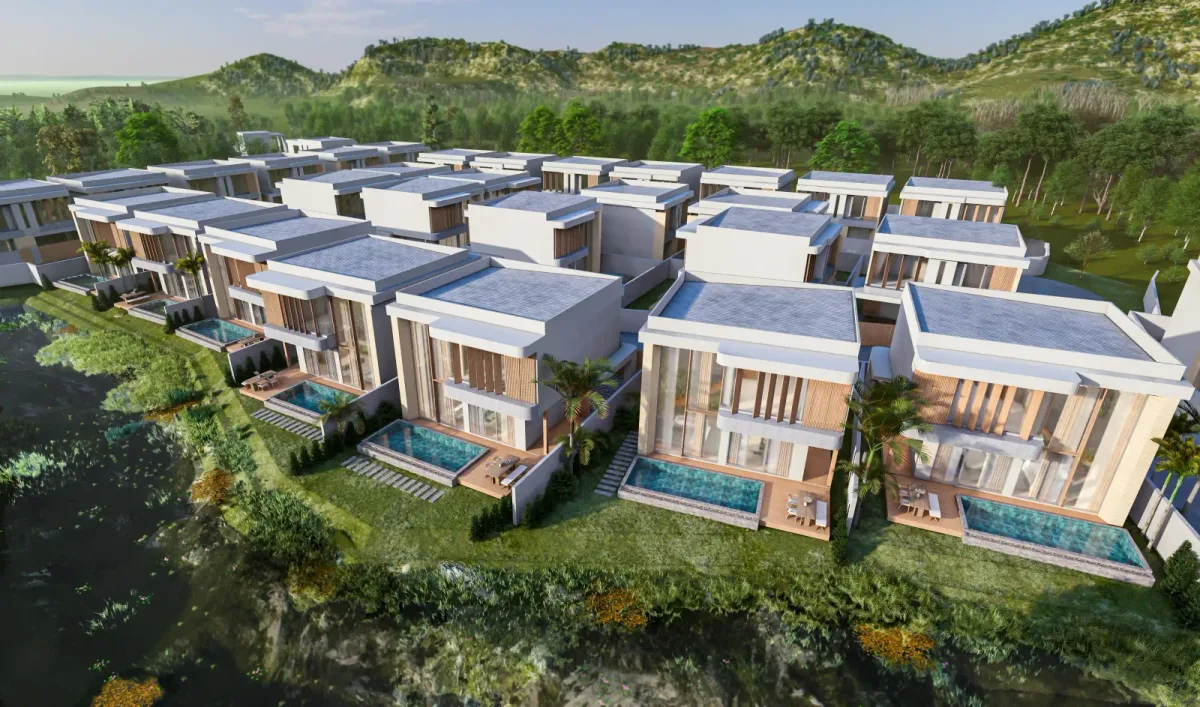
Buy Property in Phuket 2026: The Complete Foreign Buyer’s Master Guide
Phuket is the most accessible international property market in Southeast Asia for foreign buyers. The legal framework is mature, the foreign condo quota is enshrined in the 1979 Condominium Act, and the buying process, when done correctly, takes 30 to 60 days for a resale condo from accepted offer to keys in your hand.
This is the master pillar of moregroup.estate: a single, exhaustive walkthrough of every step a foreign buyer goes through, from “can I even own this?” to “where do I sign and how much does it actually cost in 2026?” If you’re reading one article on buying Phuket property, this is the one.
Summary: Buying Phuket Property in 30 Seconds
Key numbers (2026):
- Foreign condo freehold cap: 49% of building floor area (Condominium Act)
- Realistic condo entry: $80,000 (3M THB), investment-grade from $120K
- Villa entry (leasehold): $300,000 (10M THB)
- FET form trigger: a single inward transfer of USD 50,000 or more
- Transaction timeline: 30-60 days resale / 6-36 months off-plan
- Total transaction fees: 3-6% of purchase price
- Gross rental yields: not published for Phuket by anyone, so no range appears here
Get a personalised Phuket buying plan
Real numbers, real properties, zero buyer commission. Reviewed by a senior MORE Group adviser within 24 hours.
Can Foreigners Actually Buy Property in Phuket in 2026?
In plain English, this gives foreign buyers in Phuket four practical ownership paths in 2026:
-
Freehold condominium (the cleanest 80% of cases). This is the recommended structure for any buyer purchasing a condo unit. You buy a unit in a building registered under the Condominium Act, the developer or seller transfers a Chanote title to your name at the Phuket Land Office, and you own the unit forever, to live in, rent, sell, gift or inherit. The only constraint is the 49% rule: across the whole building, no more than 49% of total floor area can sit in foreign names at any time. Reputable developers track quota live; your lawyer must verify quota availability in writing before you pay any deposit.
-
Registered leasehold (for villas and land-based property). A foreign individual signs a long-term lease: typically a 30-year initial term with a contractual option to extend by another 30 years, sometimes structured as 30+30+30, registered against the Chanote at the Land Department. Properly drafted, this gives you 60-90 years of practical control and is the standard structure for foreign-owned pool villas in Bang Tao, Rawai, Kamala, and Layan. The Thai legal system does not automatically guarantee renewal; renewal rights must be contractually written and, where possible, supported by a sale option or equity in the lessor entity.
-
Thai limited company. A Thai majority-owned company (Thai shareholders 51%+, foreign 49% or under) can own land and a villa freehold. Used for genuine business cases, a hotel, a serviced rental operation, a portfolio, but flagged by Thai authorities when it’s an obvious nominee structure used to circumvent foreign land ownership rules. In 2026 we do not recommend the company route for individual residential buyers unless you have a specific operational reason and a senior Thai lawyer endorsing it.
-
Usufruct (sit-saranusisit). A registered lifelong right to use and enjoy land owned by a Thai national (often a Thai spouse). Useful in family contexts, less so for arms-length investment.
For deeper detail on each ownership type, see our spokes freehold vs leasehold Thailand and legal guide to buying property in Thailand. For sister-HUB context on foreign-buyer specifics by passport, see the Phuket by Nationality master guide 2026.
What It Costs: Phuket Property Prices by Area & Type 2026
The single biggest pricing variable is distance to a beach with active tourism demand, followed by building age and management quality. A new 1BR 400m from Bang Tao beach trades 35-50% above an equivalent unit 2.5km inland. A boutique 3-storey low-rise in Surin commands 20-30% premium over a comparable unit in a 200-key high-rise nearby.
Phuket condo & villa prices by area (2026, USD rounded):
| Area | Studio / 1BR condo | 2-3BR condo | 2BR villa (lease) | 3-4BR villa (lease) |
|---|---|---|---|---|
| Bang Tao / Cherng Talay | $160K-$280K | $260K-$550K | $450K-$900K | $700K-$2.5M |
| Patong | $90K-$180K | $170K-$350K | rare | $600K-$1.5M |
| Kamala | $200K-$340K | $320K-$650K | $500K-$1.1M | $900K-$3M |
| Rawai | $80K-$180K | $140K-$260K | $300K-$550K | $500K-$1.1M |
| Nai Harn | $90K-$200K | $160K-$300K | $320K-$600K | $550K-$1.2M |
| Surin | $250K-$400K | $400K-$800K | $700K-$1.4M | $1.2M-$5M |
| Cherng Talay (inland) | $130K-$220K | $220K-$400K | $400K-$700K | $650K-$1.5M |
| Phuket Town | $50K-$130K | $100K-$200K | rare | rare |
| Chalong | $70K-$140K | $130K-$240K | $280K-$500K | $450K-$900K |
| Mai Khao | $180K-$350K | $300K-$600K | $500K-$1M | $800K-$2.5M |
Key 2026 dynamics: every two-year price movement this paragraph used to quote has been withdrawn, for Bang Tao and Surin, for Rawai and Nai Harn, and for Patong, along with the yield ranking attached to Patong. Thailand publishes no transaction index for Phuket, so none of those changes was measured. What the records do show is the shape of the market: Patong is the dearest metre on the island at 234,561 THB and the thinnest of the west-coast markets at 202 priced apartments; Bang Tao is the deepest at 4,589; and Mai Khao holds 39, which is why its resale buyer pool is thin whatever its prices do.
For deeper area-by-area analysis, the Phuket areas master guide 2026 covers all 18 microzones in detail. For the entry-budget bracket specifically, see Phuket investment under $200K complete guide and budget planning for Phuket first-time buyers.
7-Step Buying Process: From Search to Keys
Below is the working timeline we use with MORE Group buyers, including who does what at each step:
Step 1, Shortlist & viewings (Week 1-2). You define budget, area, strategy (yield vs lifestyle vs capital growth), then we shortlist 6-12 units that meet the brief. Live or recorded video tours for remote buyers. Output: ranked shortlist of 2-4 properties.
Step 2, Reservation agreement & deposit (Day 1 of transaction). Once you choose a unit, you sign a one-page reservation agreement and pay a reservation deposit of 100,000-200,000 THB ($3,000-$6,000), refundable conditional on legal due diligence outcome (this clause is essential and must be in writing). The unit is taken off market for 14-30 days while due diligence runs.
Step 3, Legal due diligence (Week 1-2 of transaction). Your independent Thai lawyer (not the seller’s, not the developer’s) verifies the Chanote, foreign-quota availability in writing from the juristic person, building permits (if recent build), construction completion certificate, mortgage / encumbrance status, outstanding common-area fees, and developer track record for off-plan. Cost: $1,500-$3,500. Timeline: 7-14 days.
Step 4, Sale and Purchase Agreement (Week 2-3). The full SPA replaces the reservation, with: confirmed price in THB, payment milestones, transfer date, who pays what at the Land Office, penalties for default both ways, warranty (off-plan), inventory / handover specs, and what happens if quota is unavailable on transfer day (must be 100% buyer-protective).
Step 5, Overseas funds transfer + FET (Week 3-5). You SWIFT the purchase price from your overseas bank to the seller’s nominated Thai bank account in foreign currency (USD, EUR, GBP). The Thai receiving bank issues a Foreign Exchange Transaction (FET) form for any single inward transfer of USD 50,000 or more, and a credit advice for smaller ones. The FET is mandatory for the Land Office to register the title in a foreign name and for repatriation when you sell. Detail in the next H2.
Step 6, Land Office transfer (Week 5-8). Both parties (or attorneys with a registered Power of Attorney) attend the Phuket Provincial Land Office. Title is signed over, transfer fee (2%) paid, taxes settled, new Chanote issued in your name. The actual appointment takes 2-4 hours. You walk out as the registered owner.
Step 7, Handover & onboarding (Week 6-9). You receive keys, signed inventory, juristic person introduction, and (if going rental) sign with a property manager. Utilities transferred to your name. Insurance bound.
For step-by-step operational detail, our spokes go deeper: buying property in Phuket guide, first-time buyer Phuket complete guide, and buy property remotely from Thailand / buying Phuket property remote guide for buyers not flying in. For timing specifically, when to buy in the calendar year; see best time to buy Phuket property.
Money Path: FET Certificate, Bank Transfer & Land Office Day
This is the single most-misunderstood mechanic for foreign Phuket buyers, so here is the practical playbook:
Use foreign currency, not THB, on the SWIFT. Your overseas bank must SWIFT the funds in USD, EUR, GBP, AED, AUD or another major foreign currency, with the THAI receiving bank converting on arrival. If you wire THB or convert yourself before transfer, the bank will not issue an FET, and you have no way to register the title or repatriate proceeds. This is the #1 transaction-killing mistake we see.
SWIFT message must state the purpose. “Purchase of condominium unit [project name], unit [number], located in Phuket, Thailand” is the standard wording. Some banks reject vague descriptions like “real estate” or “property purchase”, be specific. The beneficiary must match the seller (or developer escrow) on the SPA exactly.
The receiving bank issues the FET automatically, but you must request it. Within 5-10 business days of the funds landing, the Thai bank produces the FET. You must collect it (in person or via your lawyer with POA), verify the figures match the SPA, and lodge it with your lawyer for the Land Office package. Some Thai banks (Bangkok Bank, Kasikorn, SCB) handle thousands of foreign property transfers per month and the workflow is smooth. Others delay, your lawyer should nominate the receiving bank with this in mind.
The Land Office package (transfer day): original Chanote, original FETs covering 100% of the price, signed SPA, both parties’ passports / company documents, juristic person letter confirming foreign quota availability dated within 7 days of transfer, debt-free letter from the juristic person, transfer fee in cash or cashier’s cheque (2% of appraised value), and a power-of-attorney legalised at a Thai consulate if you are not attending personally.
Escrow is optional but increasingly common. Independent escrow accounts (offered by major Thai banks and licensed escrow providers) hold the buyer’s funds until Land Office transfer is confirmed, then release to the seller. Cost: 0.5-1% of the held amount. We recommend escrow for any resale transaction over $200,000 and for all villa leasehold transactions.
For a deeper drill into proof-of-funds documentation specifically, the most-asked-about subtopic for foreign buyers; see our pillar spoke proof of funds for Thailand property. For the legal-fee component, legal fees for buying property in Thailand and do I need a lawyer to buy property in Thailand cover the practicalities. For Land Office transfer fees specifically, see condo transfer fees Thailand.
Due Diligence Checklist: 27 Items to Verify Before Paying Deposit
Title & ownership (items 1-7):
- Chanote (Nor Sor 4 Jor) verified at Land Office: the only fully secure Thai title.
- Title is free of mortgages, liens or court orders.
- Seller named on title matches passport / company documents on the SPA.
- For company-held property: company shareholder structure, AGM minutes authorising sale, tax filings up to date.
- For leasehold: existing lease registration, remaining term, renewal clauses, sale-on-default clauses.
- For inherited property: probate completed and recorded.
- No spousal claim disputes (Thai law: marital property complexities).
Building & construction (items 8-13): 8. Building registered under the Condominium Act (not just a “rental building” being mis-sold). 9. Building permit issued and matches the actual built structure. 10. Construction completion certificate issued. 11. EIA (Environmental Impact Assessment) approved for buildings 80+ rooms or 4,000+ sqm. 12. No outstanding municipal violations or modification orders. 13. Common areas (pool, gym, lobby) actually built per the marketed plans.
Foreign quota & juristic person (items 14-18): 14. Written confirmation from the juristic person that foreign quota is available on the day of transfer (not just today). 15. Specific unit allocated against the foreign quota in the juristic register. 16. Juristic person not in legal dispute or insolvency. 17. AGM minutes from last 24 months reviewed for major capex items or planned levies. 18. Sinking fund balance disclosed and adequate.
Finance & fees (items 19-23): 19. All common-area fees paid up to date by the seller through the transfer date. 20. No outstanding utility debts attached to the unit. 21. No outstanding capital levies or special assessments. 22. Verified appraised value (used for transfer fee calculation) is consistent with market. 23. SPA payment schedule lines up with FET-able foreign currency transfers.
Off-plan specific (items 24-27): 24. Developer financial track record: at least 2 completed projects, no major delays history. 25. Project bank guarantee or escrow arrangement for buyer payments. 26. Land used for the project is owned outright by the developer (not optioned, not leased). 27. SPA includes a hard handover backstop date with refund-with-interest if missed by 12+ months.
For the full operational walkthrough (and what your lawyer should hand you in writing for each item), see due diligence process for Thailand property step-by-step. For off-plan specifically, the handover and developer risk pillars are handover risks of off-plan projects and the Origin Property developer review.
Total Cost of Ownership: Fees, Taxes, Annual Costs
One-off transaction costs (resale condo, foreign buyer):
| Cost | Typical amount | Who pays |
|---|---|---|
| Transfer fee (2% of appraised value) | 1.0-2.0% of price | Commonly split 50/50; buyer share ~1% |
| Specific Business Tax (held under 5 years) | 3.3% of price | Seller |
| Stamp duty (held 5+ years) | 0.5% of price | Seller |
| Withholding tax (individual seller) | Variable (under 1% typical) | Seller |
| Independent lawyer | $1,500-$3,500 | Buyer |
| Escrow (optional) | 0.5-1.0% of held amount | Negotiated |
| FET / SWIFT bank fees | $150-$500 | Buyer |
| Sinking fund (one-off, condo) | $1,000-$4,000 | Buyer |
| Power of Attorney legalisation | $200-$500 | Buyer |
| Total buyer side (resale) | 3-6% of price | Buyer |
Off-plan note: Developers typically pay the full 2% transfer fee on off-plan transfers, dropping the buyer’s all-in fees to 2-4% of price. This is reflected in the SPA, verify before signing.
Annual ownership costs:
| Cost | Condo (50-90 sqm) | Villa (200-400 sqm) |
|---|---|---|
| Common-area fees / estate fee | $300-$2,000 / yr | $1,500-$6,000 / yr |
| Sinking fund (annual contribution) | $200-$500 / yr | n/a |
| Land and Building Tax | $30-$300 / yr | $100-$1,500 / yr |
| Property insurance | $200-$600 / yr | $600-$2,000 / yr |
| Pool service | n/a | $80/mo ($960/yr) |
| Garden & landscaping | n/a | $150/mo ($1,800/yr) |
| Security or estate gate | included | $300/mo ($3,600/yr) |
| Utilities (vacant baseline) | $300-$600 / yr | $1,200-$2,400 / yr |
| Property management fee (if rented) | 18-25% of gross | 20-30% of gross |
Sale-side costs (when you exit): seller pays the share of the transfer fee not absorbed by the next buyer, plus Specific Business Tax (3.3%) if held under 5 years, or stamp duty (0.5%) if held 5+ years, plus withholding tax. Total seller-side costs: 4-8% of sale price typically. Holding for 5+ years saves you about 3% of sale price by eliminating SBT, a major reason to buy with a multi-year horizon.
For the full taxes-and-fees pillar on this topic, the dedicated sister hub Phuket property taxes and fees complete guide is the deepest reference. For budgeting tools and worked spreadsheets, see budget planning for Thailand property buyers.
Off-Plan vs Resale vs Resale-Plus-Renovation: Pros, Cons, Risk
Off-plan, when to choose it:
- You want maximum capital growth and can wait 18-36 months for income.
- You can fund staged payments rather than one lump sum (typical 10-30-30-30 plan: 10% reservation, 30% at construction milestones, 30% at top-out, 30% at handover).
- You’re buying with a 5+ year horizon (capital growth needs time to crystallise).
- The developer has 2+ completed projects in Phuket with on-time delivery.
Off-plan, risks:
- Developer delivery delay (12-24 months late is unfortunately not uncommon in mid-tier projects).
- Specification dilution between marketing and handover (lower-grade fittings).
- Currency exposure across construction (THB/your-currency moves of 10-15% are typical).
- Foreign quota fully allocated by the time of transfer, forcing leasehold or company workaround.
Resale, when to choose it:
- You need income from month one (most retirement-income buyers).
- You want to verify the building’s actual occupancy, reviews and management quality before committing.
- You can move quickly on a motivated seller (15-25% discounts to asking are achievable).
- Your hold horizon is shorter (3-5 years), you avoid the off-plan handover lag.
Resale, risks:
- Hidden capex coming up (lift replacement, façade refresh), covered by item 17 in the due diligence list above.
- Outdated kitchens / bathrooms, discount, then renovate.
- Less negotiation power than with developers offering launch discounts.
Resale-plus-renovation (the underused middle path): target 5-10 year-old units in established buildings with strong management. Acquire 25-40% below new-build per sqm. Run a full renovation (60-90 days, $300-$600 per sqm for cosmetic refresh + appliances + AC, $800-$1,500 per sqm for full strip-and-rebuild). The re-listing rate and the capitalised-value improvement this passage used to quote have been withdrawn: both described achieved outcomes that no Phuket source records. What is real about the strategy is the acquisition discount, which is negotiable and visible in comparable asking prices, and the fact that you are buying a building with an operating history instead of a promise. This is the most-undervalued strategy in the Phuket market in 2026.
The full off-plan-vs-resale analysis lives in the spoke buying off-plan vs resale Phuket complete guide. For pure off-plan, off-plan property Phuket guide and payment milestones off-plan Thailand cover the operational mechanics.
Common Mistakes That Cost Foreign Buyers $20K+ (and How to Avoid Them)
Below are the seven mistakes, the dollar cost we’ve seen each one carry, and the 30-second fix:
Mistake 1, “I’ll save the lawyer fee.” (Cost: $20,000-$200,000) Skipping independent legal due diligence and using the seller’s or developer’s lawyer “to save $2,000.” Result: undisclosed mortgages, unavailable foreign quota on transfer day, or buying a unit in a building that was never registered under the Condominium Act. Fix: spend the $1,500-$3,500 on your own lawyer. Always.
Mistake 2, Transferring funds in THB. (Cost: deal-killing) SWIFT in baht (or convert before transfer) and the Thai receiving bank cannot issue an FET. No FET = no foreign condo registration and no foreign-currency repatriation when you sell. Fix: SWIFT in USD/EUR/GBP/AUD only, with explicit “purchase of condominium” purpose code.
Mistake 3, Verbal foreign quota promises. (Cost: $50,000-$500,000) Seller / agent promises “quota is fine” but it isn’t checked in writing by the juristic person within 7 days of transfer. Quota fills, you transfer to leasehold or your deposit is at risk. Fix: insist on written quota confirmation from the juristic person, dated within 7 days of Land Office appointment.
Mistake 4, Picking off-plan on yield projections. (Cost: $30,000-$150,000) A developer model shows a gross yield. It is a sales position rather than a measurement, and this page no longer quotes a “realistic” replacement figure either, because none is published. Project delivers 18 months late. Marketed pool, kids’ club and co-working never get built. Fix: verify developer track record (2+ completed Phuket projects), inspect a comparable completed building, model on an occupancy and a rate from a comparable completed building’s own statements, never on developer figures.
Mistake 5, Paying 100% before transfer (resale). (Cost: $80,000-$500,000) Buyer wires full price to seller’s personal Thai bank account before Land Office transfer. Seller delays, demands renegotiation, or in the worst case disappears. Fix: use escrow for any resale over $200,000. Funds release on Land Office transfer confirmation, not before.
Mistake 6, Selling at year 4 instead of year 5. (Cost: 3% of price) Specific Business Tax (3.3%) applies to holdings under 5 years; switches to stamp duty (0.5%) at 5 years exact. Selling 11 months early costs 2.8% of sale price. Fix: if you’re inside year 5, model the saving, usually worth waiting.
Mistake 7, Cheapest property manager. A cut-rate manager on 15% commission with a single-platform listing and no dynamic pricing can leave you behind a manager on 22-25% with multi-platform distribution and professional photography, because the commission is the smaller number in that comparison. The worked figures this entry used to give have been withdrawn: they needed a gross income nobody publishes. Fix: evaluate managers on net delivered to owner, not commission rate. Get 2-3 quotes; ask for actual past-12-month owner P&Ls on comparable units.
Bonus mistake (8), Buying without an exit thesis. Beautiful property, terrible resale market. Areas like Mai Khao and deep Chalong have very few priced units on our list (39 and 396 against Bang Tao’s 4,589) so you would be waiting for a buyer to appear rather than choosing among several. How long that takes is not published for Phuket, and the month ranges this sentence used to give have been withdrawn. Fix: ask “who buys this from me in 5 years and at what price?” before you ask “do I love it?” The buying Phuket property 2026, is it worth it spoke goes deep on the exit-liquidity test.
Comparative Table: Bang Tao vs Patong vs Rawai vs Phuket Town
| Metric | Bang Tao / Cherng Talay | Patong | Rawai | Phuket Town |
|---|---|---|---|---|
| Average condo price (1BR, 2026) | $180K-$240K | $110K-$160K | $110K-$170K | $70K-$120K |
| Average villa price (3BR lease) | $700K-$1.4M | rare ($600K-$1.2M) | $500K-$900K | rare |
| Gross rental yield (1BR condo) | Not published | Not published | Not published | Not published |
| Foreign buyer share (new sales) | 70-85% | 55-70% | 50-65% | 15-25% |
| Infrastructure level | Premium (international schools, hospitals, beach clubs) | High (tourism-dense, mixed quality) | Mid (residential, growing) | High (city services, hospitals, schools) |
| Distance to Phuket airport | 20 min (15 km) | 50 min (35 km) | 60 min (45 km) | 35 min (28 km) |
| Lifestyle profile | Resort + family | Tourism nightlife | Quiet residential / wellness | Urban / authentic Thai |
| Exit liquidity (priced apartments to sell into) | 4,589 | 202 | 1,291 | Wichit 374, Kathu 244 |
How to read this table: Bang Tao wins on liquidity and lifestyle balance, pay the premium and exit into the deepest market on the island. Patong wins on visitor density and costs the most per square metre for it, on 202 priced apartments in two unbuilt schemes. Rawai wins on lifestyle-per-dollar, accept the longer exit horizon and the residential (not resort) feel. Phuket Town is for buyers who genuinely want city living or who have a $70K-$100K budget and need to be in something rental-viable; it is not the right answer for a leisure investor who can stretch to $140K+ in a beach area.
For the comprehensive area pillar (all 18 microzones, not just these 4), see the sister hub Phuket areas master guide 2026.
Related Guides (Spokes):
This master hub is supported by 23 in-depth spoke guides organised in four subclusters. Use them as deeper drill-downs on any topic above.
Process & Steps
- Buying property in Phuket, operational guide
- First-time buyer Phuket complete guide
- Buy property remotely from Thailand
- Buying Phuket property remote guide
- Budget planning for Phuket first-time buyers
- Budget planning for Thailand property buyers
- Best time to buy Phuket property
Money & Legal
- Proof of funds for Thailand property (FET pillar)
- Due diligence process for Thailand step-by-step
- Legal guide to buying property in Thailand
- Do I need a lawyer to buy property in Thailand?
- Legal fees for buying property in Thailand
- Condo transfer fees Thailand
- Freehold vs leasehold Thailand
Off-plan vs Resale
- Buying off-plan vs resale Phuket complete guide
- Off-plan property Phuket guide
- Handover risks of off-plan projects
- Payment milestones off-plan Thailand
- Origin Property developer review
Areas & Investment
- Best areas in Phuket to buy property
- Phuket investment under $200K complete guide
- Phuket rental yield complete guide 2026
- Buying Phuket property in 2026, is it worth it?
Sister HUBs
- Phuket Investment Master Guide 2026, pure investor lens (yield, ROI, exit, tax efficiency)
- Phuket Areas Master Guide 2026, full area-by-area breakdown of all 18 Phuket microzones
- Phuket Property Taxes and Fees Complete Guide, every fee, tax and ongoing cost in detail
- Phuket by Nationality Master Guide 2026, passport-specific guidance for the top 12 buyer nationalities
Ready to start your Phuket purchase?
MORE Group: 0% buyer commission, independent due diligence, 100+ nationalities served. From shortlist to keys in 30-60 days.
Get Personal Help
MORE Group is a Phuket-based real estate advisory founded by Maksim Shchegolev, working exclusively for foreign buyers across 100+ nationalities since 2016. We charge 0% buyer commission, developer-funded, and are fully independent of any single developer or project. Our team has advised on 500+ Phuket transactions across Bang Tao, Kamala, Patong, Surin, Rawai, and Layan. We are a property advisory firm, not a hotel, not a spa brand, and not affiliated with any resort chain. We provide independent legal coordination, due diligence on title and juristic compliance, currency transfer guidance, and remote buyer support from shortlist to transfer. Contact: info@moregroup.estate · +66 65 119 5327 · moregroup.estate.
You’ve now got the full A-Z of buying property in Phuket as a foreign buyer in 2026, the legal structures, the prices by area, the 7-step process, the FET / Land Office mechanics, the 27-item due diligence list, and the seven mistakes that cost other buyers tens of thousands. The next step is matching this framework to your specific budget, passport, timeline and investment goals.
MORE Group works exclusively for the buyer side: 0% commission from you (developer-paid), independent due diligence coordinated with vetted Phuket lawyers, escrow for resale transactions, and remote-buyer support across 100+ nationalities. Submit the form below and a senior adviser will come back within 24 hours with a personalised shortlist and a written buying plan.
Which route suits which buyer
This guide covers every route; only one of them is yours.
- Under about $150K: a condominium, almost certainly compact, in a resident or mid-market zone. Freehold within the 49% quota is realistic at this level, and the yield case rests on active management rather than on the address.
- $150K to $300K: the broadest part of the market, a one- or two-bedroom in a resort corridor, off-plan or resale. This is where the off-plan versus resale comparison in this guide actually bites.
- $300K to $1.5M: villa territory, which means leasehold over the land rather than freehold, and a different legal checklist. The due diligence list matters more here than the price comparison.
- Above that: trophy and branded stock, where the contract with the operator decides the return more than the property does, and liquidity is a search for one buyer.
- Relocating rather than investing: ignore the yield sections entirely. Schools, healthcare, commute and everyday cost decide the zone, and the property follows.
Read the section that matches your row first. The 27-item due diligence list applies to all of them.
Frequently Asked Questions
Studios start around $50,000 (1.7M THB) in mid-tier areas. Realistic 1-bedroom condos start at $80,000 (3M THB), with decent investment-grade quality from $120,000. Villa entry on leasehold begins around $300,000 (10M THB) for a 2-bedroom pool villa in Rawai or Chalong hills.
Yes, mandatory for foreign condo buyers. The Foreign Exchange Transaction certificate proves your money entered Thailand in foreign currency. It is required by the Land Office to register freehold and to repatriate proceeds when you sell.
No. Remote purchase is standard with a notarised Power of Attorney legalised at a Thai consulate. Around 60% of MORE Group foreign buyers complete remotely after one inspection trip or video viewings.
Questions about this guide? Ask us on WhatsApp. The guide's title is already in the message, so you only need to write your question.
Ask on WhatsApp
Maksim Shchegolev
Founder, MORE Group
Founder of MORE Group. Four years in investment banking before moving to Phuket, where he has worked in the local property market since 2018. Oversees developer relationships and every engagement above $300K.
About MORE Group →Get a Focused Phuket Property Shortlist
Share budget, area and goal. We will reply with suitable live projects, not a generic catalogue.
