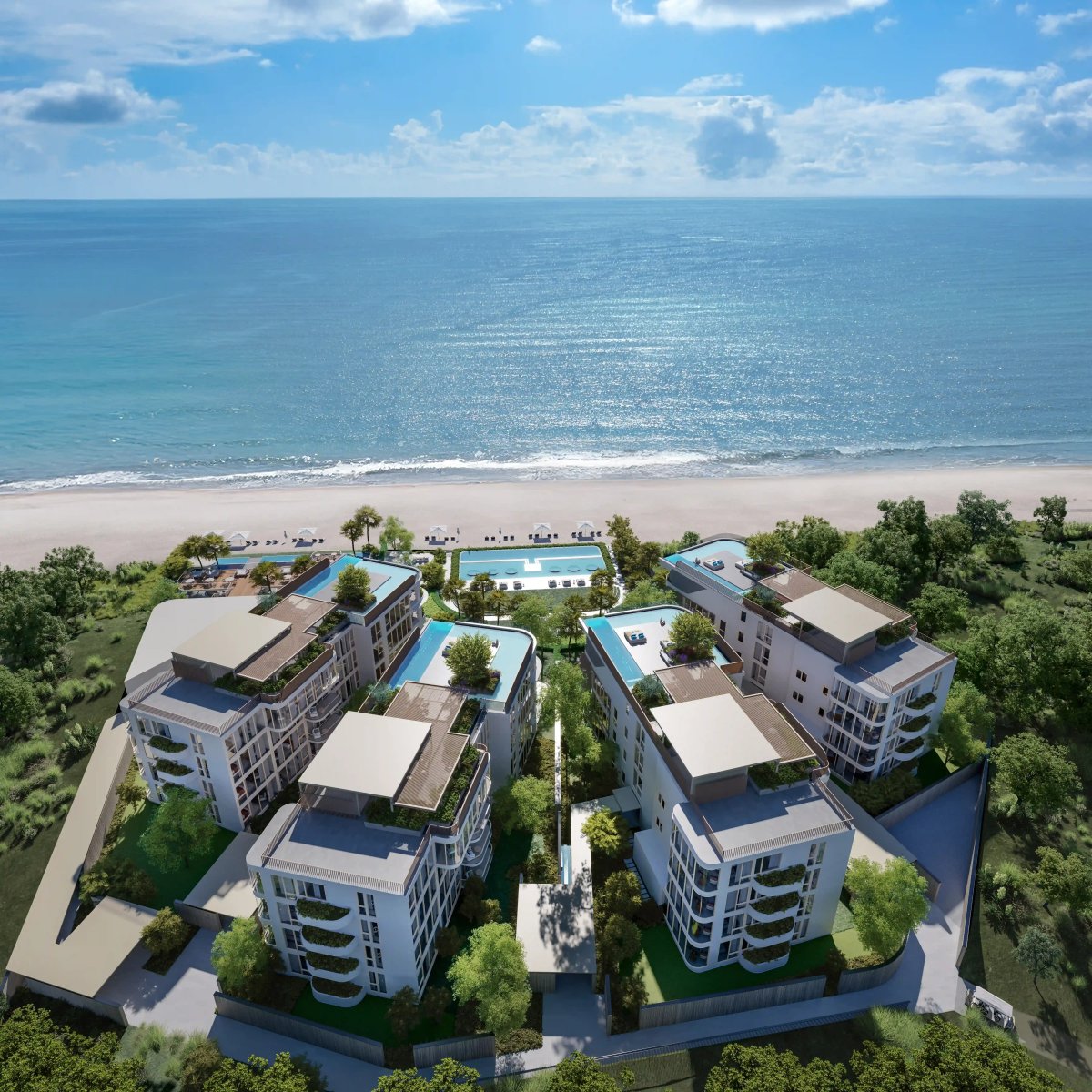
Branded Residences Phuket 2026: True Fees, Brand Cuts, ROI Reality
Branded residences are Phuket’s loudest 2026 luxury product. Banyan Tree, Marriott, Anantara, Wyndham, Dusit, Garrya and Cassia are stamped on towers from Layan to Patong. Brochures promise hotel-grade service and “guaranteed” returns. What they rarely show is the fee stack - the brand premium baked into your sticker, the operator cut between gross room revenue and your bank account, and the real net yield after OPEX and Thai tax.
This is the honest version, with real Phuket pricing, industry-typical operator splits reported by developers and asset managers in 2024-2025, and a worked 12,000,000 THB example. For wider context start with the Phuket Investment Master Guide 2026 and the Phuket rental yield guide.
Summary:
- Brand premium is real; license fee is invisible. You pay 15-35% over a comparable unbranded unit, baked into the sticker. No separate line item.
- Operator cut is the silent yield killer. Hotel pools take 30-50% of net after OPEX eats 35-55% of gross. Owner typically receives 30-50% of gross.
- Net yield on branded Phuket condos runs 3-5%. Unbranded well-located runs 5-7%. Branded buys stability and brand resale, not maximum cash.
- Furniture pack is mandatory. Budget 200,000-450,000 THB per bedroom on top of the unit price.
- Appreciation premium exists for tier-1 only. Banyan Tree beachfront and Anantara Layan have beaten the wider market by 10-25% over 5 years. Mid-tier flags have not.
- Owner-use is capped. Expect 30-60 nights per year, blocked out of peak. Wrong product for a freely-used holiday home.
What Is a “Branded Residence” in Phuket - Four Structures?
1. License-only branded (no operator)
The developer pays a one-off licensing fee to use the brand’s name and design language. No rental program, no hotel staff, no operator cut. You own a unit that happens to say “Marriott” on the gate; maintenance is standard Thai juristic person. Yield is whatever you generate on Airbnb or via a private manager. Rare for famous flags but common for smaller “Wyndham” or “Ramada” condos using the brand for marketing only.
2. White-label / soft-brand
The brand provides design, lobby and concierge - but the on-site operator is local. Owners can opt into rental management, often via a third party. Splits and OPEX are negotiated, not standardised. Read every clause.
3. Full hotel rental pool
The classic model (Banyan Tree Beach Residences, Anantara Layan, most JW Marriott Residences). Your unit joins a pool; the hotel rents whichever room is available; income is split by share (size, view, floor). Hotel OPEX is deducted first (35-55% of gross), the operator takes 30-50% of what’s left, the remainder is split among pool owners. Usage is capped, usually 30 nights per year.
4. MLR (Managed Long-stay Rental) / hybrid pool
Newer projects (parts of Garrya, Wyndham Fantasea Chalong, several Laguna Bellaguna products) place 1-12 month tenants instead of nightly guests. OPEX is lower and the nightly rate is much lower by design, because you are placing tenants rather than guests. Occupancy is steadier for a structural reason rather than a measured one: a one-to-twelve-month tenancy has one changeover instead of dozens, so the calendar does not have to be refilled every few nights. The net-yield band this line used to give is withdrawn; no Phuket letting series exists to have produced it.
Fee Stack - Where the Money Actually Goes
| Cost line | Typical range | When paid | Notes |
|---|---|---|---|
| Brand premium (built into price) | 15-35% over unbranded equivalent | At purchase | Hidden in sticker, no separate invoice |
| Furniture & FF&E pack | 200,000-450,000 THB per bedroom | Before handover | Almost always mandatory in branded |
| HOA / juristic person fee | 80-150 THB/sqm/month | Monthly | Branded sits at the top of the range |
| Sinking fund | 600-1,000 THB/sqm | One-off at handover | Replenished if depleted |
| CAM (common area maintenance) | Usually inside HOA | Monthly | Verify it is bundled, not extra |
| Hotel OPEX deduction | 35-55% of gross room revenue | Monthly, before split | Linen, OTA, F&B share, marketing, front-office |
| Operator management cut | 30-50% of net rental | Monthly | After OPEX. Some contracts say “of gross” - much worse |
| Owner-usage night cost | 4,000-12,000 THB/night | Per use | Housekeeping & utilities on your own unit |
| Annual property tax (residential) | 0.02-0.10% of appraised value (transition rates 2020-2026); ceiling 0.3% | Annual | Land and Building Tax Act B.E. 2562 (2019), collection from 1 Jan 2020 |
| Withholding / income tax on rental | 5-15% effective | Annual | Depends on structure (personal vs Thai company) |
Full tax detail in the hidden costs of buying property in Thailand.
Real Fee Examples - By Brand
Banyan Tree (ultra-luxury flagship)
- Products: Beach Residences Oceanus, Varuna, Nammu (Beach Terraces); Grand Residences Sirena.
- Sticker: Nammu beachfront townhomes 110-116M THB for 468 sqm (235,000-248,000 THB/sqm). Oceanus and Varuna apartments from ~4.7M USD.
- Brand premium: 25-35% over a comparable unbranded Bang Tao villa.
- Operator cut: Industry-typical 60/40 owner/operator on net after ~45-50% OPEX. Owner usage 30 nights, blocked out of peak.
- Gross-to-net: Owner receives 30-35% of gross room revenue.
- Sanctuary Club: Loyalty across Banyan Group hotels - real value if you travel the brand.
Full Banyan menu in Banyan Group developer review and off-plan property Phuket guide.
Marriott / JW Marriott / Autograph Collection
- Products: JW Marriott Mai Khao Residences (limited resale); Autograph Collection condos (varying quality).
- Brand premium: 20-30% for true JW; 10-15% for Autograph soft-brand.
- Operator cut: Industry-typical 50/50 net for full Marriott pool; Autograph often 60/40 with higher OPEX.
- Gross-to-net: Owner receives 25-30% of gross under full Marriott management.
- Watch out: “Autograph” is a soft-brand - verify which Marriott entity actually signs the management contract.
Anantara (Minor Hotels)
- Products: Anantara Layan Residences (resale), Avadina Hills, Layan Residences by Anantara.
- Sticker: From ~100M THB for Layan branded villas; Avadina Hills 6BR estates at 250M+.
- Brand premium: 25-30% over comparable unbranded Layan / Cape Yamu.
- Operator cut: Industry-typical 60/40 net with leaner OPEX (~40-45%).
- Gross-to-net: 30-35% of gross.
- Notable: the resale claim this line used to make, several Layan units at a 30-40% gross uplift between 2018 and 2024, described as verifiable, is withdrawn. Thailand publishes no transaction register for Phuket, so no resale uplift is verifiable for this brand or any other, and calling it so was the strongest form of the error this page otherwise avoids. What can be established is whether individual units have changed hands at all, which the juristic office and the Land Office can confirm case by case.
- Not on our price list: Anantara Layan, Avadina Hills and the Layan Residences by Anantara carry no priced units in MORE Group’s records, so the sticker figures above are from the market rather than from our list.
Wyndham
- Products: Wyndham Fantasea Chalong, Wyndham Garden Bang Tao, plus several mid-market condo-hotels.
- Brand premium: 5-15% - smallest of the major flags.
- Operator cut: often 60/40 to 70/30, and frequently sold with a guarantee attached. Treat the guaranteed percentage as a marketing rate rather than a market rate: it is a payment obligation from the developer’s balance sheet, not a measurement of the property, and no Phuket yield is published for it to have been derived from. After the guarantee period, splits revert to a real pool.
- Watch out: “Guaranteed” is a marketing rate, not a market rate. Check year 6. Some Wyndham-flagged Phuket condos are licence-only.
Dusit
- Products: Dusit Residences (Laguna), Dusit Princess Patong (resale).
- Brand premium: 15-25%.
- Operator cut: Industry-typical 60/40 net, lighter OPEX than international brands.
- Gross-to-net: ~35% of gross.
- Notable: Thai-owned (Dusit Thani PCL); strong domestic reach - useful in low-foreign-tourism years.
Garrya, Cassia, Angsana (Banyan Group sub-brands)
- Garrya Residences Phuket (Bang Tao, 2029): 35 priced units on our list, from 16,360,000 THB for a 57 sqm 1BR (287,018 THB per square metre) up to 120,220,000 THB for a 316 sqm signature unit, at a 312,259 median metre rate. That median is 94% above the Bang Tao area figure of 161,000 and is the second dearest scheme in the corridor after Banyan Tree Beach Residences Oceanus at 452,479. Wellness-focused; rental shared with Garrya Phuket Hotel.
- Cassia Phuket (Laguna, 2019, secondary): from about 5.75M THB for a studio, a market figure rather than one from our price list, which holds no priced Cassia units. The most accessible Banyan product on entry price. Owner receives 30-35% of gross under the pool agreement, which is contractual and should be read in the agreement itself.
- Angsana Oceanview Residences (Laguna): three priced units on our list, 209-304 sqm, asking 45,820,000 to 84,940,000 THB, which works out at 219,234 to 279,408 THB per square metre.
- Brand premium: 10-20% Garrya; 5-10% Cassia; 15-25% Angsana.
- Operator cut: Industry-typical 60/40 net across all three under the Banyan Group umbrella.
Worked Example: 12,000,000 THB Branded 1BR Condo
Both halves of this example used to start from a nightly rate and an occupancy, 9,000 THB at 65% on the branded side, 5,500 at 70% unbranded, and every figure below them, including the two net yields it concluded with, was arithmetic on those four numbers. None of the four is published for privately owned Phuket units. They are withdrawn, and the example is rebuilt as what it should always have been: a comparison of the two deduction stacks on the same gross, which is the part that is contractual and is where the actual difference between the two models lives.
Take any gross figure G on a 12,000,000 THB, 60 sqm one-bedroom, and put the same G through both structures:
| Line | Branded hotel pool | Unbranded, private manager |
|---|---|---|
| Hotel OPEX, deducted first | −50% of G | not applicable |
| Variable OPEX (cleaning, linen, consumables) | inside the OPEX above | −25% of G |
| Operator / manager | −40% of what remains | −15% of G |
| Left to the owner before fixed costs | 30% of G | 60% of G |
| HOA at the building’s rate | 120 THB/sqm/month = −86,400 | 60 THB/sqm/month = −43,200 |
| Furniture pack | 350,000 THB, usually mandatory | 250,000 THB, your choice of spec |
| Owner usage | 30 nights, blocked out of peak, housekeeping ~1,500 THB/night still payable | unlimited |
| Who sets the rate | the operator | you |
Half of the gross reaching you versus a fifth of it is the whole trade, and it does not require anyone to know what the gross is. What the branded side buys with that difference is a booking channel you do not have to build, an operator who answers the phone, statements in English, and a resale audience that recognises the flag. Whether the hotel’s distribution generates more than twice the revenue your own listing would, which is what it must do for the branded side to win on net, is precisely the thing nobody publishes.
The honest read. The two structures are not ranked here, because ranking them needs the one number neither side will show you. Brand alone is not a thesis: location, supply pipeline and operator quality matter more, and the deduction table above is the part you can settle before signing.
Buyer scenarios: who should buy branded?
Scenario A: hands-off investor, lives in Singapore or Hong Kong, will not self-manage. Trades a materially larger share of gross, 30% reaching them against roughly 60% under private management, for operator reliability, English statements and a booking channel they do not have to build. The yield differential this scenario used to name is withdrawn; the share differential above is contractual and is the real number.
Scenario B: the buyer who wants the largest share of gross reaching their own account should look at unbranded Bang Tao or Kamala stock with private management, where the deduction stack is roughly 40% rather than 70%. That is a statement about the contracts, not about the outcome: see the Phuket rental yield guide for why the outcome cannot be quoted.
Scenario C: First-time foreign buyer under $200K: brand premium plus mandatory furniture pack often makes branded the wrong entry, start unbranded or resale with proven net.
What the brand actually contributes
Buyers pay a premium for a name and are rarely told precisely what the name does, which makes the premium impossible to judge. In practice a brand licence delivers four things, in descending order of reliability.
Standards enforcement. The operator specifies how the building is finished, staffed and maintained, and audits against it. That is the most durable part of the value: it is why branded stock often looks better at ten years than unbranded stock at five, and it is a real cost the fee pays for.
Distribution. Access to the operator’s booking channels and loyalty base. Genuine, and it varies enormously by brand and by how strong that brand is in the source markets your guests come from. A name that means a great deal in one region may mean nothing in another.
Guest confidence. A booker who does not know Phuket knows the flag, which shortens the decision and supports rate. This is worth most in a market with a lot of undifferentiated supply, which describes several Phuket corridors.
Resale narrative. A recognisable name helps an overseas buyer who is working from photographs. It is real and it is the softest of the four, because a brand supports a story rather than a price.
What the licence does not do is guarantee performance, fix the building’s location, or last forever. Judge the premium against the first three, and treat the fourth as a bonus rather than a reason.
Red flags in a branded residence offer
| Red flag | What it usually means | What to check |
|---|---|---|
| The brand licence term not stated | Brands leave buildings, and the premium leaves with them | The licence length and what happens at expiry |
| Brand fee described as included | It is charged, and it comes out of your revenue | Every fee layer, itemised, before distribution |
| Appreciation premium asserted | The premium is paid on entry, not guaranteed on exit | Resale prices achieved on branded stock here |
| Rental programme participation mandatory | Your options are narrower than you think | Whether you may let independently, and on what terms |
| Owner-use nights unlimited in the pitch | Most programmes cap or charge them | The owner-use clause, in writing |
| CAM compared with unbranded stock only | Branded service standards cost more to maintain | Charge per square metre against a branded peer |
Insider tip: ask what happens if the brand exits at the end of its licence term. A building that loses its flag keeps its construction quality and loses the premium it was priced on, and the answer to that question is the difference between buying a building and renting a name.
What MORE Group Does?
We don’t take buyer commission - the developer pays us. We’ll show you the actual rental program documents (not the brochure), pull historical pool data where it exists, and run the worked-example math on the specific unit with your tax structure before you sign. First-time buyers should also read the Phuket property complete guide 2026.
Looking for the right property in Phuket?
Our experts send a shortlist within 2 hours. 0% buyer commission.
Frequently Asked Questions
There is rarely a separate line-item license fee shown to the buyer. The brand premium is built into the price as a 15-35% mark-up over a comparable unbranded unit. The developer pays the brand, then prices it into your sticker.
Industry-typical for Phuket is a 30-50% management cut of net rental after hotel OPEX (linen, F&B share, OTA, marketing, labour). OPEX itself consumes 35-55% of gross first. Net to owner from a managed pool is commonly 30-50% of gross room revenue, before HOA and tax.
On 2018-2024 Phuket resale data, ultra-luxury brands (Banyan Tree beachfront, Anantara Layan) outperformed comparable unbranded by 10-25% over 5 years. Mid-tier brands (Wyndham, Cassia, generic Autograph) have not consistently outperformed.
Yes, but with caps. Most Phuket branded programs limit owner usage to 30-60 nights per year, blocked out of peak (Dec 20-Jan 10, Chinese New Year). MLR programs are more flexible but yield less.
Sanctuary Club gives discounts at Banyan Group hotels worldwide and access to private residence facilities. Real value for owners who travel the brand 4+ times a year, financially neutral for pure investors. Treat as a soft benefit, not a yield-positive feature.

MORE Group Editorial
Phuket Real Estate Experts
The MORE Group team has helped 500+ European and American buyers purchase property in Thailand. We provide legal support, 0% commission, and on-the-ground expertise with 8 years in the Phuket market.
About MORE Group →Get a Focused Phuket Property Shortlist
Share budget, area and goal. We will reply with suitable live projects, not a generic catalogue.
