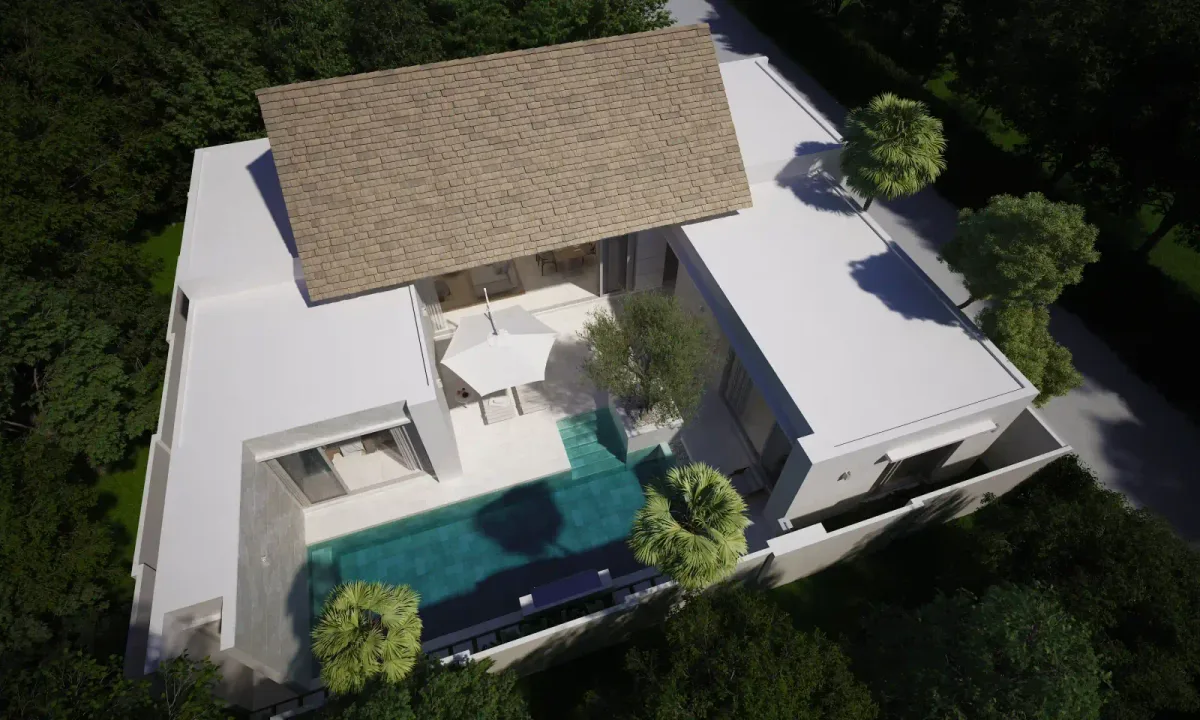
Quick answer: on our price file the island holds 1,186 priced three-bedroom villas at a 25,765,000 THB median (about $788,000 at the site’s working rate of 32.7). The cheapest is 9,500,000 THB in Layan, not in Rawai (Rawai’s cheapest is 12,280,000) and Kamala’s four three-bedroom villas all sit at 38,900,000, so the “$2M+ in Kamala” this page opened with was wrong at both ends. Foreigners buy through a registered lease, since land cannot be held freehold. The net yield figures are withdrawn: Thailand keeps no letting register, so no villa yield has been measured.
| Area | Priced 3BR villas | Median (THB / USD) | From | Median built area |
|---|---|---|---|---|
| Layan | 310 | 26,900,000 / $822,630 | 9,500,000 | 376 sqm |
| Bang Tao | 255 | 29,900,000 / $914,373 | 11,900,000 | 341 sqm |
| Nai Yang | 233 | 21,800,000 / $666,667 | 13,250,000 | 280 sqm |
| Naithon | 197 | 25,900,000 / $792,049 | 18,000,000 | 324 sqm |
| Chalong | 48 | 23,100,000 / $706,422 | 13,990,000 | 370 sqm |
| Rawai | 46 | 23,540,000 / $719,878 | 12,280,000 | 308 sqm |
| Ko Kaeo | 37 | 25,900,000 / $792,049 | 9,550,000 | 342 sqm |
| Nai Harn | 21 | 22,795,987 / $697,125 | 17,700,000 | 163 sqm |
| Mai Khao | 19 | 25,900,000 / $792,049 | 15,838,050 | 404 sqm |
| Patong | 16 | 27,400,000 / $837,920 | 19,970,000 | 196 sqm |
| Kamala | 4 | 38,900,000 / $1,189,602 | 38,900,000 | 372 sqm |
Two things the table settles. Layan and Bang Tao are the market, holding 565 of the island’s 1,186 priced three-bedroom villas between them; Rawai, which this guide framed as the entry point, holds 46. And Nai Harn and Patong are not comparable products at these prices: their median built areas are 163 and 196 sqm against 300 to 400 elsewhere, so a “three-bedroom villa” there is a materially smaller house at a similar price.
Villa vs Condo Investment Case
| Metric | 3BR pool villa (Rawai) | 2BR condo (Bang Tao) |
|---|---|---|
| Purchase price on the record | 23,540,000 THB median, from 12,280,000 | 11,737,000 THB median, from 2,850,000 |
| Gross income | Not measured; Thailand keeps no letting register | Not measured, same reason |
| Operator share of gross | Customarily 20-25% for a villa programme, per the agreement | Customarily 20-35% for nightly letting, per the agreement |
| Recurring costs falling on the owner | Pool plant, garden, staff payroll, utilities on a whole house, insurance, all running whether or not there is a guest | Common area charge per sqm and the sinking fund, both set by the juristic person and shared across the building |
| Ownership type | Registered lease, 30 years per registration; no foreign freehold in land | Freehold within the 49% foreign quota, measured by floor area |
| Personal use space | Private pool and garden | Shared amenities |
| What decides resale | Buyer pool for a leased villa at that ticket | Buyer pool for a quota unit at a much lower ticket |
The net yield comparison this table used to draw is withdrawn on both sides. What remains true, and is the actual reason condominiums tend to out-earn villas net of costs, is the cost column: a villa carries a private, fixed operating base (staff, pool, garden, whole-house utilities) that does not shrink when the house is empty, while a condominium’s equivalent costs are shared across the building and are an order of magnitude smaller in absolute terms.
That is a structural difference, not a measured one, and it does not need a percentage to be decisive. The villa wins on space, privacy and the use you will get out of it. The condominium wins on operating simplicity, on ticket size, and on holding a title that does not expire.
Villa Rental Demand and Occupancy
- Average booking length: 7-14 nights (vs 3-5 nights for condos)
- Primary driver: Privacy and private pool access
- Nightly rates and occupancy: not published. The seasonal rate bands and the occupancy target this list used to give are withdrawn, Thailand keeps no letting register, so no Rawai villa’s rate or occupancy has been measured by anyone.
- Best-performing months: the dry season runs roughly November to April and every operator prices it differently from the monsoon months. That is calendar, not measurement.
The claim that villas hold up better than condominiums in the low season is a reasonable one, villa guests are choosing privacy rather than a beach location, and that motivation is less seasonal, but nobody has measured it, so treat it as a hypothesis to test against an operator’s statements rather than as a fact to underwrite.
Villa Management Costs: The Real Numbers
| Cost Item | Annual Cost (USD) | Notes |
|---|---|---|
| Rental management fee (35% of gross) | $11,200-$12,600 | On $32,000-$36,000 gross |
| Pool maintenance | $2,400-$4,800 | Chemical treatment, cleaning |
| Garden maintenance | $1,200-$2,400 | Regular upkeep |
| Security / housekeeper | $3,600-$7,200 | Varies by arrangement |
| Building insurance | $1,500-$3,000 | Structure and liability |
| Annual maintenance reserve | $2,000-$4,000 | Repairs, appliances |
| Leasehold renewal fees | $200-$500 | Annual Land Dept. fees |
| Total non-management costs | $10,900-$21,900 | Significantly above condos |
This is why villa net yields are substantially lower than gross yields, management and maintenance costs eat 35-45% of gross income in total (vs 35-40% for condos where maintenance is minimal).
Leasehold Structure for Villas
Standard Leasehold: 30-year registered lease at the Land Department. Many quality projects offer 30+30+30 structure (total 90 years in the contract). The building/villa structure itself may be owned separately.
Thai Company Ownership: Foreigner holds shares in a Thai company that owns the land. Legally possible but more complex and requires ongoing company maintenance. Increasingly less favored due to regulatory scrutiny.
One point that catches buyers who have read about 30+30+30 and assumed it means ninety years of security. It does not, quite. Thai law caps a single lease registration at thirty years, so the second and third terms are contractual promises to grant new leases rather than registered rights you already hold. They are worth having and they are routinely honoured, but they are enforceable as contract, against a specific counterparty, rather than as an interest in the land itself. Check who that counterparty is and whether they are likely to still exist in three decades.
Key leasehold considerations:
- Lease must be registered at the Land Department to be enforceable
- Look for clearly documented renewal terms
- Ensure the lease transfers to a buyer in the same terms
- Review any land encumbrances or restrictions
Capital Appreciation Data for Villas
| Zone | 2015 Entry Price (3BR) | 2025 Market Price (3BR) | 10-Year USD Gain |
|---|---|---|---|
| Rawai pool villa | $200,000-$280,000 | $380,000-$600,000 | 90-114% |
| Kata villa | $250,000-$350,000 | $450,000-$700,000 | 80-100% |
| Kamala sea view | $500,000-$700,000 | $900,000-$1,500,000 | 80-114% |
| Bang Tao (Botanica) | $700,000-$1,000,000 | $1,300,000-$2,500,000 | 86-150% |
Villa values in Phuket have risen substantially over the past decade across every zone in that table, and the top of the market has risen most in absolute terms. Two cautions before you extrapolate any of it.
The first is that a decade to 2025 contains an unusual sequence: a long expansion, a collapse in tourism, and a recovery that ran hot. Averaging across it produces a number that describes a particular decade rather than a normal one, and the recovery years flatter the whole series.
The second is sample size. Villa transactions at these price points are infrequent and many are private, so a range like the one above is assembled from a small number of trades and from asking prices, not from a deep, verifiable dataset. It is directionally useful and it is not a forecast.
The practical rule that follows is the one on every honest page about this market: build the case on income you can verify and treat appreciation as unbudgeted. If a villa only works when you assume the next decade repeats the last one, you are not buying an income asset.
Villa or condominium, for the same money
Most buyers considering a three-bedroom villa are implicitly choosing against a condominium, and the comparison is worth making explicitly because the two behave very differently.
| Three-bedroom villa | Two or three-bedroom condominium | |
|---|---|---|
| What a foreign buyer owns | A registered lease over the land, plus the building | Freehold title to the unit, within the 49% quota |
| Nightly rate achievable | Substantially higher | Lower |
| Share of gross lost to running costs | Much larger, and all of it yours | Smaller, and largely shared through CAM |
| Effort required | Real, even with a manager | Minimal with a competent manager |
| Space and privacy | The reason to buy one | Limited |
| Buyer pool at resale | Narrower | Wider, foreign and Thai |
| Time to sell | Months, sometimes many | Weeks to months in the liquid zones |
| Term risk | The lease is finite and decays | None |
Neither column is better in the abstract. The villa wins decisively for a buyer who will use the property, wants space, and holds long enough that the lease term is not yet a problem. The condominium wins for a buyer optimising net income, liquidity, or simplicity. The mistake is choosing the villa for the gross yield and discovering the operating cost line afterwards.
Buyer scenarios for 3BR villas
Scenario A: income-focused, at the bottom of the market. On the record that means Layan from 9,500,000 THB or Ko Kaeo from 9,550,000, both around $290,000. Self-manage or take an operator at 20-25% of gross. The break-even occupancy and nightly rate this scenario used to state are withdrawn; instead, price the fixed costs first (pool plant, garden, staff, utilities) and ask what monthly income would cover them. That figure is the question to put to a manager.
Scenario B: Premium Bang Tao ($1.25M Botanica): Brand resale in 9-18 months vs 12-24 for unknown developer. Lower gross yield, higher absolute appreciation history.
Scenario C: Budget under $300K: Limited managed stock, compare 2BR freehold condo on net yield before forcing villa format.
See freehold vs leasehold and hidden costs before reservation.
Why villas underperform the spreadsheet
Foreign buyers who underwrite a three-bedroom villa the way they would underwrite a condominium consistently overstate the net. The gross figures look better, because a villa commands a much higher nightly rate than a two-bedroom apartment, and then the operating cost line arrives.
A managed condominium’s running costs are largely the building’s, shared across every owner and charged as a rate per square metre. A villa’s running costs are entirely yours. The pool is serviced weekly and the plant has a replacement cycle you own outright. The garden needs attention year-round in this climate, and neglect shows within weeks. Housekeeping covers a whole house rather than an apartment, so turnover cleaning costs several times more per booking. Insurance is higher, security is a line item rather than a shared service, and the refurbishment cycle that keeps a villa competitive at the top of its price band is expensive when it comes.
The consequence is that villa operating costs consume a much larger share of gross revenue than a managed condominium’s do. If your spreadsheet shows the villa beating a Bang Tao two-bedroom freehold on net, after honest pool, garden and housekeeping lines, go back and re-check the management quotes rather than congratulating yourself. Many foreign buyers run this comparison properly and end up buying the condominium.
What the brand names do and do not tell you
VIP Property and Botanica between them dominate foreign-qualified villa resale searches on this island, and buyers filter by brand before they filter by street. That is a real advantage to owning one, and it is worth understanding precisely what it buys.
It buys a shorter marketing period. A recognised name gives a prospective buyer something they can check without engaging a surveyor, and in a market where a villa sale is measured in months rather than weeks that shortens the search meaningfully. Botanica buyers additionally pay for Laguna adjacency and for an established management story that arrives with the property rather than needing to be assembled.
It does not buy a higher yield, and it does not widen the buyer pool. Boutique stock at the lower end without any operator history is what sits on the market for a year or more, and the fix there is pricing to the median early rather than hoping for the buyer who values what you value.
Red flags and what to check before you reserve a villa
| What to check | Why it matters on a villa specifically | What a clean answer looks like |
|---|---|---|
| That the lease is actually registered | An unregistered lease is the most expensive villa mistake made on this island | Registration completed at the Land Department, evidenced, before you treat handover as done |
| The land under the villa | If the lessor’s own position over the plot is defective, so is everything they granted you | A Land Department search on the parent plot by your own lawyer |
| Twelve months of operator statements | Developer short-let projections on villas are consistently optimistic | Real statements from a comparable villa, ideally on the same street |
| Ground conditions and drainage | Water table, surface water and slope decide what the structure costs you over a decade | An engineer’s opinion, and a visit during heavy rain rather than in February |
| Pool plant and its age | Pumps and filtration are yours to replace on a known cycle, not the building’s | Equipment identified and its age recorded at snagging, with serial numbers noted |
| Legal budget for the lease | Lease review and registration cost more than a condominium transfer | A quoted fee for review plus registration, agreed before instruction |
| The renewal mechanism | The value of years 30 onward depends entirely on this clause | The mechanism, the trigger, and what the lessor can charge |
Insider tip: ask three villa operators, not the selling agent, for occupancy data on the same street. Villa performance varies far more between adjacent properties than condominium performance varies between adjacent units, because a villa’s result depends on its own photographs, its own reviews and its own manager rather than on a shared building reputation. Three independent answers about one street tell you more than any island-wide average.
Lease renewal negotiation at year 28
This is the conversation nobody has when they buy and everybody has eventually, and the time to prepare for it is at purchase rather than at year 28.
A registered lease cannot exceed thirty years in a single registration. Arrangements described as 30+30+30 are a first registered term plus contractual promises of two further terms, and the second and third are enforceable as contract rather than registered as property rights. That distinction is invisible for twenty-five years and decisive after that.
What weakens your position at renewal is time and need. As the remaining term shortens, the asset becomes harder to sell, which means your alternative to renewing on the lessor’s terms gets worse exactly as the negotiation approaches. What strengthens it is preparation: a clause that fixes the renewal cost or the method of calculating it, a lessor whose identity and solvency you checked at purchase, and a decision made early about whether you intend to renew at all or to sell while the term is still long enough to attract a normal buyer.
Have your lawyer read the renewal clause before you sign, and ask them one specific question: what exactly happens if the lessor simply declines. If the honest answer is that you have a claim for damages rather than a right to the land, you know what you are buying, and you can price it accordingly.
Get a free Phuket property consultation
MORE Group shortlist and due-diligence support.
Frequently Asked Questions
Yes, via leasehold structure. Foreigners cannot own land in Thailand (where villas sit), but can hold a registered 30-year leasehold on a villa and land. Quality projects offer 30+30+30 renewal options. The villa building itself can be owned in the foreigner's name. Freehold condominiums with villa-like specifications (ground floor pool access units) are another option available in foreign quota.
Entry-level boutique pool villas in Rawai start from $300,000-$350,000, but for a project with established professional rental management (VIP Property, Botanica), the practical minimum is $400,000-$450,000. Below $350,000, you're typically buying from smaller developers without formal rental programs, requiring self-management or third-party management contracts.
Yes. Rental income earned in Thailand is subject to Thai income tax. For non-resident foreigners, a 15% withholding tax typically applies on rental income paid to foreign accounts. Additionally, income may be taxable in your home country, Thailand has double taxation treaties with most Western nations, so check the treaty provisions. Property-related costs are deductible against rental income.
Not published, and the seasonal rates, annual average and yield this answer used to give are withdrawn: Thailand keeps no letting register, so no Rawai villa's achieved nightly rate has been measured. What is on the record is price, Rawai holds 46 priced three-bedroom villas at a 23,540,000 THB median, from 12,280,000, at a 308 sqm median built area. For the income side, ask an operator running comparable villas in the south for twelve months of statements, month by month, with the deductions itemised.
Villa resale in Phuket typically takes 12-24 months. The buyer pool is smaller than for condos, fewer international buyers are searching specifically for leasehold villas versus freehold condos. Pricing competitively and using an agency with an active international buyer database accelerates the timeline. Botanica-branded villas have a shorter resale timeline (9-18 months) due to brand recognition among returning buyers.
Read Also:
Questions about this guide? Ask us on WhatsApp. The guide's title is already in the message, so you only need to write your question.
Ask on WhatsApp
Maksim Shchegolev
Founder, MORE Group
Founder of MORE Group. Four years in investment banking before moving to Phuket, where he has worked in the local property market since 2018. Oversees developer relationships and every engagement above $300K.
About MORE Group →Get a Focused Phuket Property Shortlist
Share budget, area and goal. We will reply with suitable live projects, not a generic catalogue.
