
Every other page on this site eventually has to talk about seasonality: the peak, the shoulder, the green-season hole, the discipline required to price through it. Phuket Town does not need that conversation. Its demand comes from an economy that operates on a Monday in September exactly as it does on a Monday in February: the provincial capital’s hospitals, government offices, schools, courts and the businesses attached to them. Occupancy here is not a marketing achievement; it is a function of employment, and it is why the town rewards a completely different kind of owner.
No season, and what that is worth
The practical consequence of a working-city tenant base is that the annual number is close to twelve times the monthly one. A west-coast unit earning well in January and nothing in September may show the same headline yield as a Phuket Town unit earning steadily all year, but the two are not the same asset: one requires an operator, a pricing strategy and a nerve; the other requires a tenant and a lease.
That said, the risk simply moves rather than disappearing. Vacancy is the hidden line item here, and it is concentrated rather than spread: a unit sits empty between tenancies, not between weekends. Lease-up timing follows school cycles and hiring seasons, so underwrite one month of vacancy per year as a baseline stress test unless a manager can show you documented lease-up times in your specific micro-market. That single assumption moves a Phuket Town model more than any furnishing decision.
Some buyers pair the two economies deliberately: an urban unit on a long lease for stability, a beach condo elsewhere for tourism upside. That is not required, but it illustrates the right frame. Phuket Town should be evaluated as island city housing, not as Phuket tourism, and if the words “digital nomad” appear in a pitch, ask whether the underwriting behind them assumes a resident or a visitor, because the two behave nothing alike.
What Phuket Town costs
| Unit type | Typical size | Indicative price range | Notes |
|---|---|---|---|
| Studio | 22-28 sqm | $60,000-$110,000 | Lowest entry on the island; building age varies enormously within the range |
| 1-bedroom | 32-42 sqm | $85,000-$180,000 | Strong tenant demand near retail and transport |
| 2-bedroom | 55-75 sqm | $140,000-$260,000 | Expat families and long-stay tenants |
| Premium new-build | 70-110 sqm | $220,000-$300,000+ | Facilities, parking and sinking-fund credibility |
The gap between the bottom and top of the studio band is not a bargain-hunting opportunity so much as a warning: a 22-square-metre unit at $60,000 and another at $110,000 usually differ by decades of building age and by whether the juristic person has been collecting properly. Cheapest-on-the-island is a real feature of this market and it deserves the diligence that cheap things always deserve.
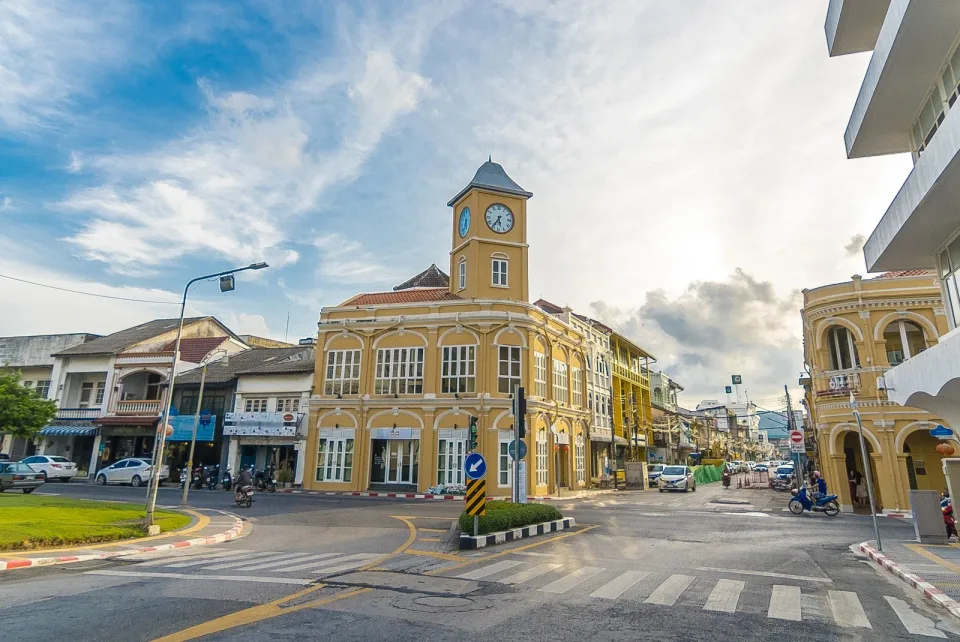
Three towns inside one name
“Phuket Town” covers areas that behave differently for tenants and at resale, and the label alone settles nothing.
The Sino-Portuguese Old Town. Walkable lanes, shophouse architecture, cafés and the weekend market. It carries genuine character premium and genuine maintenance risk: wiring, plumbing, roof ingress and common-area disputes hide behind photogenic facades. Character stock needs a building survey and legal review, not enthusiasm.
The arterial roads. Cheaper, better connected, noisier. Motorbike traffic starts early, and a bedroom that cannot stay dark and quiet at sunrise costs you tenant retention rather than a bad review, the resident simply leaves at renewal.
The tower belt near the malls. Modern facilities, parking, lifts, predictable maintenance. The least romantic and usually the easiest to let and to sell, because it matches what a working tenant actually shortlists.
Before buying anywhere in the town, walk the block at rush hour and again after dark. Security lighting, motorbike noise and how the street feels at 22:00 are practical details a spreadsheet never contains, and they decide whether the tenant you want will take the lease.
What the tenant actually inspects
An urban tenant assesses a home, not a holiday. That reorders the entire furnishing budget away from what photographs well and towards what works for the two-hundredth time:
- A washing machine that works and a kitchen someone can cook in. Both are assumed by a resident and both are frequently missing in stock furnished for short stays.
- Internet that survives the working day, with the building’s electrical system able to run air-conditioning plus devices without tripping.
- A bedroom that stays dark past sunrise, which on an arterial road is a glazing question rather than a curtain one.
- Humidity management. Monsoon-season mould and air-conditioning failures are the two complaints that end tenancies here, and both are prevented by maintenance rather than solved by apology.
The trade is straightforward: long tenants remove nightly churn and introduce landlord work: deposit disputes, maintenance expectations, lease enforcement. Owners who succeed treat this as professional letting with clear contracts, documented inspections and fast repairs. Owners who treat a unit as a furnished closet collect vacancies instead of rent.
Who lives here, and why that keeps a lease signed
The town’s tenant base is unusually legible, which is what makes it underwritable. Vachira Phuket Hospital and Bangkok Hospital Phuket employ hundreds of staff who need to live within a short commute. The provincial government offices, the courts and the land office concentrate white-collar employment in the same few blocks. Thai and international schools serve resident families rather than seasonal ones. Around all of it sits the commercial layer - banks, logistics, the businesses that supply the west-coast resorts from an inland base where rent is a third of the price.
None of those employers close in September. That is the whole thesis, and it is also the thing to verify rather than assume: ask a prospective manager which employers their current tenants work for, and how many of the leases they wrote last year were renewals. A book dominated by one employer is a concentration risk dressed as stability; a spread across hospitals, schools and offices is the real thing.
The second-order effect reaches resale. A unit that lets easily to a working resident sells easily to the next investor who wants that tenant, and the buyer pool for that story includes Thai buyers as well as foreign ones - which is not true of most west-coast stock. Liquidity in this market is quieter and broader than the beach corridors, where a sale often waits for a specific kind of foreign buyer to appear.
Ownership and letting, in the one place where the quota is not the problem
Condominium freehold for a foreign buyer runs through the same 49% floor-area allowance as everywhere else under the Condominium Act B.E. 2522, but Phuket Town is the corner of the island where it is rarely the binding constraint. Demand in these buildings is largely domestic and residential, so the foreign allocation is generally uncontested compared with the west-coast corridors, where the same rule causes most of the deadline pressure. Confirm the remaining square metres for your unit in writing regardless; “generally uncontested” is a market observation, not a guarantee about your building.
The constraint that does bind here is letting policy. Many town buildings are built and governed for long-term residents, and their bylaws say so; the Hotel Act’s 30-day threshold sits on top of that. A short-stay model in the Old Town can be legal and can be lucrative, but it needs the building’s written position first, and in a market whose whole advantage is the year-round resident, buying a town unit to run it nightly is often solving the wrong problem.
Heritage shophouses raise a separate file: ownership structure, the condition survey, and what alterations the building’s status permits. That is a lawyer-and-surveyor purchase, not a viewing-and-deposit one.
Insider tip: ask the juristic office how many units in the building are owner-occupied. A high owner-occupancy share is the single best predictor of common-area condition and of how quickly a real repair gets voted through, and it is a question almost nobody asks in a market where everyone is focused on quota.
See the town and a beach in the same trip
The trade-off between year-round tenants and seasonal guests is easier felt than modelled. 0% buyer commission, legal support end to end.
Running costs, and why they read differently here
The town’s operating economics are the quiet half of its case. Common-area maintenance charges in a mid-range town building typically run well below what a premium west-coast tower charges for a comparable unit, because the amenity list is shorter - a pool and a lift rather than a beach club, landscaped grounds and a shuttle. On a $100,000 studio that difference compounds into real money over a decade, and it lands entirely in the owner’s pocket rather than in a resort experience the annual tenant never uses.
Utilities behave differently too. A resident pays their own electricity, which removes the single most volatile line from a short-stay owner’s model - air-conditioning run by guests who are not paying for it. What replaces that volatility is a slower, duller cost: fabric maintenance in a humid inland climate, where mould, corroded fittings and tired air-conditioning arrive on schedule rather than by surprise. Budget for it annually rather than reactively, and inspect between tenancies as a matter of routine rather than when something is reported.
The one line that is genuinely higher here is management, if you use it. Letting to residents is landlord work, and a competent agent charges for tenant screening, contract enforcement, deposit handling and inspections that a nightly manager never performs. That fee is not a leak in the model; it is the model. Owners who try to run an urban tenancy from abroad without it usually discover the cost anyway, in a deposit dispute or an unrepaired leak that ends a lease early.
Buyer scenarios
| Profile | What fits | What decides it |
|---|---|---|
| Income buyer, $85K-$180K | 1-bedroom near retail and transport | A manager with documented lease-up times; one month vacancy in the model |
| Retiree prioritising healthcare and cost | 2-bedroom in a lift building | Bangkok Hospital Phuket proximity; lift and security non-negotiable in older stock |
| Diversifier already owning a beach unit | Long-lease town unit | Whether you genuinely want landlord work, or just wanted a second yield line |
| Character buyer | Renovated Old Town shophouse | Survey and legal review before offer, not after |
The buyer who should not be here is the one emotionally purchasing a holiday. If the fantasy is a morning swim, the town will disappoint no matter how the numbers read: Patong or Kata is the honest answer, and the beach areas are a twenty-five to forty-minute drive away for weekends.
Red flags in Phuket Town purchases
- A studio priced at the bottom of the band with no juristic accounts offered. The discount is usually the deferred maintenance.
- Heritage stock sold on aesthetics, with no survey and no clarity on what alterations are permitted.
- A short-stay projection on a building whose bylaws favour residents: verify before, not after.
- Arterial-road units viewed only at midday, when the noise profile is at its most flattering.
- Any model without a vacancy assumption. In a market with no season, the gap between tenancies is where the loss lives.
Frequently Asked Questions
Sometimes in the Old Town, rarely elsewhere: many buildings are governed for long-term residents and their bylaws restrict nightly letting, on top of the Hotel Act's 30-day threshold. Verify the building's written position before buying for short-stay - and consider whether nightly letting fits a market whose advantage is the year-round tenant.
5-7% gross on annual leases, and the annual figure is close to twelve times the monthly one because there is no season. Stress-test net after management, maintenance and at least one month of vacancy a year unless a manager can document faster lease-up in your micro-market.
Yes, within the building's 49% foreign quota by floor area. This is the part of the island where the quota is least contested, because demand in town buildings is largely domestic and residential - but confirm remaining square metres in writing for your specific unit anyway.
Roughly 35-50 minutes to the airport depending on traffic, and 25-40 minutes to the west-coast beaches. Close enough for weekends, far enough that the town's tenant base is people who work here rather than people visiting.
For buyers prioritising healthcare access and running costs, often yes: Bangkok Hospital Phuket is close, CAM charges run below premium west-coast towers, and daily life does not require a car in the way the southern bays do. Insist on a lift and proper security in older stock.
Related Guides:
- Patong Investment Property Guide, the seasonal opposite of this market
- Cherng Talay Property Guide, where the school-run families go instead
- Bang Tao & Laguna Property Guide, resort infrastructure and estate charges
- Buying Property in Phuket: Step-by-Step, ownership mechanics end to end
- Phuket Rental Yield Guide, long-lease versus nightly arithmetic
Questions about this guide? Ask us on WhatsApp. The guide's title is already in the message, so you only need to write your question.
Ask on WhatsApp
Olga
Head of Rentals, MORE Group
Runs the rental side at MORE Group: occupancy and rate data from managed Phuket units, management-company selection, and what an owner actually nets after costs.
About MORE Group →Get a Net Yield Calculation for Phuket Projects
Share your budget and preferred area. We will compare live projects using rent, fees and occupancy assumptions.
