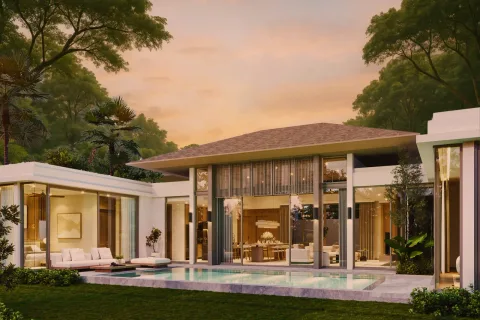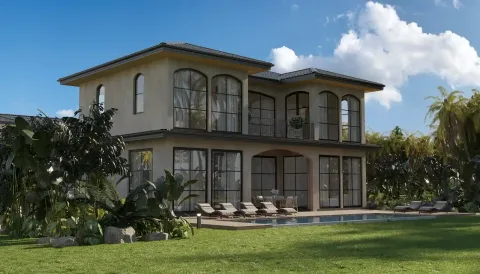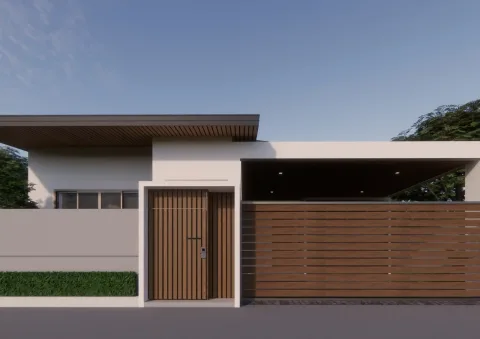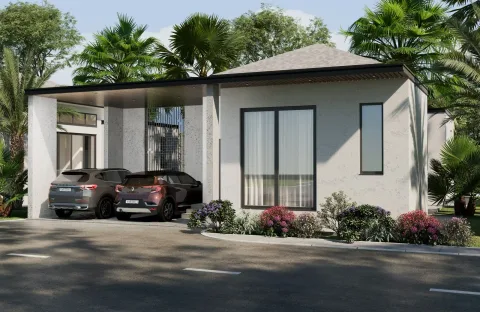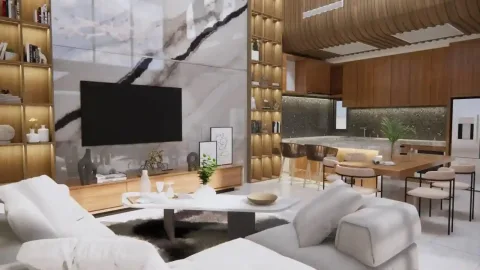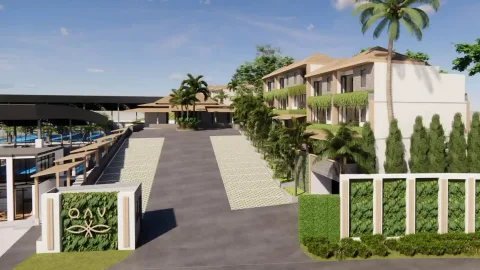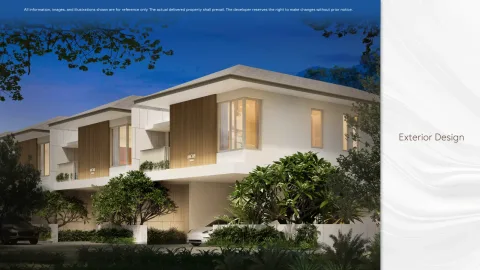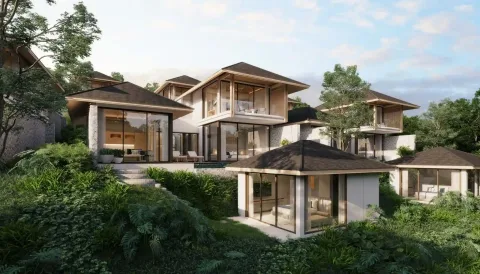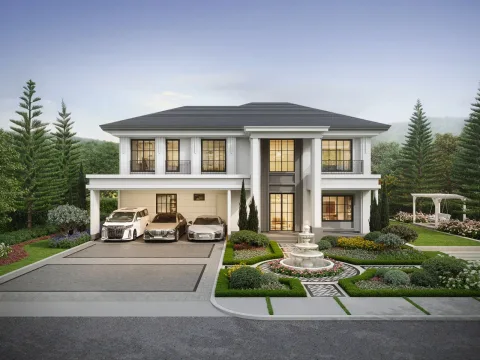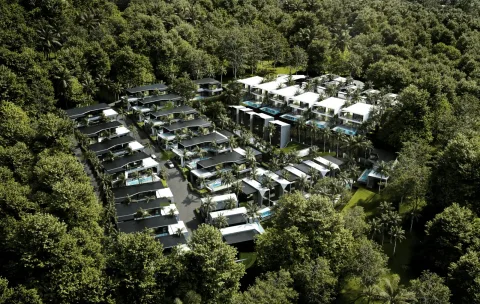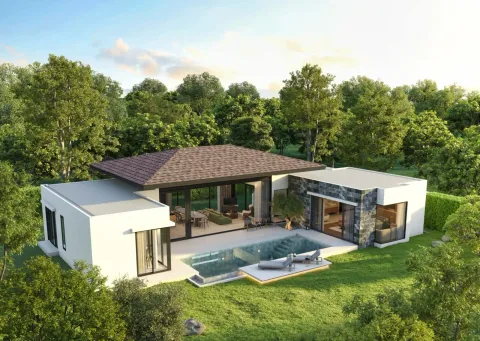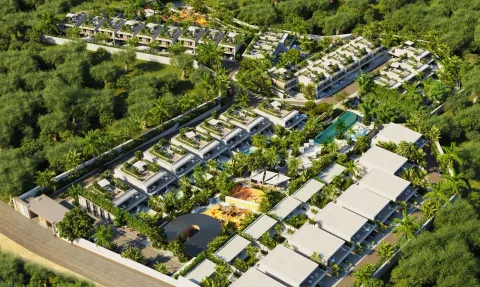
Anasiri Paklok by Sansiri: Family Homes from 5.49M THB
Pa Khlok
- Price from
- 5,490,000 THB
- In dollars
- about $167,900
- Type
- Villa
- Status
- completed
Phuket · Family homes, townhouses and pool villas under 20,000,000 THB · Updated 2026-09-05
Quick answer: Phuket has no separate house market: a house here is a villa estate with a smaller price, and this page takes the 44 developer estates on this site whose starting price is 20,000,000 THB or less, from 5,490,000 THB for Sansiri's completed family homes in Pa Khlok to 20,000,000 THB in Rawai, with a median starting price of 13,990,000 THB. Twenty-four start under 15,000,000 THB and three are completed. A foreigner owns the house and holds the land on a registered 30-year lease or through a Thai spouse; a Thai company is lawful only when it is real. The family districts are Thalang, Koh Kaew, Pa Khlok and Kathu near the international schools, and Rawai and Chalong in the south.
40 estates at or under 20,000,000 THB, from 5,490,000 THB (about $167,890 at 32.7 THB per dollar); 23 start under 15,000,000 THB; 2 completed, 38 under construction or off-plan.
Pa Khlok
Nai Yang
Bang Tao
Nai Yang
Layan
Bang Tao
Ko Kaeo
Layan
Bang Tao
Rawai
Nai Yang
Rawai
Bang Tao
Layan
Chalong
Nai Yang
Nai Yang
Naithon
Bang Tao
Bang Tao
Chalong
Bang Tao
Nai Yang
Nai Yang
Nai Yang
Mai Khao
Bang Tao
Bang Tao
Bang Tao
Ko Kaeo
Layan
Nai Yang
Chalong
Naithon
Kathu
Rawai
Ko Kaeo
Nai Yang
Ko Kaeo
Bang Tao
People who move to Phuket look for a house; the people who build on Phuket sell villas. The difference is marketing, not law, and understanding it saves a family a good deal of time. A villa, in the island’s vocabulary, is a detached house with a private pool sold inside a gated estate, and most of them are priced and designed for buyers who will use them a few months a year or let them the rest. A house, in the sense a relocating family means it, is the same building bought to live in: a plot large enough for a garden the children can use, storage, a kitchen a family can cook in, a school within twenty minutes, a hospital within thirty, and neighbours who are also at home on a Tuesday. Phuket has both, and the second kind is concentrated in the estates whose starting price sits below the luxury line.
This page draws that line at 20,000,000 THB, about $611,621 at 32.7 THB per dollar, and takes the 44 developer estates on this site that start at or under it. Above the line, the island’s houses are pool villas for a different buyer, covered on the Phuket villas page; below it are the family homes, the townhouses and the entry-price villas that a household moving to the island will actually consider. The 44 range from 5,490,000 THB for Sansiri’s completed homes in Pa Khlok to 20,000,000 THB for completed villas in Rawai, with a median starting price of 13,990,000 THB; 24 start under 15,000,000 THB, and 3 are finished.
The law does not distinguish the two either. A house and a villa are both buildings standing on land, and the rule for a foreign buyer is the same: own the building, lease the land. The Thailand houses page sets Phuket’s houses beside Pattaya’s housing estates and Bangkok’s townhouses, and the Phuket property page holds the island’s whole catalogue.
| District | Estates under 20,000,000 THB | Starting price from | What sells there | Completed |
|---|---|---|---|---|
| Bang Tao and Cherng Talay | 15 | 8,990,000 THB | Three- and four-bedroom pool villas on the plain inland of the beach road, twenty to forty homes an estate, the school run shortest of all | 0 |
| Nai Yang, Sakhu and Thep Krasattri | 11 | 6,500,000 THB | The inland corridor north of the plain: identical-house estates such as AG Club’s 208-square-metre four-bedrooms, ten minutes from the airport | 0 |
| Layan and its valley | 4 | 9,500,000 THB | Semi-detached townhouses at College Villas Phase II and small pool-villa schemes in Thep Krasattri | 0 |
| Rawai and Nai Harn | 6 | 12,280,000 THB | Owner-occupier estates between the two beaches, some single-storey, near the Chalong hospitals; the completed villas at WamDom mark the district’s top | 1 |
| Chalong | 1 | 13,990,000 THB | Phirunda’s seventeen completed pool villas near the marinas, delivered in August 2025 | 1 |
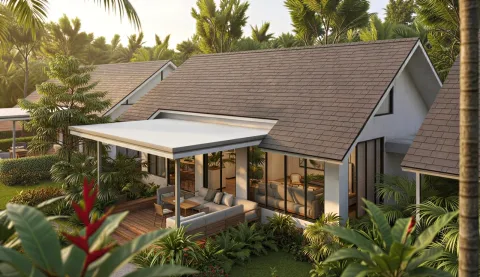
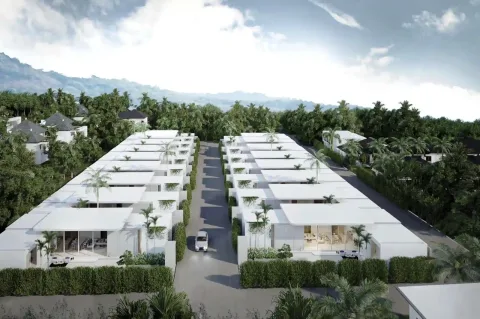
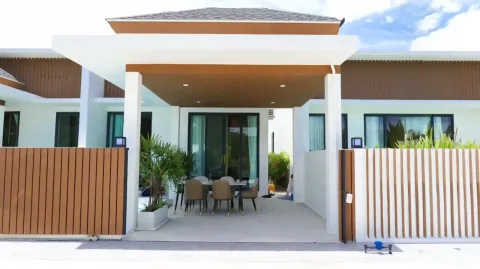
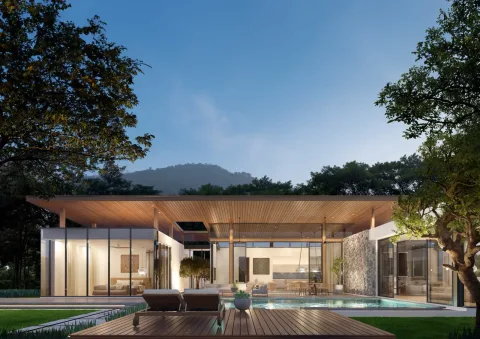
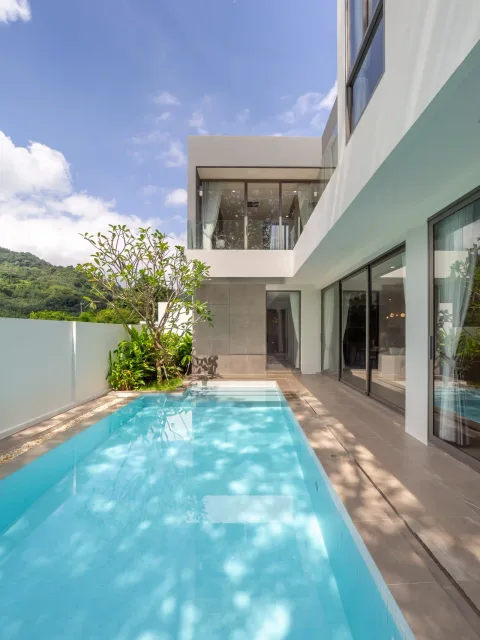
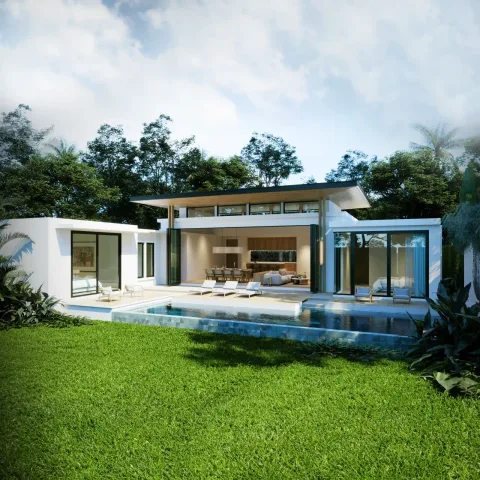
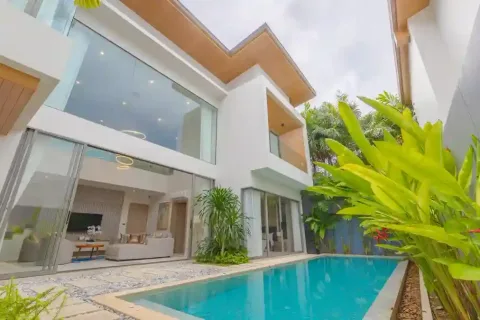
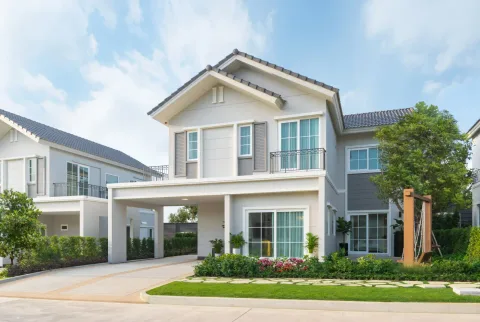
| Pa Khlok | 1 | 5,490,000 THB | Anasiri Paklok, Sansiri’s completed family homes on the east coast; the island’s cheapest developer houses | 1 |
| Naithon, Mai Khao, Kathu, Kata and Patong | 6 | 13,500,000 THB | Aileen Villas Phase 6 by the quiet northern beach, the Mai Khao entry price, a Kathu estate near Phuket Town, and single hillside schemes above Kata and Patong just under the line | 0 |
The pattern is the island’s geography turned into prices. Where the land is flat and inland, in Thalang, Thep Krasattri and Pa Khlok, a family house costs 5,490,000 to 14,000,000 THB and comes with a bigger plot; where it is close to a west-coast beach or a hill with a view, the same house costs 20,000,000 THB and up and leaves this page for the villas page. Families who work backwards from the school find that the inland belt is where the schools are anyway.
Prices by district are abstract until they are turned into a house, so here are three family budgets walked through the estates on this page, all developer starting prices on 5 September 2026.
Eight million THB, about $244,648 at 32.7 THB per dollar, buys a completed home rather than a promise, but only on the east coast: Anasiri Paklok, Sansiri’s finished family homes in Pa Khlok, from 5,490,000 THB, on a Thai housing estate with a juristic person and a shared pool. On the west side of the island it buys the entry villa at Akara Golden Section in Sakhu, a three-bedroom pool villa from 6,500,000 THB, off-plan, nine kilometres north of Bang Tao and close to the airport. It buys nothing in Cherng Talay, Layan or the south.
Twelve million THB, about $366,972, is where the family estates open up. In Si Sunthon, on the Cherng Talay plain, Greenfield Residences sells three- and four-bedroom pool villas from 8,990,000 THB across 34 homes, and Verdi Villas detached pool villas from 9,500,000 THB; in Koh Kaew, Crown Estate on Dulwich Road sells British-styled houses from 9,550,000 THB a few minutes from the international school of the same name; in Thep Krasattri, College Villas Phase II sells three-bedroom semi-detached townhouses from 9,500,000 THB; in Layan’s valley, Aileen Residence Lagoon sells four- and five-bedroom villas from 10,150,000 THB for delivery in the first quarter of 2028; and in Bang Tao, Rise Villas sells three-bedrooms from 10,500,000 THB for the fourth quarter of 2027. Every one of them is off-plan, and the delivery dates matter as much as the prices.
Sixteen million THB, about $489,297, reaches the south and the completed estates. In Rawai, Charn Baan Saiyuan sells four-bedroom pool villas from 12,280,000 THB, The Greens nineteen private pool villas from 12,600,000 THB, and Nile Residence from 12,950,000 THB for the fourth quarter of 2029; in Chalong, Phirunda’s seventeen villas are completed and sold from 13,990,000 THB. In the north, Narinsaya from 12,500,000 THB, Janya from 13,250,000 THB and Phuvista 3 from 14,800,000 THB fill the Nai Yang corridor, Aileen Villas Phase 6 sells three- and four-bedrooms from 13,500,000 THB by the quiet beach at Naithon, and AG Club’s identical 208-square-metre four-bedrooms start at 13,452,240 THB in Thep Krasattri. In Bang Tao, Proxima’s fourteen three-bedroom villas from 13,500,000 THB, Sana Vista from 12,890,000 THB, Diamond Pool Villa from 13,652,490 THB and Sunrise Lake’s 31 villas from 13,990,000 THB are the plain’s family product, and in Layan, Monstera Nature sells from 12,900,000 THB. Above sixteen million the estates thin out until the line at twenty, where the pool villa market proper begins.
A viewing in February shows a house at its best. The questions below show it in September. Where does the rain go: the Cherng Talay plain, parts of Thalang and the Kathu valley flood in heavy monsoon years, and the height of the estate above the road, the size of the storm drains and where the estate discharges them decide whether the ground floor stays dry. Where does the water come from: Phuket has had dry-season shortages in recent years, some estates are on the municipal supply, some on their own boreholes and some on tankers when both fail, and a house without a week of stored water in its tank will run dry in April. How often does the power fail: the Provincial Electricity Authority’s supply is good on the main roads and less so at the end of a long estate cable, and a house that runs on air-conditioning wants a stabiliser and, for a family working from home, a battery or generator plan. Which fibre providers reach the estate, and at what speed, because the brochure’s “high-speed internet” means nothing until a provider’s name is on it. Are the windows screened and the pool fenced, because the mosquitoes and the toddlers do not wait for the family to settle in. And who maintains the estate’s roads and lights in year five, because a road the developer built and then forgot is the most common complaint on the island’s older estates. None of these questions appears on a portal listing, and every one of them appears in the first year of living in the house.
The island runs on two calendars, and a family buying a house should know both. The weather calendar is a dry season from November to April, when the west-coast beaches are calm and the roads are full, and a monsoon from May to October, when the sea is rough on the west coast, the afternoons rain, the prices of everything fall and the flooding shows. The school calendar at the international schools mostly starts in August and runs to June, with enrolment decided in the spring, which is why families aim to be in a house, or at least a rental, by July. A house bought off-plan for delivery “in the first quarter” is a house for the following school year, not the coming one.
Owning a house does not grant a visa, and a family needs one for each member. The parents’ routes are the Long-Term Resident visa for wealthy or remote-working applicants, the Destination Thailand Visa for remote workers with stays of 180 days per entry, the retirement extension for a parent over 50, or a guardian extension on a Non-Immigrant O visa for a parent of a child enrolled at a Thai school; the children’s route is the education visa through the school. The LTR guide, the DTV guide and the retirement visa guide set out the thresholds, and the school’s admissions office handles the children’s. A family that spends 180 days or more of a year in Thailand becomes tax resident, and the tax guide explains what that means for income brought into the country.
Working backwards from an August start, the timeline that the agency sees work is this. Eighteen months before, the family rents a house in the district it is considering for a school year and enrols the children; the year teaches the school run, the monsoon and the neighbours. Twelve months before the intended move into an owned house, the brief is written around the school and the bedrooms, and the shortlist is drawn from the estates on this page and the Thai housing estates that never reach the portals. Ten months before, the lawyer pulls the title, the subdivision and the permits on the shortlist, and the structure is settled. Nine months before, the reservation and the contract, with the delivery date read as a year later than written if the house is off-plan. From then to handover, the instalments follow construction, someone who works for the family inspects at each stage, and the money for each instalment arrives from abroad in foreign currency with the bank’s record kept. At handover, a snagging visit with a written list and a retention held until it is cleared; at registration, the lease onto the land title and the house into the family’s name on the same day at the Phuket Land Office. A completed house compresses the last four steps into six to ten weeks, which is the strongest argument for buying one of the three on this page that are finished.
Families who cannot wait for a construction schedule have three finished estates under the line on this page, and each is a different answer to the same brief.
| Estate | District | Starting price | What it is | Who it suits |
|---|---|---|---|---|
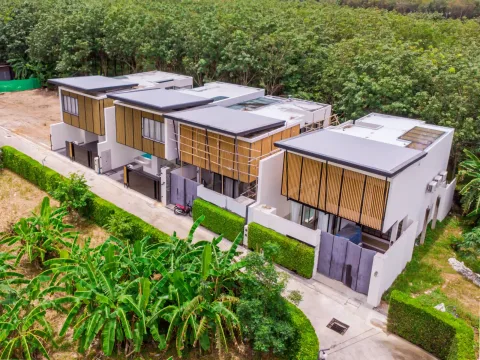
| Anasiri Paklok | Pa Khlok | 5,490,000 THB | Sansiri’s completed family homes on a Thai housing estate with a juristic person and a shared pool | A family that wants the lowest price, a large plot and Thai neighbours, and accepts a longer drive to the west-coast schools |
| Phirunda Pool Villa | Chalong | 13,990,000 THB | Seventeen pool villas delivered in August 2025 near the marinas and the Chalong hospitals | A family in the south with children at the Rawai and Chalong schools, or a retired couple near the hospitals |
| WamDom Villas | Rawai | 20,000,000 THB | Completed pool villas ready to occupy between Rawai and Nai Harn | A family that wants Nai Harn beach at the end of the road and a finished house at the top of this page’s range |
A finished house also changes the diligence: the estate’s real fees are in its accounts, the neighbours can be asked what floods, and the lease can be registered on the day the balance is paid, because the plots already have their deeds.
A house in Phuket is bought around a school run, and the schools are not where the tourists are. The international schools sit in a belt across the island’s waist: British International School Phuket and HeadStart’s Cherng Talay campus in Koh Kaew and Cherng Talay, UWC Thailand in Thalang, HeadStart in Kathu, Kajonkiet’s campuses in Kathu and the town, and smaller schools in Rawai and Chalong. A family in a Cherng Talay or Thalang estate reaches most of them in ten to twenty minutes; a family in Rawai reaches the southern schools quickly and the northern ones in forty minutes or more in high-season traffic. The international schools guide lists the schools with fees, curricula and locations, and it is the first document a relocating family should read, before any brochure.
Hospitals shape the second circle. The private hospitals are in Phuket Town and on the bypass road, with a cluster of clinics in Chalong and Cherng Talay, which is why retirees favour Rawai and Chalong and why a house in Pa Khlok or Mai Khao is a longer drive when it matters. The schools, internet and healthcare guide covers the practical side, including the fibre providers that a family working from home will care about more than the pool.
The drive itself is the island’s hidden cost. Phuket has one main north-south road and a few east-west passes, and a house that is fifteen minutes from a school at seven in the morning can be forty at eight. Families who rent for a school year before buying learn this in the first month, and the agency’s advice is to do exactly that.
Phuket has two kinds of gated estate, and a family should know which one it is looking at. The foreign villa estate is built by a Phuket developer for foreign buyers: twenty to a hundred pool villas, a sales office, a rental programme offered at the door, leases registered for foreigners as a matter of course, and neighbours who are as likely to be tenants as owners. Most of the 44 estates on this page are of this kind, and the Cherng Talay and Thalang schemes are its family end.
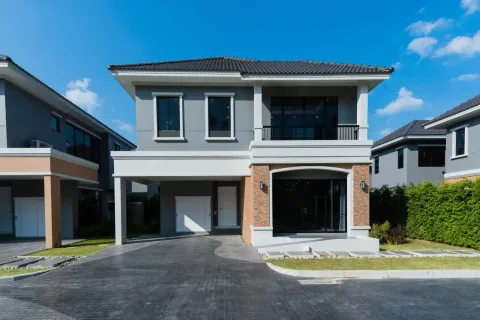
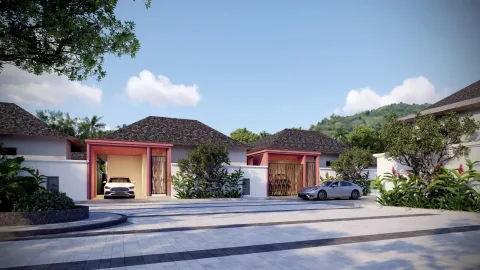
The Thai housing estate, the moo baan, is built by a national housebuilder for Thai families: detached and semi-detached houses without pools, a clubhouse and a pool shared by the estate, a juristic person under the land allocation law that owns the roads and collects a modest fee, and neighbours who live there. Sansiri’s Anasiri Paklok and Setthasiri Kohkaew Retreat are the two on this site, and the first, completed, from 5,490,000 THB, is the cheapest developer house on the island. Buying into a moo baan as a foreigner is lawful and less common: the developer’s sales office may not be set up to register a lease to a foreigner, the Thai neighbours may be surprised, and the house will be finished to a Thai family’s specification rather than a European one. It is also often the best value on the island for a family that wants a home rather than an investment, and the agency can arrange the lease paperwork that the sales office cannot. The company purchase guide explains why a company is not the answer to that paperwork.
Insider tip: on a Thai housing estate, ask for the juristic person’s accounts and the estate’s regulations before the house’s floor plan. A moo baan with a functioning juristic person, a maintained clubhouse and a security contract is a better home than a foreign estate with a marketing suite and no owners’ body, and it costs a fraction to run.
Phuket’s developers build detached two-storey houses by default, and three variants matter to a family budget. The townhouse or semi-detached house shares a wall and a plot line, costs a third less than the detached house beside it, and is the island’s scarcest product for foreign buyers: College Villas Phase II in Thep Krasattri sells three-bedroom semi-detached townhouses from 9,500,000 THB, and several Rawai and Thalang estates carry attached homes at the bottom of their lists. Thai housing estates across the interior sell townhouses in volume, rarely marketed to foreigners and available on request. The single-storey house, one floor around a courtyard or a pool, suits retirees and small children and appears on nine estates on this site, most of them in Rawai, Chalong and the Thalang interior. The identical-house estate, where every home is the same design and the plot is the only variable, is the island’s most transparent product: AG Club’s 26 four-bedroom houses of 208 square metres in Thep Krasattri, sixteen of them at exactly 14,490,000 THB, show a buyer precisely what the developer thinks each plot is worth.
The structure is decided before the house is chosen, because it changes the contract, the cost and what the family’s children inherit.
The standard route is a registered lease of the land and ownership of the house. The plot is leased for 30 years, the maximum the Land Office will register, and the lease is written onto the land title at the Phuket Land Office for a registration fee of 1 percent of the total rent for the term plus 0.1 percent stamp duty. The house is registered in the foreign owner’s name, by transfer of the building or by the construction permit being issued in the buyer’s name, and a superficies, the registered right to own a building on another’s land, is the cleanest record of the arrangement. The renewal clauses in a 30+30+30 contract are the developer’s promises, not registered rights, and the 30-year lease guide explains how to price a house on the term that is registered.
The second route, common among families, is the Thai spouse’s name. Where one parent is Thai, the land and house can be registered freehold in that parent’s name, with a declaration at the Land Office that the purchase funds are the Thai spouse’s separate property. The foreign spouse has no claim on the property on divorce or death beyond what a will, a usufruct or a registered lease from the Thai spouse grants, and families who choose this route should have those documents drawn up on the same day. The land ownership guide covers the declaration and the rights that can be registered alongside it.
The third route, a Thai company holding the land, is lawful for a family with a genuine Thai business and unlawful as a device with nominee shareholders, and the enforcement of 2025 and 2026 has made it the wrong answer for a home. Whatever the route, the purchase funds should arrive from abroad in foreign currency, in the buyer’s name, so that the bank issues the Foreign Exchange Transaction record that lets the proceeds leave the country on a later sale.
Tell us the school, the budget and how many bedrooms
We reply within 2 hours with the estates from this page that fit the school run, the structure each developer offers a foreign family, and the estates we would rent in first.
Only three of the 44 houses on this page are completed: Anasiri Paklok, Phirunda in Chalong and WamDom in Rawai. The other 41 are sold from plans or during construction, with instalments over 12 to 36 months, and a family buying one is buying a completion date as much as a house. The date matters more to a family than to an investor, because a school year starts in August whether or not the developer has finished, and the agency’s rule is to plan on the contract date plus a year and to rent until the keys are in hand.
The checks are the ones that apply to every off-plan purchase on the island, with a family’s emphasis. The construction permit for the specific plot, matching the plans. The environmental approval where the estate is large enough to need one. The subdivision of the estate’s land into plots with their own deeds, without which the lease cannot be registered at handover. The developer’s record of delivering on time, which the track record guide and the developer reputation guide show how to check. And the contract’s delay clause, penalty and refund right, which the off-plan guide sets out clause by clause. A family should also read the estate’s regulations for what they say about nightly letting, because an estate that permits it will have holiday guests as neighbours.
The purchase costs follow the structure. A lease is registered at about 1.1 percent of the price; a building transferred in the buyer’s name carries a 2 percent fee on its appraised value, often absorbed by the developer on an off-plan sale; the seller pays specific business tax or stamp duty and withholding tax; the buyer pays a lawyer from about 60,000 THB for a straightforward lease purchase and more for a spouse or company structure. The 0.01 percent transfer fee that Thai housing estates advertise until June 2027 is the relief for Thai individual buyers of homes up to 7,000,000 THB, and it applies to a Thai spouse’s purchase but not to a foreign buyer’s lease.
The running costs are where a house beats a villa. An estate fee for roads, security and shared landscaping, lower on a Thai housing estate with many homes than on a foreign estate with twenty; a pool contract only if the house has a pool; a gardener; building insurance; electricity, with air-conditioning the largest line; water, municipal or from the estate’s supply; and Land and Building Tax at 0.02 percent of the assessed value a year, due by the end of April. The tax guide carries the yearly rates and the sale-side taxes.
Most families who buy a house in Phuket rented one first, and the agency recommends it. A school year in a rented house in the district you are considering shows the school run in traffic, the flooding in the monsoon, the estate’s real fees, the neighbours and the noise, none of which a viewing shows, and it turns the purchase from a visitor’s decision into a resident’s. When the family is ready, the work is the brief, written around the school and the bedrooms; the shortlist from the estates on this page and the Thai housing estates that are not marketed to foreigners; the structure, decided with a lawyer; the title, subdivision and permit checks; the contract; the money, sent from abroad with the right record; and the Land Office day. MORE Group’s office is on the island, developers pay its fee on new-build sales so the buyer pays the list price, and the agency will say plainly when an estate is not a place to raise children. Families still choosing between the island and the rest of Thailand can compare Phuket’s houses with Pattaya’s and Samui’s on the Thailand houses page, and the guides to Bang Tao and Laguna, Cherng Talay, Rawai and Mai Khao and north Phuket cover the districts street by street.
Send us the school and the budget, and we send back the houses
Matching estates from the 44 on this page and the Thai housing estates that never reach the portals, with the structure each offers a foreign family and the honest caveats on each.
On this site on 5 September 2026 the cheapest developer estate is Anasiri Paklok, Sansiri's completed family homes on the east coast, at 5,490,000 THB, about $167,890 at 32.7 THB per dollar. Forty-four estates start at or under 20,000,000 THB, 24 of them under 15,000,000 THB, and the median of the 44 starts at 13,990,000 THB. Above that price the island's houses are pool villas at 20,000,000 to 160,000,000 THB, covered on the villas page.
In law, none: both are buildings on land, and a foreigner owns the building while leasing the land. In the market, a villa has a private pool and sells to holiday and investment buyers; a house is what a family calls the villa it lives in, and the estates that sell to families are the ones near the schools, with larger plots, more storage and fewer nightly guests. Sansiri's Anasiri Paklok, the College Villas townhouses and the Thalang estates are houses in that sense.
Yes, as a building on leased land. The house is registered in the foreign buyer's own name and the plot is leased for the maximum registrable term of 30 years, endorsed on the land title at the Phuket Land Office. A foreign spouse of a Thai citizen may see the land registered in the spouse's name with a declaration about the funds. A Thai company may hold the land only when it is a real company with Thai shareholders who paid for their shares.
The belt from Koh Kaew through Thalang to Cherng Talay, where the international schools are, and the Pa Khlok side of the island for larger plots at lower prices; Rawai and Chalong in the south for families who prefer the beaches and the hospitals there and accept a longer school run. Kathu suits families working in Patong or Phuket Town. Estates in these districts start between 5,490,000 THB and 13,000,000 THB on this site.
A few, and more are appearing. College Villas Phase II in Thep Krasattri sells three-bedroom semi-detached townhouses from 9,500,000 THB, and several Thalang and Rawai estates sell attached or semi-detached houses at the lower end of their price lists. Townhouses on Thai housing estates by the listed builders exist across the island's interior but are rarely marketed to foreigners; the agency can source them on request.
An estate fee for roads, security and shared landscaping, a pool and garden contract if the house has them, building insurance, electricity and water, and Land and Building Tax at 0.02 percent of the assessed value a year. A house without a pool costs less to hold than a villa; a house on a Thai housing estate with a juristic person costs less again, because the estate fee is shared across many more homes.
Almost never from a Thai bank as a foreigner, because the collateral is a lease rather than freehold land. Buyers pay from their own funds, use the developer's instalment plan on an off-plan house, or borrow at home against assets there. A Thai spouse with Thai income may qualify for a Thai mortgage in their own name, and some families buy that way.
Most families do, for a school year. Renting a house in the district you are considering shows the school run in traffic, the flooding in the monsoon, the noise from the road and the neighbours' habits, none of which a viewing shows. The agency's advice is to rent for six to twelve months, then buy with the knowledge of a resident rather than a visitor.
Tell us the school, the bedrooms and the budget; we reply within 2 hours with the estates that fit the school run, the structure each developer offers a foreign family, and the honest caveats.